How To Reduce Total Dissolved Solids In Water

Let’s be real: we’ve all taken a sip of water and thought, “Hmm, that tastes… minerally.” That’s your tongue meeting Total Dissolved Solids, or TDS—the catch-all term for tiny...

Let’s be real: we’ve all taken a sip of water and thought, “Hmm, that tastes… minerally.” That’s your tongue meeting Total Dissolved Solids, or TDS—the catch-all term for tiny particles of salts, metals, and organic matter floating in your glass. Think of it as the “seasoning” of your water, but sometimes the chef overdoes it.
What Exactly Are We Filtering Out?
TDS isn’t all bad. In fact, trace minerals like calcium and magnesium are good for you—they’re why some mineral waters cost eight bucks at a trendy café. The trouble starts when levels climb above 500 parts per million (ppm), leaving water tasting flat, salty, or even metallic.
High TDS can also mean hard water, which is why your shower glass looks like a foggy Picasso. Fun fact: The Great Salt Lake has a TDS around 270,000 ppm—good for floating, terrible for your morning tea.
Must Read
Tip 1: Reverse Osmosis—The Gold Standard
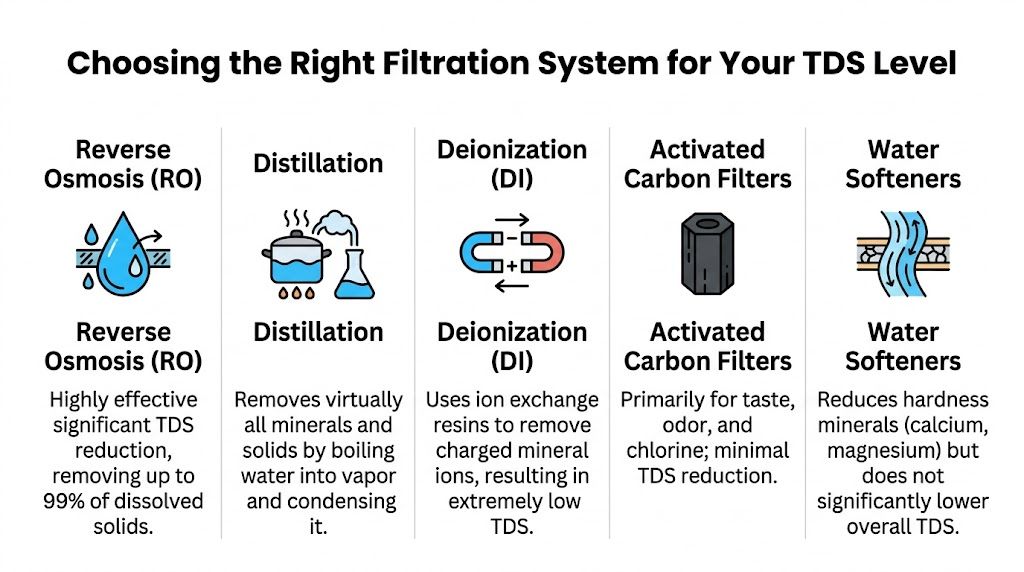
If you want to go from “tap mystery” to “pristine spring,” a reverse osmosis (RO) system is your best friend. It forces water through a semi-permeable membrane that blocks up to 99% of dissolved solids, including lead, fluoride, and nitrates.
Yes, it’s a splurge—around $150 to $600 installed—but it’s the same tech used to make bottled water for your favorite influencer’s Instagram story. The trade-off: RO systems waste about three gallons of water for every one they filter. But modern units are getting smarter, some recycling that waste for your garden.
Tip 2: Distillation—For the Purists
Ever watched steam rise off a pot? That’s distillation in its most romantic form. A countertop distiller boils water, catches the vapor, and condenses it back into liquid—leaving all those solids behind.
The result is water with TDS near zero. It’s so pure, some people claim it tastes “dead,” like drinking a white room. But for medical sterilizing or making the perfect pour-over coffee without mineral interference, it’s unmatched. Just remember: distillation uses electricity, so your energy bill might pout a little.
Tip 3: Deionization—The Lab Coat Approach
Deionization (DI) is like a bouncer at an exclusive club—it uses ion-exchange resins to physically remove charged particles. It’s the go-to for aquariums, car detailing (no water spots!), and labs studying DNA.
 How to Remove or Reduce TDS (Total Dissolved Solids) in Water | PPTX
How to Remove or Reduce TDS (Total Dissolved Solids) in Water | PPTX
The catch? DI filters eventually saturate and need regeneration with acid or chemicals, which is a hassle for home use. For a weekend warrior project, you can buy a portable DI filter for your garden hose—it makes your car shine like a James Bond Aston Martin.
Tip 4: Activated Carbon Filters—The Everyday Hero
Your standard Brita or fridge filter uses activated carbon, which is excellent for removing chlorine, taste, and odor—but not TDS. Think of carbon as a sponge for big, smelly particles, not a scalpel for dissolved salts.
That said, a carbon filter will make tap water feel cleaner, and it’s the cheapest entry point (under $30). Pair it with a TDS meter (a $15 gadget from Amazon) to see what you’re actually removing. Spoiler: it’s usually not much—but your morning coffee will still thank you.
Cultural Water Cooler Moments
Japan has mizu-bue, or “water whistles,” made from reeds that filter water through porous membranes—an ancient take on the same idea. Meanwhile, in rural India, families still use cloth filtration and exposure to sunlight (SODIS method) to lower germs and solids. We’ve been chasing clean water since we were hunter-gatherers, and now we have apps that tell us our tap’s TDS in seconds.
Remember the 1990s fad of “ionized alkaline water”? That’s just a fancy way of increasing TDS with calcium and magnesium—then charging you ten times the price. Don’t be fooled: your body already balances its pH perfectly. What you actually want is balance, not marketing hype.
 What Is TDS in Drinking Water? A Homeowner's Guide
The Lazy Person’s Quick Fix
No budget for RO? Boil your water and let it cool. Boiling kills bacteria but increases TDS by concentrating the solids. The real hack: invest in a good pitcher filter with an ion-exchange cartridge (like ZeroWater). It combines carbon with resin, dropping TDS from 300 to near zero for about $40 a year in replacements.
Another trick: let your water sit open in the fridge for 24 hours. Chlorine gasses off, and some calcium will settle. It won’t fix high TDS, but it’ll taste gentler—like a deep breath before a busy day.
When to Worry (and When Not To)
A TDS of 100–300 ppm is ideal for drinking—it’s got minerals and tastes alive. Above 600 ppm? Your water might leave white scales on your kettle and a funny taste in your mouth. If you’re on well water, test for nitrates and heavy metals, which can spike TDS dangerously.
Fun fact: The Aquarius spacecraft found that Saturn’s moon Enceladus has water with TDS levels similar to Earth’s oceans—meaning it’s ized with salt. So when you filter your water, you’re literally doing planetary science.
A Final Sip of Perspective
Reducing TDS isn’t about chasing “perfect” water—it’s about choosing what you consume. In a world where 2.2 billion people lack safe drinking water, every drop you clean is a small act of gratitude. The next time you fill a glass, think of the journey: from clouds, through pipes, past your filter, into your lips. That’s a little bit of magic.
So go ahead, measure your tap’s TDS, pick a method that fits your life, and drink with intention. Because the best water is the one that makes you pause, smile, and say, “Damn, that’s good.”
