How To Tell If Water Softener Is Not Working

Living with hard water is like having that one friend who shows up uninvited to every party—annoying, clingy, and leaves a mess. You installed a water softener to banish the m...

Living with hard water is like having that one friend who shows up uninvited to every party—annoying, clingy, and leaves a mess. You installed a water softener to banish the mineral mayhem, but lately, your shower feels like you’re rinsing in chalk. So, how do you know if your trusty machine has gone rogue?
The first clue is often hiding in plain sight: your soap suddenly refuses to lather. If your shampoo feels like a sad gel and your hands need a second wash to feel clean, your softener is likely on vacation. Hard water minerals bind to soap, creating that filmy scum instead of a rich, bubbly foam.
Next, give your dishes a critical eye. Are you seeing white spots or a cloudy film on your glassware after the dishwasher runs? That’s calcium carbonate throwing a comeback party. A working softener should make your wine glasses sparkle like Instagram filters, not look like they’ve been dusted with flour.
Must Read
Your skin and hair will also tattle on a failing system. If your skin feels tight, itchy, or you’ve suddenly developed a mysterious case of “why is my hair so dull?”, blame the hard water. Soap residue clings to your body, leaving behind a dry sensation that no fancy lotion can fix.
The Classic “Spot the Salt” Test
Pop open your brine tank and peek inside. If the salt level looks low or you see a hard crust (a salt bridge) forming on top, your softener can’t regenerate properly. Fun fact: a salt bridge is not a cool new pastry—it’s a rock-hard layer that blocks the system from doing its job.
Grab a clean glass bottle, fill it halfway with tap water, add a few drops of liquid soap, and shake vigorously. If the water turns milky and won’t clear up, you’ve got hard water. If it foams beautifully and clears within seconds, your softener is still a hero.
Another cultural reference: think of your water softener as the Jan Brady of home appliances—it works silently in the background, but when it breaks, everyone yells “Marcia, Marcia, Marcia!” at their faucets. Nobody notices it until the crap hits the fan.
Listen to the Machine’s Whispers
Your softener has a voice, and it’s not always polite. If you hear grinding, hissing, or gurgling noises during regeneration, something is jammed or clogged. A healthy softener hums like a satisfied cat; a troubled one sounds like a dying robot.
 9 Signs Your Water Softener Isn't Working (+Solutions)
Check your water pressure, too. If your shower head suddenly sprays like a grumpy tea kettle, mineral buildup might be choking your pipes. Low pressure is a sneaky sign that your softener is failing to protect your plumbing from scale.
Don’t forget to inspect the bypass valve—it might be stuck in the “off” position. This is the most common dumb mistake, and it’s basically the appliance equivalent of having your car’s emergency brake on while trying to drive to the beach.
The Monthly pH Rebellion
Use a simple water hardness test strip (available at any hardware store) to get scientific. Dip it in a glass of tap water and compare the color to the chart. If it reads above 1–3 grains per gallon, your softener is ghosting you.
Fun trivia: hard water is actually rich in calcium and magnesium, which sounds healthy until it ruins your $200 kettle. Ancient Romans loved hard water for building aqueducts, but they didn’t have to scrub their tiles off with vinegar.
If you notice rust-colored stains in your sink or toilet, that’s iron sneaking through. Some softeners struggle with iron, but a complete failure will let it slide right into your porcelain, leaving orange tears everywhere.
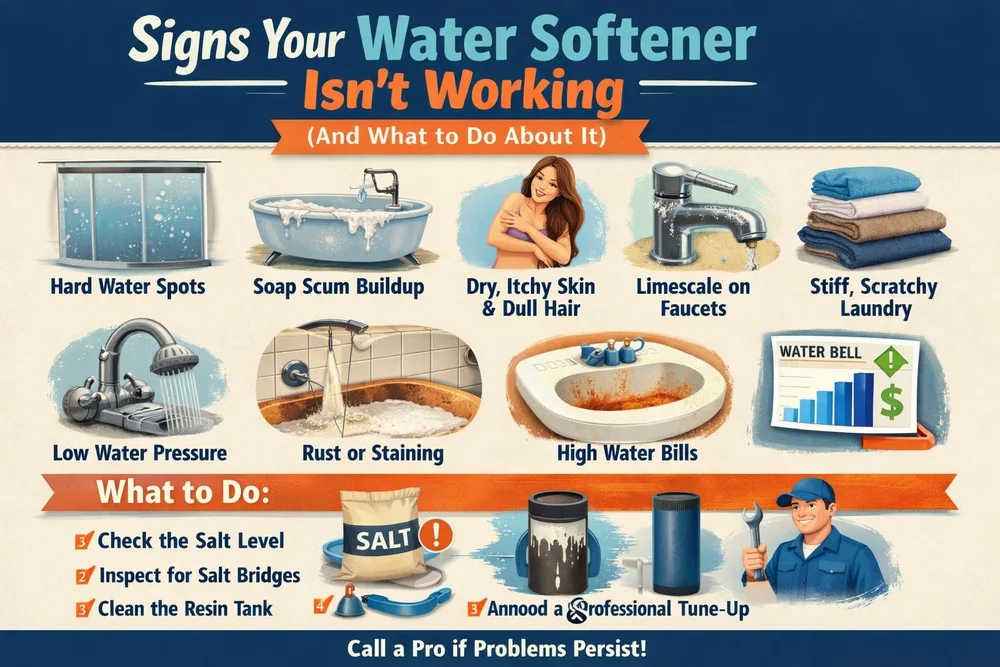 Signs Your Water Softener Isn't Working (And What to Do About It)
When to Call for Backup
If you’ve checked salt, cleaned the injector, and reset the timer but your water still feels like a hug from a rock, it’s time to call a pro. A broken rotor valve or a fried control board is beyond DIY charm.
Practical tip: most softeners have a service light or error code. Look up your model’s manual online (yes, really, do it) and decode the blinking pattern. It’s like reading Morse code for a better shower.
And here’s a fun, low-stakes test: boil a pot of water and let it cool. If a white crust forms on the surface or the sides, that’s calcium throwback. A working softener would leave that water as clear as your ex’s excuses.
Reflection: The Quiet Luxury of Soft Water
We rarely appreciate the things that work perfectly until they don’t—like a silent fridge, a reliable car starter, or water that actually rinses your conditioner out. Your water softener is a humble guardian, fighting a mineral war you never see.
That first shower after fixing the issue? It’s pure velvet. Your skin feels like silk, your hair has bounce, and your dishes look like museum pieces. Suddenly, you realize soft water isn’t just a luxury; it’s a quiet, daily win against the universe’s tendency to leave residue.
So next time you hear a suspicious hiss from the utility closet, don’t ignore it. Your softener is just begging for a little attention—and honestly, aren’t we all?
