What Is Reverse Osmosis Water Filter System

So, picture this: I’m at my buddy Dave’s place, and he pours me a glass of water. It looks… fine. Clear, no floaties. I take a sip, and it tastes like the inside of a swimming...

So, picture this: I’m at my buddy Dave’s place, and he pours me a glass of water. It looks… fine. Clear, no floaties. I take a sip, and it tastes like the inside of a swimming pool mixed with a faint memory of hard-boiled egg. I grimace. Dave grins and says, “Ah, that’s the mineral-rich local water. Good for you!” I wasn’t convinced. That’s when he launched into a rant about his new reverse osmosis system, and honestly, it changed how I think about what’s in my glass.
That tap water battle is exactly why reverse osmosis—or RO for short—exists. You probably know that gross pool-and-egg flavor isn’t “mineral charm.” It’s often chlorine, dissolved salts, or trace metals.
So, what is this magical machine? Think of it as a desperately picky bouncer for your water. It forces water through a semi-permeable membrane that only lets pure H₂O molecules through, while kicking out nearly everything else.
Must Read
I know, “semi-permeable membrane” sounds like something from a sci-fi movie. But honestly, it’s just a super-fine filter. We’re talking pores so small—about 0.0001 microns—that they block stuff like lead, arsenic, fluoride, and even those pesky dissolved salts.
You know what doesn’t get through? Bacteria, viruses, and most chemicals. It’s like a water sieve for a paranoid person, and I mean that as a huge compliment.
Here’s the irony: reverse osmosis uses more water to make less water. For every gallon of clean water you get, the system usually sends 2-4 gallons down the drain as “brine.” It’s wasteful, yes. But for folks on city water with funny tastes, it’s often worth the trade-off.
The process isn’t instant, by the way. It’s slow. You’ll hear a tiny trickle from your RO faucet instead of a gush. Patience, young grasshopper. That trickle is purified and worth waiting for.
What does it actually take out?
This is where it gets fun. RO systems are brutal on contaminants. They zap away 90-99% of: lead, mercury, arsenic, nitrates, chlorine, and even most pharmaceuticals.
 Process of ro water filter system – Artofit
But they also strip out the good stuff. That mineral taste from calcium and magnesium? Gone. Some people hate that—they say RO water tastes “flat.” You can add minerals back in with a remineralization filter, though.
Pro tip: if you’re on a well with heavy iron or sulfur smells, an RO system will save your sanity. It’s like giving your water a fresh start in life.
The whole shebang comes with stages
A typical RO system isn’t just one filter. It’s a multi-stage team effort. You’ve got a sediment filter for sand and dirt, a carbon filter for chlorine taste, then the RO membrane, then often another carbon filter to polish things off.
It’s like an assembly line for purity. Each stage passes the baton to the next, until your water is basically liquid, guilt-free emptiness. Actually, it’s more like a blank canvas for your coffee or tea.
And yes, you have to change those filters every 6-12 months. Forgetting to do that turns your RO system into a science experiment you don’t want to drink from. Don’t be that person.
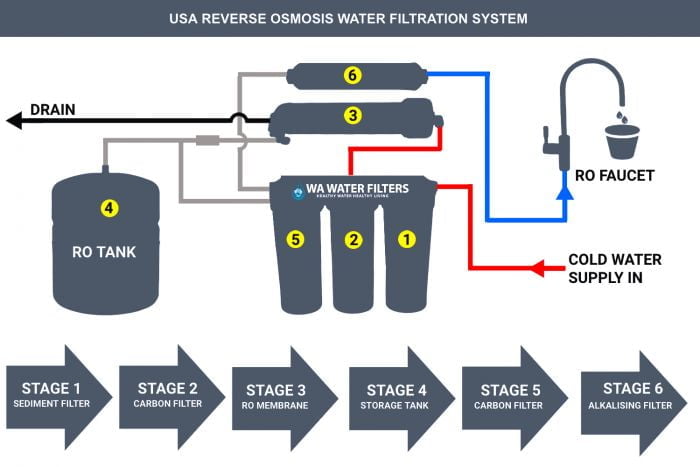 Filtration Process in 5 Stage Reverse Osmosis Systems - Wa Water Filters
Is it a gimmick?
Honestly? For most people with decent municipal water, a standard carbon filter (like a Brita) does the job. But if you’re on a well, or your city water tastes like a chemical lab, RO is a game-changer.
I’ll be real with you: installation can be a pain. You need a small hole for a dedicated faucet, and the system takes up cabinet space under your sink. Plus, the initial cost can be $150 to $500, depending on how fancy you go.
But once it’s set up? You tap that dedicated faucet, fill a glass, and take a sip. There’s no taste. No smell. Just silence. It’s almost unsettling how clean it tastes at first.
One last thing: don’t confuse RO with distilled water. Distilling boils water and recondenses it, which also kills everything. But distilling uses electricity, while RO uses water pressure. Both are pure, but RO is generally faster and cheaper for daily use.
So, should you get one? If you’re tired of buying plastic bottles, yes. If your tap water tastes like Dave’s swimming pool, absolutely yes. If you just want annoyingly pure water for your espresso machine, this is your solution.
Me? I still drink tap sometimes. But now I have an RO system for my morning coffee. And you know what? My coffee no longer tastes like a faint memory of hard-boiled egg. That, my friend, is worth the cabinet space.
