How Much Do Whole House Water Filters Cost

So, you're thinking about a whole house water filter. Welcome to the grown-up world of "rust-free laundry" and "that weird smell is gone." It’s a purchase that screams, "I car...
So, you're thinking about a whole house water filter. Welcome to the grown-up world of "rust-free laundry" and "that weird smell is gone." It’s a purchase that screams, "I care about my pipes!" And your wallet is about to have a very serious conversation with you. Let’s talk dollars and sense—and maybe a little sense of humor.
The Baseline: What Are We Even Paying For?
A whole house water filter isn't a single gadget. It’s a system. Think of it as the bouncer for your entire plumbing club. The cost isn't just the box; it’s the installation, the fancy valves, and the promise of never tasting pool water from your tap again. Prices range from a "spontaneous coffee buy" to a "used car down payment."
You can snag a basic sediment filter for $150. That’s the "I just want to catch sand" special. A high-end reverse osmosis or carbon tank system? That will set you back $3,000 or more. That’s the "my water tastes like a spring meadow" upgrade.
Must Read
Here’s the kicker: the price tag is the least funny part. The real cost is the ongoing drama. Filter cartridges are like printer ink—tiny, expensive, and you'll always run out on a Sunday.
The "Hidden" Costs That Make You Gulp
Installation is the villain of this story. A plumber might charge $200 to slap a basic filter on a pipe. But if your house has weird plumbing? That number can balloon to $1,000. It’s like paying for a haircut and ending up with a full spa day—but not the relaxing kind.
Don't forget the media—the sand or carbon inside the tanks. You can't just rinse it. You have to replace it. For a big carbon tank, that’s $300 every few years. It’s cheaper than buying bottled water, but it stings more emotionally.
Then there’s the fun surprise: if you have hard water, you might need a water softener, too. That’s another $1,500 to $3,000. Suddenly, your whole house filter is in a relationship with a second machine. And they both demand salt pellets.
Funny Detail: The "Type" of Filter You Pick Changes Everything
Not all filters are born equal. A cartridge filter is the couch potato of the family. Cheap to buy ($200), but the cartridges cost $50 a pop. Change them every six months, or watch your water pressure turn into a sad trickle.
 Whole House Water Filter Costs for 2025-2026
Then there’s the backwashing filter. This is the overachiever. It cleans itself by flushing water backward. It costs $1,200 to $2,500 upfront, but it uses less electricity and lasts longer. It’s the Prius of water filtration.
And the reverse osmosis system? That’s the drama queen. It removes everything—even good minerals. You’ll pay $2,000 to $4,000 for the whole house version. Plus, it wastes a few gallons of water for every one it cleans. Your plants will judge you.
Why This Topic is Actually Fun
Think of this as a treasure hunt for your water. You get to ask, "What’s in my tap?" Is it chlorine? Lead? The ghost of last week’s pizza? A whole house filter is like a detective’s badge for your sink.
Here’s a quirky fact: some filters can remove 99% of microplastics. That means your morning coffee is now a superhero beverage. You’re not just hydrating; you’re fighting pollution from the comfort of your kitchen.
Another funny detail: the first flush of a new filter often looks like mud. Don’t panic. That’s carbon dust saying hello. It’s like the filter’s way of sneezing before it gets to work.
 Home Water Filtration Systems: Types, Costs, and Eco-Friendly Options
The "You're Doing It Wrong" Budget Trick
Do not buy the cheapest filter on Amazon. I know. It’s tempting. But a $100 system might clog in a month. Then you’ll spend more time under the sink than on Netflix. Pay a little more for something with a bigger filter surface. Your future self will thank you with a glass of clear water.
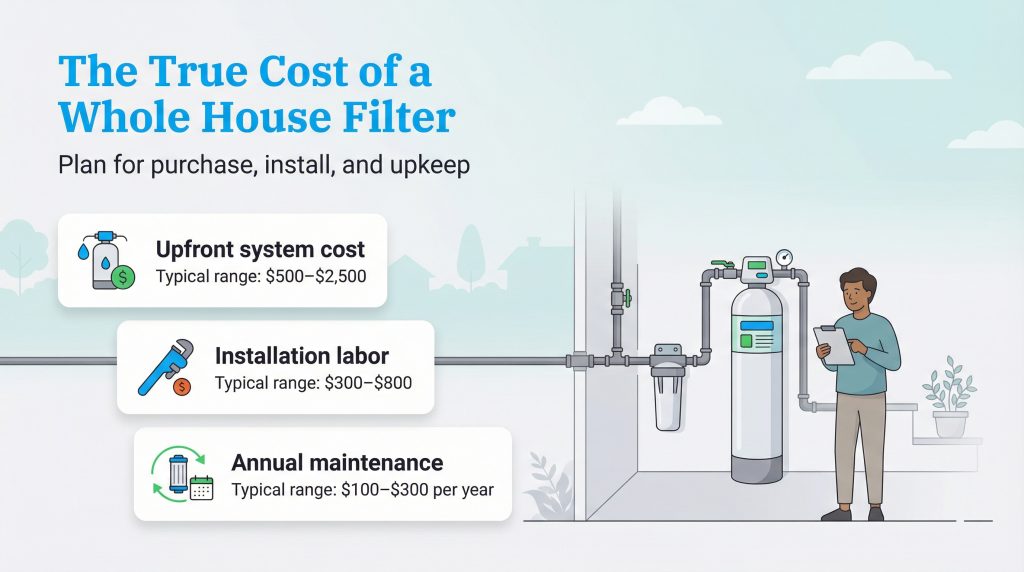
Also, factor in annual maintenance. A good rule: budget about $150 to $300 per year for cartridges and check-ups. That’s less than a fancy streaming subscription. And your water won’t buffer.
The Final Number (Brace Yourself)
So, how much? For a decent setup—installation, a mid-range carbon filter, and a year of filters—expect to spend $1,000 to $2,000. For top-of-the-line with all the bells, whistles, and a reverse osmosis tank? That’s $3,500 to $6,000.
Is it worth it? If you’re tired of buying bottled water, scrubbing rust stains off your toilet, or listening to your ice maker complain, yes. It’s the unsung hero of your home. Your dishwasher will work better. Your skin will feel softer. Your spouse will think you’re a wizard.
And the best part? You’ll never have to smell that sulfuric egg odor again. That alone is worth the price of admission. Go forth, filter friends. Your pipes are waiting.
