How To Size A Water Softener For Your Home

Let’s be honest—thinking about water softeners isn’t exactly on your top-ten list of fun activities. But what if I told you that sizing one correctly could turn your shower in...
Let’s be honest—thinking about water softeners isn’t exactly on your top-ten list of fun activities. But what if I told you that sizing one correctly could turn your shower into a silky-smooth spa and your dishes into streak-free miracles? That’s right—this isn’t just plumbing; it’s a lifestyle upgrade you can actually measure.
Here’s the kicker: a water softener that’s too small will leave you with hard water residue and a grumpy family. A unit that’s too big is like buying a monster truck for a trip to the grocery store—wasteful and awkward. So let’s make this sizing thing easy, fun, and maybe even a little thrilling.
Step one: know your water’s hardness
First, you need to know what you’re dealing with. Grab a simple water test kit from a hardware store, or better yet, check your local water utility’s annual report online. You’re looking for a number in grains per gallon (gpg)—that’s the gold standard for measuring hardness.
Must Read
If your water is around 1–3 gpg, you’re mostly fine (hi, lucky you!). Anything above 7 gpg? That’s when your soap stops lathering, your hair feels like straw, and your pipes start plotting against you.
Step two: count the people and the water
Now, let’s get personal: who lives in your house? Each person uses about 75–80 gallons of water per day (yes, including that epic pre-bedtime shower). Multiply that by the number of people in your home to get your daily water usage.
For example, a family of four uses roughly 300 gallons a day. Now multiply that number by your water’s hardness in grains per gallon—that’s the daily hardness load you need to remove.
So if your water is 10 gpg and you use 300 gallons, your daily load is 3,000 grains. That’s the number that matters.
Step three: add a little fudge factor (the fun part)
Why a fudge factor? Because life happens—Thanksgiving dishpiles, sleepover guests, and that one week when everyone decides to wash their cars. Add at least 20% to your daily load to stay safe.
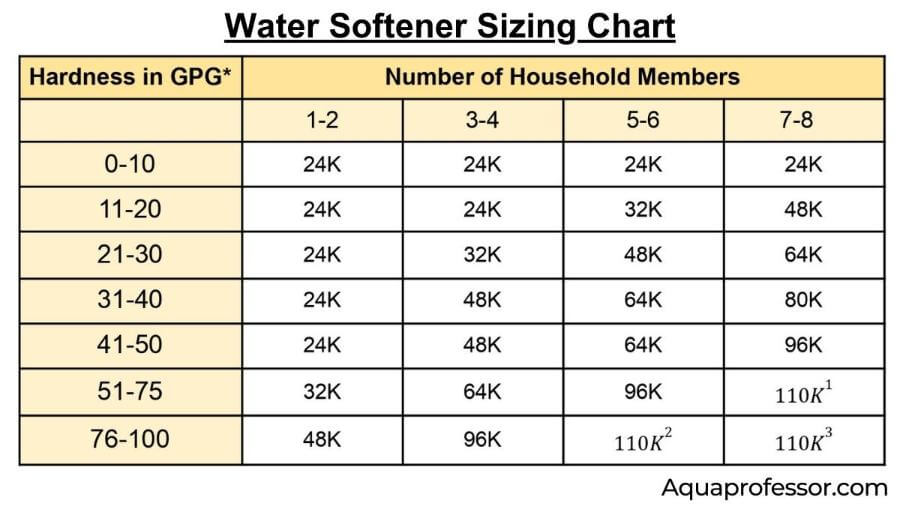 Water Softener Grain Chart & Calculator: Ultimate Cheatsheet
So 3,000 grains from our example becomes 3,600 grains per day. This little buffer means your softener won’t throw a tantrum when you need extra soft water. It’s like buying a bigger pizza—you’ll thank yourself later.
Step four: match it to a softener’s capacity
Water softeners are rated by how many grains they can remove before they need to regenerate (clean themselves). Small units handle about 24,000 grains, while larger ones go up to 64,000 or more.
Divide the softener’s total capacity by your daily load to see how many days it lasts between regenerations. You want that number to be between 3 and 7 days—any less, and you’ll hear it whirring all night; any more, and you’re wasting salt and water.
For our 3,600-grain example, a 32,000-grain softener lasts about 9 days. That’s a bit too long—so go down a size to something like 24,000 grains, which gives you 6.6 days. Perfect.
Bonus tip: don’t forget iron
If your water has iron (that rusty-looking stain in your toilet), it complicates things—a lot. Iron acts like super-hardness, so add 5 times its concentration to your grain total.
For instance, 2 ppm of iron = 10 extra grains per gallon. Suddenly your 10 gpg water becomes 20 gpg. That’s why you can’t just eyeball it—test for iron, or you’ll end up with a softener that gives up on you.
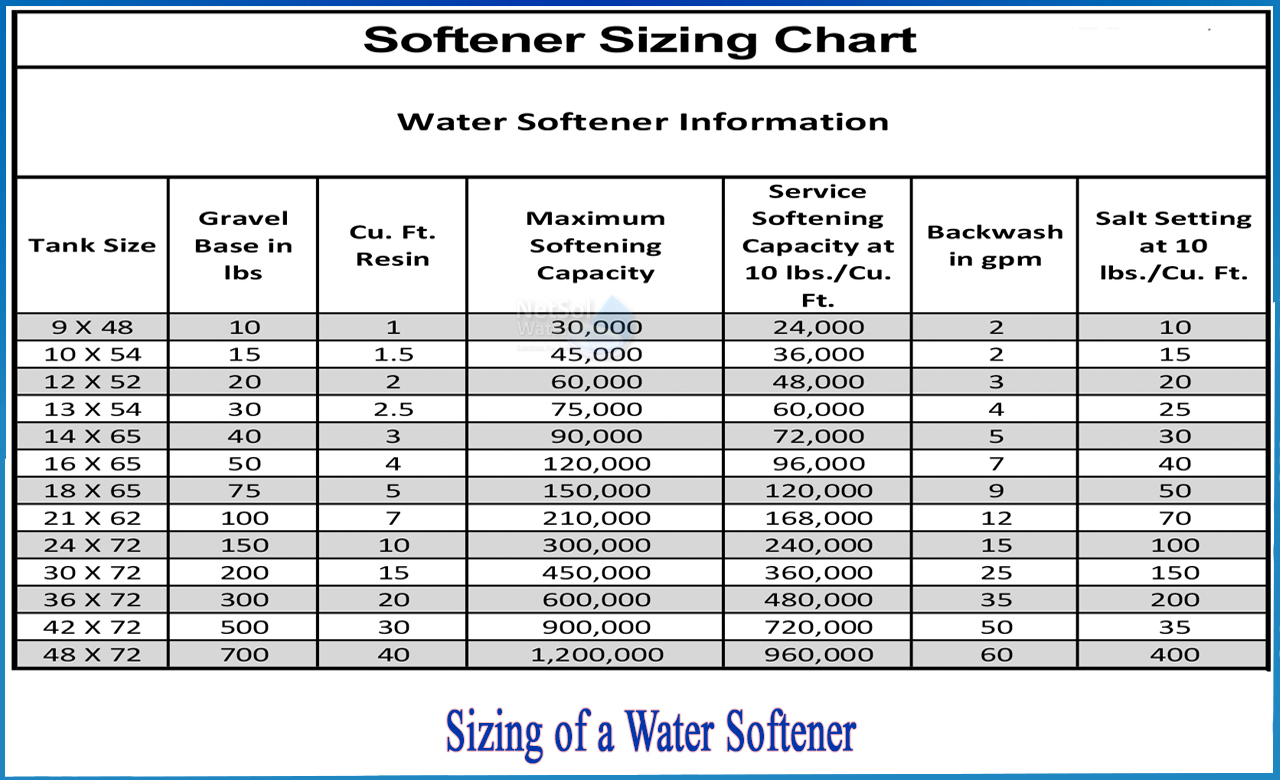 How To Size A Water Softener? : Best Water Softeners for Your Home – GXSSB
Still with me? Good, because we’re almost to the best part.
Why this silly math makes your life sparkle
Get the sizing right, and your water will feel like liquid silk on your skin. Your coffee will taste better (yes, really—hard water messes with extraction). Your laundry will be softer, your faucets won’t get that chalky crust, and your hair will stop acting like you’ve been through a windstorm.
And here’s the underrated win: a properly sized softener uses less salt and less water over time. That’s kinder to your wallet and the planet—a double high-five in appliance form.
You’ve got this
I know, I know—it’s a bit of number crunching. But you just learned how to size a water softener in about four minutes. That’s faster than most people spend scrolling for a bad movie on Netflix.
Imagine the next time you’re at a dinner party and someone complains about their crusty showerhead. You’ll casually mention grains per gallon and regeneration days, and they’ll look at you like a wizard. You are a wizard—the kind who makes life softer, one smart choice at a time.
So go ahead, test that water, do that tiny bit of math, and then enjoy a future of feathery-soft towels and spotless glassware. Your home is about to get a whole lot more fun. And honestly? You totally deserve it.
