Does Water Intoxication Happen Right Away

You know that feeling when you’re at a summer picnic, it’s hotter than a sidewalk in Phoenix, and you chug a whole bottle of water in one go? That gasp for air, the sloshing i...

You know that feeling when you’re at a summer picnic, it’s hotter than a sidewalk in Phoenix, and you chug a whole bottle of water in one go? That gasp for air, the sloshing in your stomach—it feels heroic, like you just conquered thirst itself. But then a little voice in your head, probably from that one health-conscious friend, whispers, “Careful, you might get water intoxication.” And you freeze, wondering if you’re about to collapse right there next to the potato salad.
Let’s clear up the panic right now. Water intoxication, also known as hyponatremia, is not something that hits you like a cartoon anvil the second you take a big gulp. It’s more like that slow, awkward moment when you realize you’ve been wearing mismatched socks all day—it creeps up because of a pattern, not a single slip-up. Your body is actually pretty smart; it can handle a decent flood without short-circuiting instantly.
Think of your kidneys as that chill bouncer at a club. If you chug a 20-ounce bottle, the bouncer just waves it through and you pee it out in an hour. But if you show up with a keg and try to chug the whole thing in thirty minutes, the bouncer gets overwhelmed, the dance floor floods, and suddenly everyone’s slipping on electrolyte tiles. That is the problem—it’s about speed and volume, not just drinking water.
Must Read
So, does it happen right away? Only if you’re trying to win a very stupid gold medal. Imagine you’re at a boring work meeting and you nervously sip water for three straight hours—that’s not going to do it. But if you’re that person who finishes a marathon, chugs a gallon of water in ten minutes, and then does it again after a selfie, your sodium levels drop faster than your motivation on a Monday morning. That’s when your brain starts swelling, and trust me, you’ll feel it.
The Early Warning Signs (That You’ll Definitely Ignore)
Your body has a sense of humor, so it gives you hints before the big meltdown. First, you feel nauseous—that weird, “did I eat a bad burrito?” sensation. Then you might get a headache that feels like a tiny construction worker is jackhammering your temples. Most people just think, “Ugh, I need more water,” which is ironic in a tragic way.
Then comes the bloating. You’ll look down at your belly and wonder if you secretly swallowed a beach ball. It’s not fat; it’s just your cells yelling, “Dude, stop!” If you’ve ever felt that sloshy, overfilled feeling after a water-drinking challenge, you’re already on the express train to too much.
By the time you get confused or start slurring your words, you’ve basically become a human water balloon with legs. That’s the point where it’s not a joke anymore. But here’s the comforting part: for normal people, this takes a lot of water. We’re talking gallons in a short window, not a big bottle after a hike.
 Symptoms of water intoxication : r/healthdisscusion
The Real-Life Scenarios (That Might Sound Familiar)
Picture this: you’re at a buffet, and you decide to “pre-game” with water so you eat less. So you down three glasses in ten minutes. You’re fine. You might burp dramatically and excuse yourself to the restroom twice, but you won’t seize up. Your kidneys are like, “I got this, bro.”
Now picture this: you’re a college freshman at orientation, and you and your buddies do a “drink as much as you can” challenge because you’re bored. That’s closer to danger zone. Stories about water intoxication usually happen in extreme contexts—military training, ultramarathons, or frat houses where common sense took a vacation. It’s not the glass of water by your bedside.
And here’s my favorite anecdote: my friend once tried a “water cleanse” where she drank a gallon in two hours. She spent the afternoon feeling like a beached whale, peeing every ten minutes, and swearing off water forever. She was fine. Just very, very annoyed and slightly embarrassed. That’s the everyday reality—annoyance, not an ambulance.
When Does It Actually Become Scary?
It becomes scary when you stop peeing. That’s the big red flag. If your kidneys are working, they’ll flush out the excess. But when you drink so fast that your kidneys can’t keep up, the water stays in your blood and dilutes your sodium. Your brain doesn’t like that, because it needs salt to function properly. Think of it like your brain being a picky chef—too much water ruins the sauce.
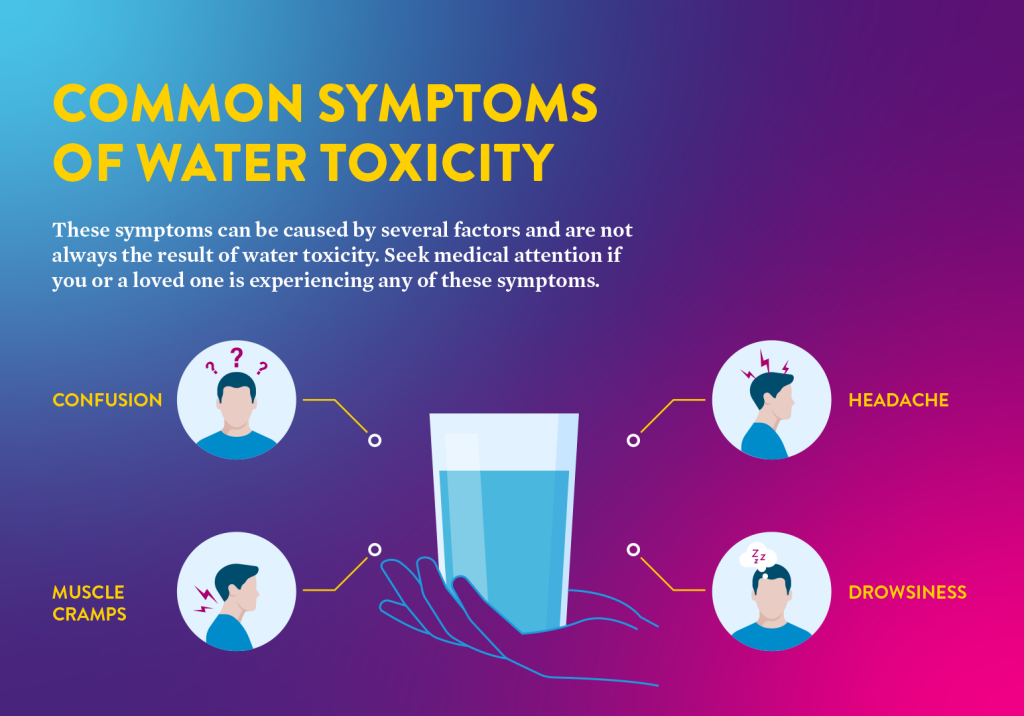 Water Intoxication Symptoms
Also, if you’re exercising really hard, you’re losing salt through sweat, so you’re more vulnerable. The classic scenario is a marathon runner who drinks plain water without electrolytes. They’re basically pouring gasoline on a fire—the water goes in, the salt drops, and suddenly they’re dizzy and confused. That’s why sports drinks exist, folks. They’re not just sugar water; they’re your body’s safety net.
But for the average person sitting on the couch after a workout? You’re fine. Drink your water, take a deep breath, and don’t try to out-chug a camel. Your body is built for moderate, steady hydration, not a tsunami in a thermos.
The Takeaway (So You Can Sleep Tonight)
Water intoxication does not happen right away. It’s like worrying about getting struck by lightning while holding a plastic fork—technically possible, but you’d have to be doing something truly unusual to make it happen. Most people who “overhydrate” just get a pat on the back from their bladder and a slight inconvenience.
So next time you’re at that picnic and you chug a bottle, don’t panic. Slosh it down, enjoy the cool feeling, and maybe pace yourself with a little salty snack like pretzels. Your body will thank you for the balance, and the only thing you’ll experience is a satisfying burp and a trip to the porta-potty. That’s the real-life, easy-going truth.
