Why Does The Mouth Water Before Vomiting

You know the drill. One minute you’re fine, the next your stomach does a cartwheel, and suddenly your mouth is a waterfall. That sudden rush of saliva before you get sick is w...

You know the drill. One minute you’re fine, the next your stomach does a cartwheel, and suddenly your mouth is a waterfall. That sudden rush of saliva before you get sick is weirdly specific—and honestly, a little embarrassing. But here’s the thing: your body isn’t just being dramatic. That watery mouth is a clever, ancient survival tactic straight out of evolution’s playbook.
The Body’s Secret Signal
Think of your salivary glands as the body’s early-warning system. When your brain detects a toxin, stomach bug, or even intense motion sickness, it fires a signal to produce extra saliva. This isn’t random; it’s a protective rinse for your teeth and throat, coating them against the harsh stomach acid about to rise up.
The scientific term for this is “ptyalism,” which sounds like a fancy cocktail you’d order, but it’s actually a biological safety net. Your saliva acts like a buffer, diluting the bile and acid so they don’t burn your esophagus on the way out. It’s your body’s way of saying, “Brace yourself, but we’ve got the armor on.”
Must Read
Why So Much Saliva, Though?
Picture your mouth as a water park for a second. Normally, you produce about one to two liters of saliva a day without noticing. But right before vomiting, that rate can triple in minutes. Why? Because saliva contains enzymes that neutralize bacteria and break down food—so your body is frantically trying to tidy up the mess before the big evacuation.
It’s also a calming mechanism for your stomach. Swallowing extra saliva can temporarily wash down irritants, giving your gut a split second to decide if a full purge is actually necessary. Think of it as the body’s last-ditch negotiation: “Maybe we can just settle this with a burp?”
Cultural & Pop Culture Nods
Ever noticed how movie characters always clutch their mouth before barfing? That’s not just acting—it’s because real-life saliva pools, making you involuntarily gulp. In Japanese culture, the phrase “yodare ga deru” (drool comes out) is sometimes used humorously before saying someone looks queasy, tying the physical to the emotional. And in many ancient medical texts, from Greek Hippocrates to Chinese herbal guides, this excessive salivation was seen as a sign the body was “expelling poison”—which is scientifically accurate, just in a more poetic way.
 Another Name For Vomiting Reflex at Nancy Hansen blog
Here’s a fun fact: animals do this too. Dogs often produce a foamy drool before they vomit, and even cows will over-salivate if they’ve eaten something toxic. Evolution doesn’t discriminate—it just wants everyone to survive the next meal.
Practical Tips: When Your Mouth Waves a Warning Flag
If you feel that waterfall starting, don’t panic. First, breathe deeply through your nose. Slow, steady breaths can trick your nervous system into calming down, reducing the urge to gag. Second, sip a small amount of cold water or chew a mint leaf—cold temperature can momentarily calm the salivary glands and give your stomach a distraction.
Another trick: suck on a sour candy (like a lemon drop). The intense tartness can override the nausea signals for a few seconds, giving you time to reach a bathroom or a trash can. Just don’t do this if you’re already in full-send vomit mode—then you just get sour barf, which is not an upgrade.
When It’s Not Just a Bug
Occasional mouth-watering before vomiting is normal—it’s your body’s failsafe. But if you notice this happening frequently without ever vomiting, or if it’s accompanied by heartburn or a burning throat, you might be dealing with GERD (gastroesophageal reflux disease). In that case, your esophagus is basically using the same “rinse and protect” strategy, but without the actual purge. A quick chat with your doctor can rule out bigger issues.
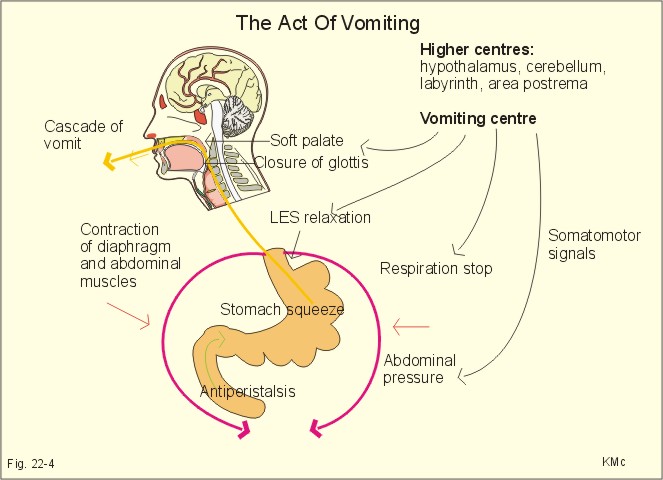 New Human Physiology Ch 22
And if you’ve ever been on a boat or a rollercoaster and felt that sudden mouth flood, you’ve experienced motion-induced ptyalism. Your inner ear gets confused by conflicting signals from your eyes and body, so it sends a distress call to your brain. The brain, in turn, orders a mouthful of saliva—just in case you need to eject that distracted lunch.
The Silver Lining
Let’s be real: vomiting is never fun. But knowing that your mouth is working for you, not against you, can make the whole experience feel a little less disgusting. Your body is a finely tuned machine that’s been practicing this dance for millions of years. It’s not personal; it’s just biology doing its job.
So next time you feel that telltale watery sensation, take a breath. Thank your salivary glands for being the unsung heroes of the digestive world. And if you do end up losing your lunch, remember: you had the best mouth-guard money can’t buy—evolved, free, and always ready to rinse.
Reflection for daily life: We spend so much energy trying to control our bodies—scheduling meals, avoiding bad foods, popping anti-nausea pills. But sometimes the smartest move is to surrender to the small, weird signals. That rush of saliva? It’s a reminder that you are a creature of instinct, wired to survive. And survival is messy, but it’s also a little bit amazing. So go easy on yourself. Your mouth knows what it’s doing.
