How Much Water Are You Supposed To Drink

My friend Sarah once carried a gallon jug of water everywhere like it was her emotional support animal. She’d glug it down by 2 p.m., then complain about constant bathroom bre...

My friend Sarah once carried a gallon jug of water everywhere like it was her emotional support animal. She’d glug it down by 2 p.m., then complain about constant bathroom breaks. I asked her why, and she deadpanned: “Because eight glasses a day.” We both laughed, but honestly—is that rule even real?
Turns out, the whole “eight glasses” thing is more of a vibe than a science. It started from a 1945 recommendation that actually said we need about 2.5 liters of water daily—but that includes what we get from food. So unless you’re eating zero soup, fruit, or vegetables, you’re probably already half-dehydrated without knowing it.
Let’s get real: your body isn’t a measuring cup. It’s a smart machine that screams at you when it’s thirsty. If you’re peeing pale yellow four to six times a day, you’re winning. If it’s dark amber, chug. If it’s clear as vodka—whoa, slow down. You’re overhydrating, and that’s a thing.
Must Read
Why the “one-size-fits-all” number is nonsense
Your friend who lives in Arizona and runs marathons needs triple the water of me, a desk-hugger who walks to the fridge. Age, weight, activity level, even the weather matters. The National Academies suggest roughly 3.7 liters for men and 2.7 liters for women daily—but that’s from all sources, including coffee, tea, and that sneaky celery stick.
(Side note: coffee does not dehydrate you. That myth is as dead as your 2016 Fitbit. It’s a mild diuretic, sure, but it still counts toward your fluid total. Enjoy your latte guilt-free.)
What about “thirst is already too late”?
You’ve heard that one, right? Some expert says if you’re thirsty, you’re already dehydrated. Okay, hilarious—because evolution gave you a thirst mechanism that works like a smoke alarm. It’s not perfect, but it’s not broken. If you’re thirsty, drink. If you’re not, don’t stress. Your kidneys are literal geniuses at balancing things.
Unless you’re a frail older adult or an ultra-endurance athlete, you can trust your brain. Your body has been doing this water regulation gig for millions of years. Respect the algorithm.
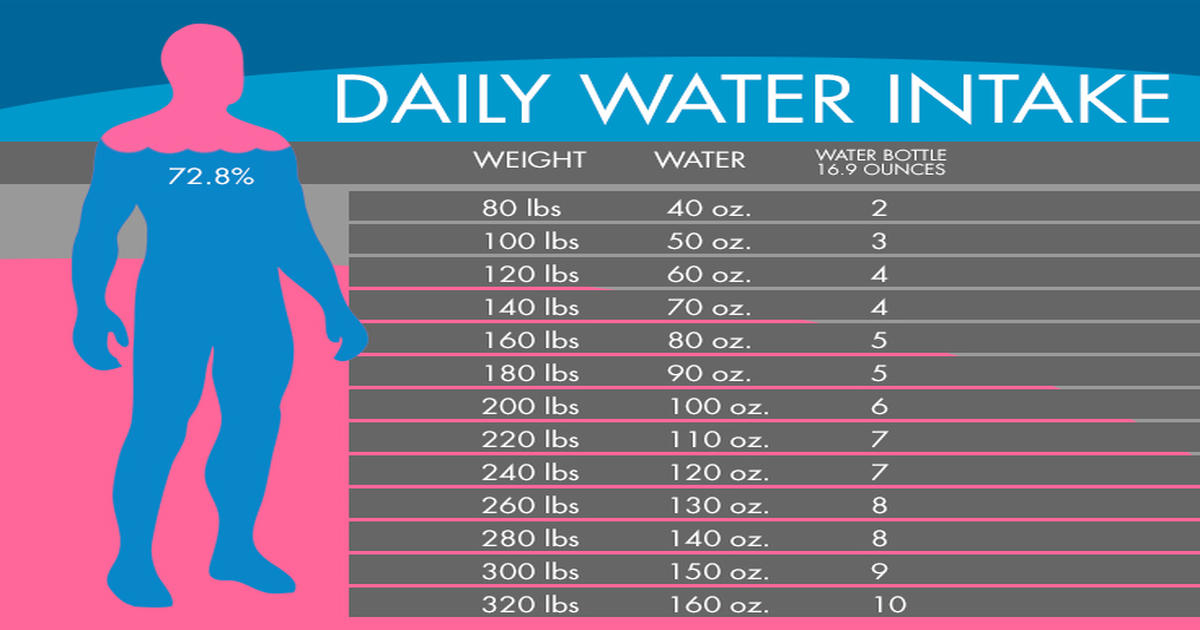 Water Consumption Calculator Thames Water Launches New Calculator To
How to actually figure out your number
Try the pee test (my favorite metric). After your morning pee, check the color. Aim for straw-yellow, not lemonade or iced tea. If you hit clear, you’re overdoing it. If you’re dark, drink a glass now. Simple, free, and doesn’t require a gallon jug.
Another hack: weigh yourself before and after exercise. If you lost one pound, drink about 16–24 ounces of water. (Don’t pull an Olivia and chug a whole liter in one go—that’s how you pee it all out in thirty seconds.)
The irony of forcing water
I’ve seen people force down water until they feel sick. Newsflash: hyponatremia (low sodium from overhydration) can be dangerous. It happened to a marathon runner who drank so much plain water her brain swelled. She survived, but her kidneys weren’t happy. So no, more is not always better.
Your body retains water better with electrolytes. If you’ve been sweating, eat a salty snack or add a pinch of salt to your water. Your cells will actually use it instead of flushing it out. You’re welcome.
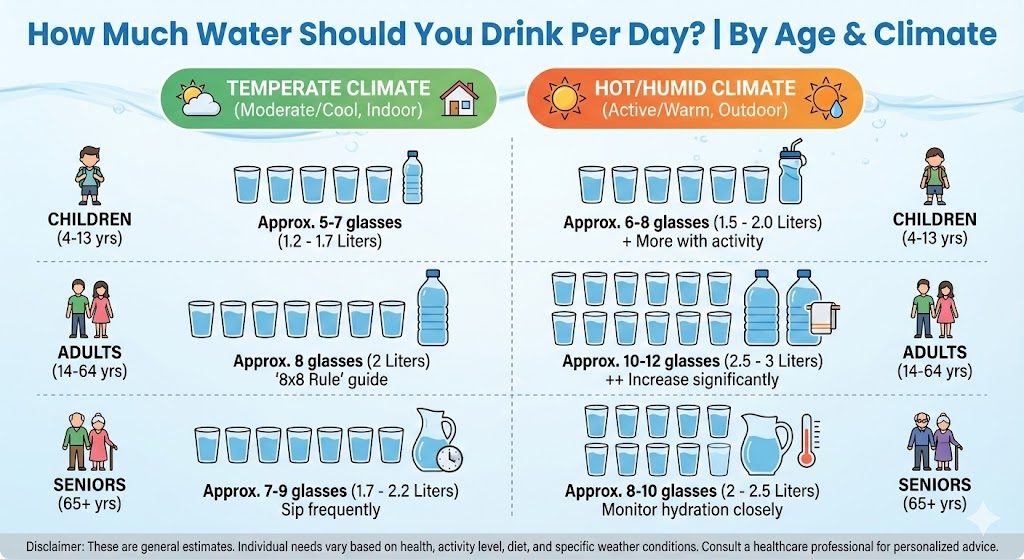 How Much Water Should You Drink Per Day?
What about the “8 glasses” gospel?
It’s catchy marketing—water bottle companies love it. But your specific need could be six glasses or twelve. A 130-pound yogi doesn’t need the same as a 200-pound construction worker. Listen to your own thirst, not a rule that started as a vague suggestion from a 1945 nutrition board.
And yes, fruits like watermelon and oranges count. Soup counts. Even beer counts (in small amounts, obviously). The goal is to keep your systems running smoothly, not to hit an arbitrary number that makes you hate life.
Final reality check
You don’t need a fancy app or a gallon bottle that says “inspire” on it. You need a glass of water when you’re thirsty, a little more if you’re active, and a lot more if you’re in the desert. Your body is not a desert—it’s a well-oiled, self-correcting habitat.
Sarah ditched her gallon jug after I told her about the pee test. Now she drinks when she’s thirsty, and her bathroom trips dropped by half. She also stopped feeling like a failure for “only” drinking five glasses. Progress.
So go ahead, drink that water. But if you forget for an hour? You’ll be fine. Your ancestors survived on puddles and berries. You’ve got this.
