How To Get Well Water Tested In Michigan

So, you’ve got a well. Congratulations—you’re basically a medieval land baron with your own secret plumbing. But here’s the thing: that water might taste like pure glacier mel...
So, you’ve got a well. Congratulations—you’re basically a medieval land baron with your own secret plumbing. But here’s the thing: that water might taste like pure glacier melt, or it might be hosting a microscopic rave with bacteria, lead, and agricultural runoff. You need to get it tested, and in Michigan, it’s easier than you think (and cheaper than a trip to the ER after drinking mystery liquid).
First, let’s tackle the why. Michigan is a water wonderland—we’ve got 11,000 inland lakes, but also 75 years of industrial “oopsie” buried in the ground. One of the most surprising facts? About one in five private wells in Michigan have unsafe levels of bacteria or nitrates. That’s not a flex. It’s like your well is hosting a “bring your own pathogen” party, and you didn’t RSVP.
Step One: Stop Panicking and Grab a Jar
You don’t need hazmat gear or a lab coat from Amazon. All you need is a clean, sterile jar—the kind your grandma used for pickles, but boiled first. No, you can’t use the one with pickle residue. Bacteria love pickle juice almost as much as I love a pasty from Mackinac Island.
Must Read
Go to your kitchen faucet, run the cold water for two minutes, then fill the jar to the neck. Don’t touch the rim. Not with your fingers, not with your cat, not with your “but I washed them” hands. You’re aiming for “crime scene evidence,” not “kid’s science fair project that grew mold.”
Step Two: Where to Send Your Liquid Treasure
You’ve got three options, and they all involve slightly less bureaucracy than renewing your driver’s license. Option A: Your county health department. Every Michigan county has one, and they love your water almost as much as they love your property taxes. Search “[Your County] Environmental Health” online. They’ll hand you a kit—or mail one—for about $30 to $50. That’s cheaper than a half-sleeve of hard cider and probably safer.
Option B: A state-certified lab. Michigan’s Department of Environment, Great Lakes, and Energy (EGLE) keeps a list. Yes, it’s a real acronym. No, I can’t pronounce it without sounding like a gargling goose. These labs test for stuff like arsenic, nitrates, and coliform bacteria (the “poop check”). Pro tip: Coliform is nature’s way of saying “something warm and furry took a dump near your well.” Startled yet? Good. Keep reading.
 Michigan Well Water Testing Guide (2026) | Septic & Well Pro
Option C: The “Throw It Over the Fence” Method
Just kidding. Do not mail your water to a random YouTube guru. But you can use a mail-in kit from reputable places like SimpleLab or WaterCheck. They send you a box, you piss—uh, I mean pour—your sample in, and FedEx it in a cooler. Results come back in two weeks, usually with a chart that makes you feel like a hydrologist. One heads-up: if the result says “high levels of radon,” that’s not a cologne recommendation. Radon gas dissolves in water and then farts into your lungs when you shower. Yes, that’s real. Michigan’s bedrock is full of it. You’re welcome for the new anxiety.
Step Three: Decode Your “Water Report Card”
When the results arrive, you’ll see scary words like “turbidity” and “total dissolved solids.” Turbidity just means “looks like dishwater.” Total dissolved solids are basically your water’s mineral “hipster cred”—a little calcium is fine, but 500 parts per million? That’s Flint’s cousin from the UP.
The real red flags are bacteria, nitrates, and lead. Bacteria means your well cap might be cracked (or a raccoon used it as a toilet). Nitrates over 10 ppm mean the farmer next door is using too much fertilizer—or your septic tank is making a guest appearance. Lead? If your pipes are pre-1988, they might be dissolving into your morning coffee. Michigan has the highest rate of lead service lines in the country. Surprised? You shouldn’t be—we also invented the car and the paella. We can do anything.
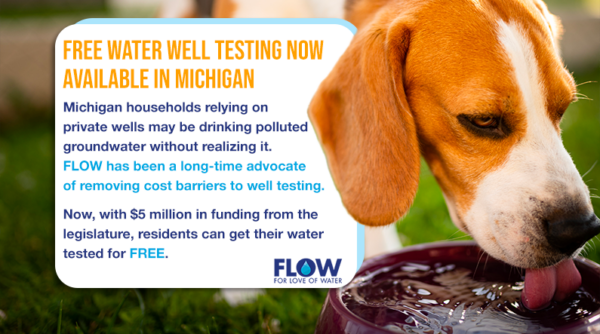 Free water well testing now available in Michigan - Flow Water Advocates
Step Four: What to Do When Your Water Is a Hot Mess
If the results say “bacteria detected,” don’t panic. You’re not doomed. Boil your water like you’re camping in 1842. Then shock-chlorinate your well—yes, bleach it like a “Jackass” stunt. You can buy a kit online or call a well driller. It costs $200, which is less than a weekend of therapy.
For lead, arsenic, or radon: Buy a filter certified for those specific contaminants. Not a Brita—that’s a glorified bouncer for dirt. You need one with carbon block or reverse osmosis. Michigan State University’s Extension office offers free consultations. They’re nerds, but they’re our nerds.
The Golden Rule: Test Every Year, Like Your Wisdom Teeth
Well water changes. Spring thaw, drought, a neighbor’s new septic tank—all drama. Mark your calendar for April 1st. If your water turns out clean? Pop a non-alcoholic kombucha. If not? Fix it. Your gut flora will thank you.
And if you read all this and still ignore testing? Remember: every Michigan well must be tested for bacteria during a home sale. So either test now, or wait until you’re selling, and your realtor makes that “why is the water green” face. Which one sounds more fun? Exactly. Go grab a jar.
