Does Water Softener Remove Calcium

Let’s face it: hard water is the uninvited guest that never leaves your home. It leaves chalky rings in your coffee mug and a crusty film on your shower glass. Life’s too shor...

Let’s face it: hard water is the uninvited guest that never leaves your home. It leaves chalky rings in your coffee mug and a crusty film on your shower glass. Life’s too short to scrub that hard, right?
The big question we’re all secretly Googling is, does a water softener actually remove calcium? The short answer is yes, but the drama is in the details. Think of it less like a filter and more like a chemical matchmaker.
A water softener doesn’t yank calcium out by its roots. Instead, it swaps your hard calcium ions for softer, gentler sodium or potassium ions through a process called ion exchange. It’s a classic trade: goodbye, scale; hello, that silky-smooth shower feel.
Must Read
So yes, your morning latte will be free of that weird, floating white dust. This means cleaner glasses, softer laundry, and a coffee machine that actually lives past its warranty.
But here’s the kicker: the calcium isn’t gone. It’s just wearing a new disguise. Your softener’s resin beads hold onto the calcium until a brine flush (regeneration) kicks it down the drain. You’re simply relocating the problem, not erasing it from the universe.
The Myth of the Magic Filter
People often get shiny-eyed and ask if they can drink this “soft” water. Technically, yes, but your tap will be a little saltier. For drinking, a dedicated reverse osmosis (RO) system is your real hero.
An RO system is the high-end restaurant of water treatment. It actually filters the calcium and other minerals out, leaving you with something close to pure H₂O. It’s the difference between a basic shampoo and a deep-conditioning mask.
For the rest of your home—the water heater, the washing machine, your skin—the softener’s ion exchange is pure gold. It protects your appliances from the slow, silent death of scale buildup. That’s a win.
A Little Culture & Science Break
Did you know that ancient Roman aqueducts were famously clogged with calcium deposits? They called it “sinter,” and it was the bane of their plumbing. We’ve been battling this stuff for millennia.
And here’s a fun fact: the “hardness” of water is measured in grains per gallon. If your water is above 7 grains, you’re basically washing your hair with limestone. Your shampoo struggles to lather because the calcium is fighting the soap molecules—a tiny, sad war happening on your scalp.
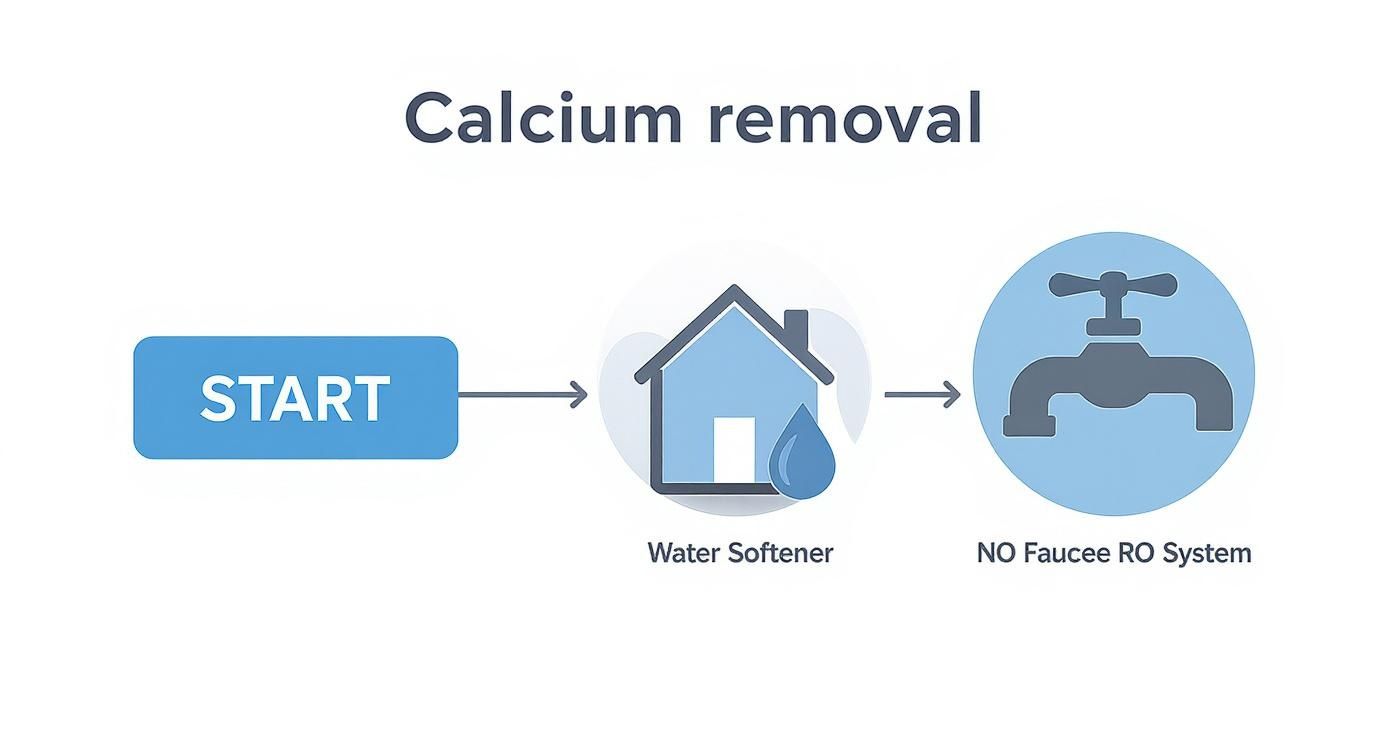 How to Banish Hard Water for Good: Your Guide to Removing Calcium
In some cultures, like in parts of Japan and Italy, people swear by “hard water” for its taste and mineral content. They’re not wrong—it’s healthy. But it’s also a nightmare for your kettle.
Practical Tips for the Modern Home
First, test your water. You can buy a simple test strip at a hardware store or call your local municipality. Stop guessing and start knowing your enemy.
If you have a softener, always bypass your outdoor faucets and any drinking water lines. Your garden plants (and your cactus) prefer the calcium. They’re natural hard water lovers.
Second, clean your softener’s brine tank once a year. It’s like taking a holiday for your machine. Dump the salt, scrub out the sludgy bits, and refill with fresh salt pellets. Your system will thank you with a decade of trouble-free service.
Third, don’t fear the sodium. The amount of salt added to your water by a softener is tiny—usually far less than what’s in a slice of bread. If you’re on a strict low-sodium diet, use potassium chloride instead. Problem solved.
For the true perfectionists: pair a water softener with a whole-house sediment filter. This catches sand and rust before they gum up the softener. It’s like wearing sunscreen and a hat—maximum protection.
The Reality Check
People often worry about “removing healthy minerals.” It’s a valid concern. But tap water is not your primary source of calcium. You get that from cheese, broccoli, and milk. A glass of hard water adds about 60mg of calcium—nice, but not a game-changer for your bones.
 PPT - Water Treatment Basics PowerPoint Presentation, free download
Meanwhile, that same hard water is silently killing your $2,000 water heater. A softener saves you more money in appliance longevity than it costs in salt. It’s a financial fact, not a marketing gimmick.
And yes, your skin feels different after a soft-water shower. It feels squeaky, perhaps even silky. That’s because the soap rinses off completely, leaving no calcium-soap scum stuck to your pores. It’s a daily spa experience.
There’s a famous old wives’ tale: rain water is “soft,” and that’s why your hair looks amazing after a storm. It’s true. A softener mimics that natural, rain-soft effect.
A Reflection on the Flow of Life
At the end of the day, a water softener isn't magic. It’s a practical, slightly boring machine that trades one element for another. But it lets you stop fighting your own plumbing.
You know that quiet, unspoken frustration when your faucets look cloudy a week after cleaning? A softener removes that friction. It’s a small, mechanical peace offering to your daily routine.
So, does a water softener remove calcium? It doesn’t erase it. It cleverly sidesteps it, trades it out, and sends it packing. In life and in water, the goal isn’t always removal—sometimes it’s graceful management. And that’s a philosophy you can take from your laundry room to your living room.
It’s one little machine, making your morning coffee—and your entire day—just a bit smoother. That’s a trade worth making.
