How To Choose Water Softener Size

So, my buddy Kevin—bless his heart—bought a water softener off the internet based solely on the price tag. It was the size of a mini-fridge, and he wrestled it into his baseme...
So, my buddy Kevin—bless his heart—bought a water softener off the internet based solely on the price tag. It was the size of a mini-fridge, and he wrestled it into his basement like it was a bear. Three weeks later, he called me, complaining his water was still "scratchy" and his dishwasher had a new chalky film. Turns out, that little bear was too small for his three-bathroom house. He’d basically bought a kiddie pool for a family of whales. Oops.
Kevin’s mistake is the classic blunder: he ignored size. Choosing a water softener isn’t about picking the shiniest gadget or the one with the funniest name. It’s about matching the machine’s capacity to your home’s actual thirst. Get it right, and you’re a hero. Get it wrong, and you’re Kevin. (And nobody wants to be Kevin.)
The One True Math (It’s Not Scary, I Promise)
First, you need to know your hardness level. That’s the number—usually in grains per gallon (gpg)—you get from a simple water test kit. (You can find them for ten bucks at the hardware store, or just check your city’s water report. Seriously, it’s that easy.)
Must Read
Then, you calculate your daily water usage. A general rule of thumb? Each person in your house uses about 80 gallons per day. So a family of four? That’s 320 gallons daily. But hold on—we’re not done yet. Multiply that 320 gallons by your hardness number. Let’s say your water is 10 gpg hard. That’s 320 x 10 = 3,200 grains of hardness you need to remove every single day.
Now, here’s the kicker—and the part Kevin missed. You don’t want a softener that works at 100% capacity every day. That’s like running a marathon at a sprint. You want a unit that regenerates (cleans itself) about once a week. So, multiply your daily grain load (3,200) by 7 days. That’s 22,400 grains. That’s your minimum target size. Go smaller, and you’ll be refilling salt every Tuesday and cussing at your water heater.
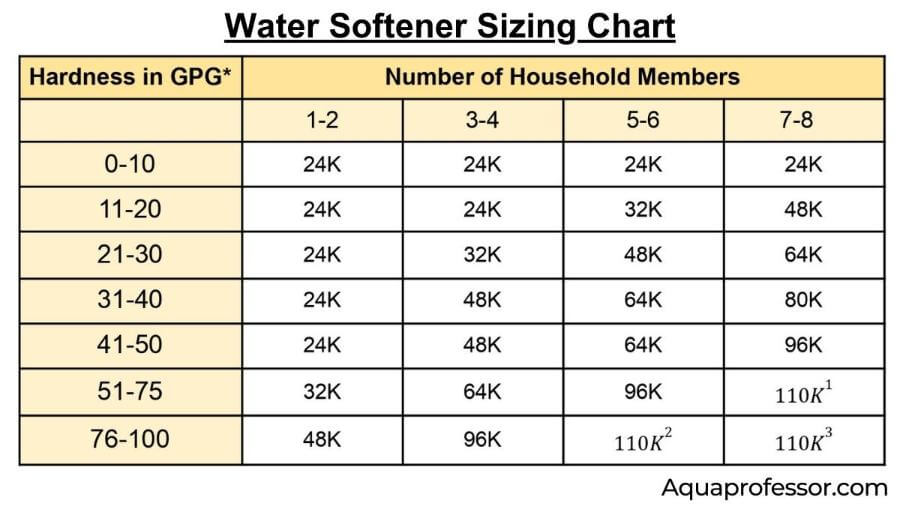 Water Softener Grain Chart & Calculator: Ultimate Cheatsheet
The "Iron Trap" Nobody Talks About
If your water has iron—and you’ll know if it smells like rusty pennies or leaves orange stains—you have to add a penalty to your math. Each part per million (ppm) of iron adds about 5 grains of hardness to your load. So, if you have 2 ppm of iron, add 10 more grains to your daily hardness number. Yeah, it’s annoying, but so is scrubbing orange toilet bowls.
Another sneaky factor: recharge efficiency. Bigger softeners actually use salt more efficiently. A 48,000-grain unit might use the same salt per regeneration as a 32,000-grain unit, but it cleans more water. Translation: buying a slightly larger softener saves you money on salt bags over a year. It’s the rare case where bigger is smarter, not just macho.
The "Just Right" Sweet Spot
For a standard 3-bedroom house with 3 people and 15 gpg hardness, a 30,000 to 35,000-grain softener is usually perfect. It’s the Goldilocks zone. Too small (say, 24,000 grains), and you’ll be regenerating every three days—wasting water and salt. Too big (like, 48,000 grains for just two people), and the unit won’t run often enough, letting bacteria grow in the resin bed. Gross.
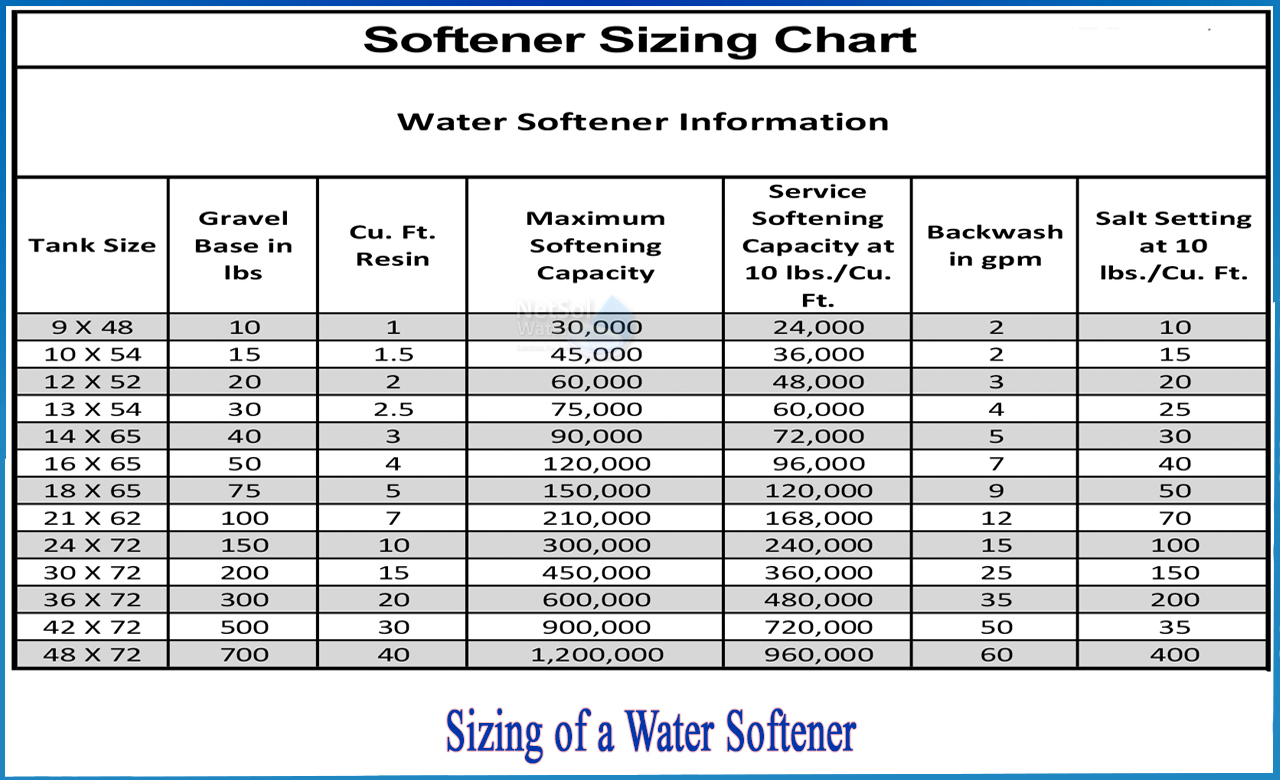 How to determine the proper size of a water softener
But here’s the irony: most people overestimate their needs. You don’t need a monster unit for a condo or a small apartment. A 20,000-grain unit for a single person with moderate hardness is plenty. Remember Kevin? He bought a 48,000-grain unit for his two-person home. He’s now using more salt than he does water. Don’t be Kevin.
The Final Trick: Talk to a Geek
If your head is spinning from grains and gallons, just call a plumber or your local water softener dealer. Tell them your number of people, hardness level, and iron content. A good tech will spit out the right size in 30 seconds. And if they try to upsell you a giant system? Walk away. You want efficiency, not a basement showpiece.
So, do the math, account for the iron, and size up slightly for safety. Your showers will feel like silky rain, your dishes will sparkle, and your pipes will thank you. And unlike my buddy Kevin, you’ll have a softener that works, not a monument to poor planning. Go forth and soften wisely. Your dishwasher deserves it.
