How To Register For Water Bill

Submitting to bureaucracy might sound about as fun as a root canal, but sorting out your water bill registration is oddly satisfying. It’s that first grown-up step that whispe...

Submitting to bureaucracy might sound about as fun as a root canal, but sorting out your water bill registration is oddly satisfying. It’s that first grown-up step that whispers, “Yes, I have my life together.” Think of it less as a chore and more as a ritual of domestic adulthood.
The process is simpler than choosing a Netflix show on a Friday night. Most municipal water authorities have realized that we live in the 21st century. You can usually do the whole dance from your sofa, in your sweatpants, with a cold brew in hand.
The First Step: Finding Your Water Soulmate
First, you need to know who provides your water. This isn’t a romantic mystery; it’s a digital one. Check your lease, ask your landlord, or poke around a recent property tax document. Usually, it’s your city’s public works department or a local utility company.
Must Read
Fun fact: The oldest water utility in the United States is the Boston Water and Sewer Commission, established in 1848. Think about that while you fill out their online form. You’re part of a 176-year-old tradition of civilized plumbing.
Once you know your provider, head to their website. Look for a button that says “New Account,” “Start Service,” or the very official-sounding “New Customer Registration.” Click it with confidence.
What You’ll Need (Gather Your Digital Ammo)
You can’t just roll up and say, “I live here!” You need proof. Have your government-issued ID ready—a driver’s license works beautifully. You’ll also need the property’s address and the date you want service to start.
Don’t forget the security deposit question. Many utilities ask for a deposit if you have a history of forgetting things (like paying bills). If your credit is decent, you might skip this step entirely. It feels like winning a small, quiet lottery.
Pro tip: Have a voided check or your bank account details handy. Most places want to set up automatic payments. It’s the ultimate “set it and forget it” move for the modern professional.
The Digital Dance: Filling Out the Form
Online forms are the Velcro of the modern world—they work, but they can be sticky. Take a deep breath. The form will ask for your name, social security number (or last four digits), and contact info. This is standard, not a scam.
 Recording and reporting - WaterNSW
A little cultural wisdom here: This is the same energy as signing up for a yoga studio membership. You provide your details, choose your plan (water is not a la carte, sadly), and accept the terms. The only difference is that yoga doesn’t keep your lawn alive.
If you hit a snag, look for a live chat bot. They are the digital receptionists of the utility world. They rarely judge you for asking about “turning on the wet stuff.”
The Fine Print (Don’t Skip This, Seriously)
You’ll encounter a section on rates and billing cycles. This is where you learn if your water is metered or flat-rate. Metered means you pay for what you use, like a gym vending machine. Flat-rate means you pay the same whether you take a 20-minute shower or a two-second rinse.
Here’s a fun life hack: Metered bills can actually save you money if you’re conservative with water. A five-minute shower uses about 10 gallons. A bath? That’s 35 gallons. Your wallet notices these things.
Look for a “paperless billing” checkbox. Check it. Future you will thank past you for not having a shoebox full of wet utility bills. Plus, it’s a tiny, quiet victory for the trees.
Verification and the Waiting Game
After you hit “Submit,” the system usually sends a confirmation email. This is the golden ticket. Save it. Screenshot it. Frame it digitally. It proves you did the thing.
If you’re moving in, call the utility two weeks in advance. That’s the sweet spot. Do it too early, and they forget. Do it too late, and you’re washing dishes with bottled water—a uniquely depressing scenario.
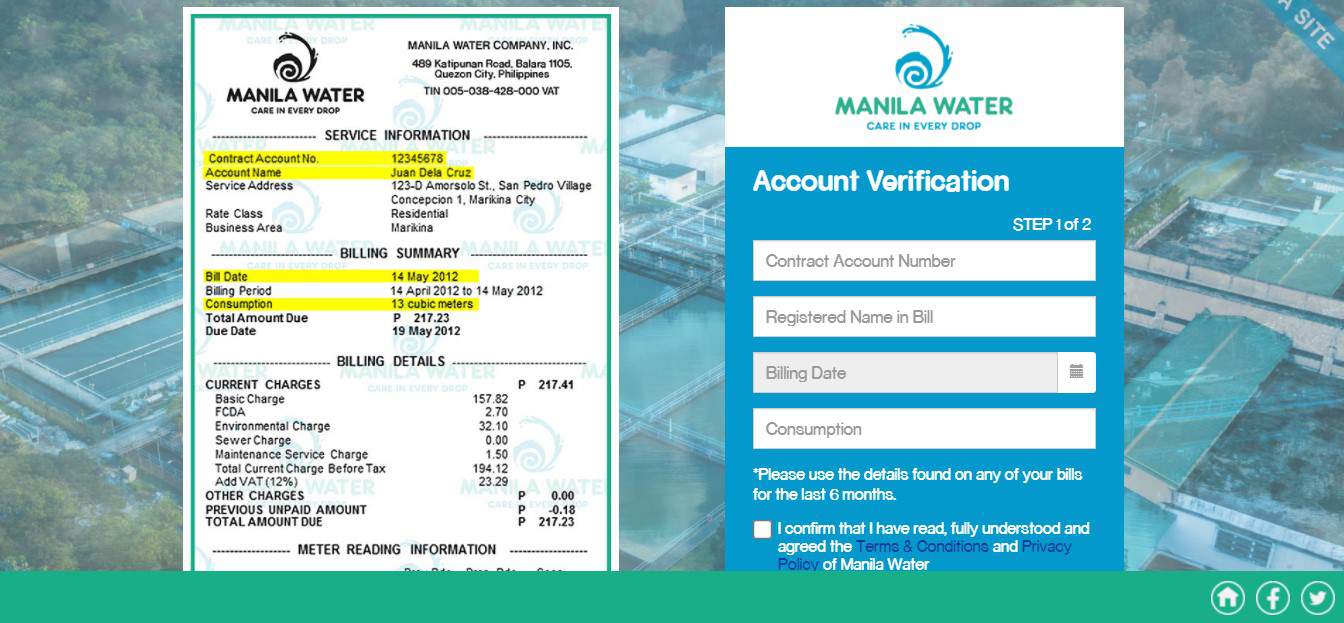 Simply Pay Manila Water using the Manila Water App and GCash - Making
Fun fact: The average American uses 82 gallons of water per day at home. That sounds insane until you realize it includes flushing (the biggest culprit), washing, and hydration. That’s 82 gallons of responsibility you’re now managing.
What If It Goes Wrong?
Sometimes, the system glitches. Maybe your address isn’t in the database. Maybe the website crashes. Don’t panic. Call the customer service line—preferably in the morning before lunch, when agents are still caffeinated and patient.
Keep a calm voice. Say, “I’m trying to register for water service at [address]. The online portal gave me a 404 error.” They’ve heard it before. They will fix it. You are not the first human to struggle with a dropdown menu.
If you’re renting, get your landlord to confirm the account is in their name first. Some cities require the property owner to start the service and then transfer it to you. It’s a little bureaucratic dance, but you can master the steps.
A Short Reflection on Daily Flow
Once the registration is done, a small miracle occurs. You turn on the tap, and water appears. It’s so immediate, so reliable, that we forget the invisible system behind it. That bill you registered for? It pays for the pipes, the treatment plants, and the people who make sure your morning coffee isn’t brown.
In a world of endless apps and subscriptions, registering for water feels grounding. It connects you to a communal infrastructure that keeps cities alive. Every time you fill a glass, you’re participating in a civil agreement.
So go ahead. Register. Pay your bill. Then take a long, guilt-free shower. You’ve earned it. After all, water is the only bill you actually can’t live without—and now you’re officially in charge of it.
