How To Remove Calcium Deposits

If your showerhead sounds like it’s wheezing through a bad cold, you’ve met the enemy: calcium deposits. Those chalky, white crustaceans aren’t just ugly—they’re the architect...

If your showerhead sounds like it’s wheezing through a bad cold, you’ve met the enemy: calcium deposits. Those chalky, white crustaceans aren’t just ugly—they’re the architectural proof that hard water has been throwing a long-term party in your plumbing. Whether it’s a faucet, a kettle, or your coffee maker, this mineral residue is essentially the exoskeleton of your daily water use.
Before you go full Breaking Bad with industrial acids, take a breath. Removing calcium deposits is more about clever chemistry and a little patience than brute force. Think of it as a spa day for your home—minus the cucumber water (which, ironically, also has calcium).
The Science of the Sponge: Why It Sticks
Calcium deposits, also known as limescale, form when hard water evaporates and leaves behind calcium carbonate. It’s the same stuff that makes up limestone, seashells, and the Great Pyramids of Giza—only less historic and more annoying. The trick to dissolving it lies in acidity. Calcium carbonate is alkaline, meaning it reacts beautifully with acids like vinegar, lemon juice, or citric acid. That’s right: the same stuff in your salad dressing can save your faucet.
Must Read
But here’s the party trick: hot liquids work faster. Warm vinegar dissolves scale about twice as quickly as cold vinegar. Think of it as a chemical dance where heat makes the molecules move faster, breaking down the crust like a bouncer at a club. Just don’t boil the vinegar—your house will smell like a pickle factory for days.
Your Go-To Arsenal: Kitchen Pantry Edition
You don’t need a chemistry degree or a hazmat suit. For most calcium deposit removal, reach for white vinegar first. It’s cheap, non-toxic, and works like a dream on showerheads, faucets, and coffee carafes. For tougher, thicker deposits on toilets or stubborn kettle bases, citric acid powder (often sold as a canning or baking ingredient) is a stronger, less-smelly option. And for glass shower doors that look like a crime scene, undiluted lemon juice cuts through the haze with a fresh scent that beats vinegar’s fume-y vibe.
A word to the wise: never mix vinegar with bleach or commercial cleaners. Doing so creates toxic chlorine gas, which is a very effective way to ruin your weekend—and your lungs. Stick to one acid at a time, and always test a small spot on delicate surfaces like marble or granite.
The Step-by-Step: From Faucet to Kettle
For showerheads and faucet aerators, fill a plastic bag with white vinegar, secure it around the fixture with a rubber band, and let it soak for two to four hours—or overnight if the deposit feels like ancient crust. Afterward, scrub gently with an old toothbrush, rinse with water, and watch the water flow like a mountain stream. Fun fact: Romans used vinegar to clean their aqueducts, so you’re channeling ancient engineering prowess.
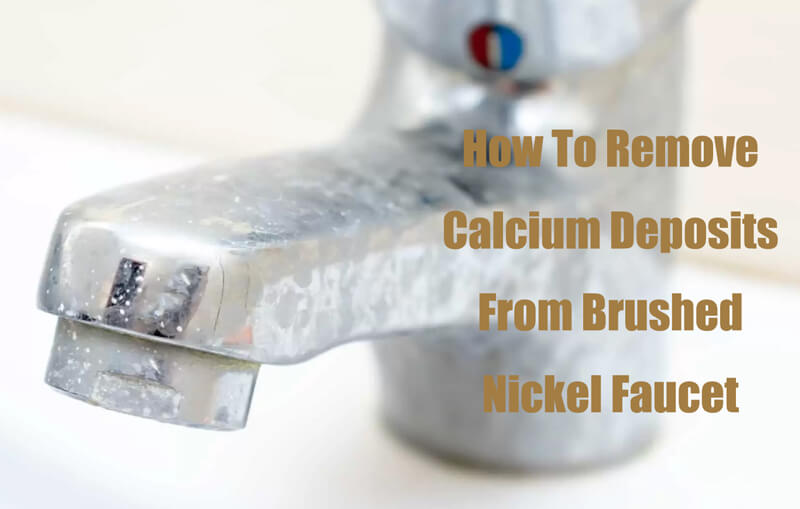 Calcium Removal From Faucets at Maggie Martinez blog
For coffee makers and kettles, run a cycle with equal parts water and white vinegar, then run two cycles of plain water to rinse. Avoid soap—it will foam up and taste bitter. For a kettle, simply boil the vinegar-water solution, let it sit for 30 minutes, then boil again with water. The scale will dissolve into a sad, dusty cloud that you dump down the sink.
Toilets and sinks require a slightly different touch. Pour a cup of white vinegar into the toilet bowl, let it sit for an hour, then scrub with a pumice stone (wet the stone first to avoid scratching). For sinks, make a paste of baking soda and vinegar—yes, it fizzes like a volcano science project—and scrub away. The reaction loosens deposits so they rinse off easily.
When the Manual Route Fails: Mechanical Help
Sometimes, especially on glass shower doors or tiles, deposits have gone beyond a chemical soak. In those cases, a pumice stone (wet, always wet) can physically scrape off thick scale without scratching. For glass, a razor blade held at a 45-degree angle can pop off stubborn spots—steady hands, please. Or try a magic eraser (melamine foam) for light haze; it’s basically a sanding block on a sponge.
If you’re dealing with a deposit that feels like geological sediment, a commercial descaler (like CLR) works fast. Just follow the label religiously—these are strong acids that can irritate skin and harm seals. Wear gloves, open a window, and channel your inner chemist.
Prevention: The Art of the Preemptive Strike
After you’ve removed the scale, keep it away by wiping down wet surfaces after use. A quick squeegee on the shower door takes ten seconds but saves you thirty minutes of scrubbing later. Install a water softener if your home has serious hard water—it exchanges calcium and magnesium for sodium, reducing deposits at the source. Think of it as hiring a bouncer for your pipes.
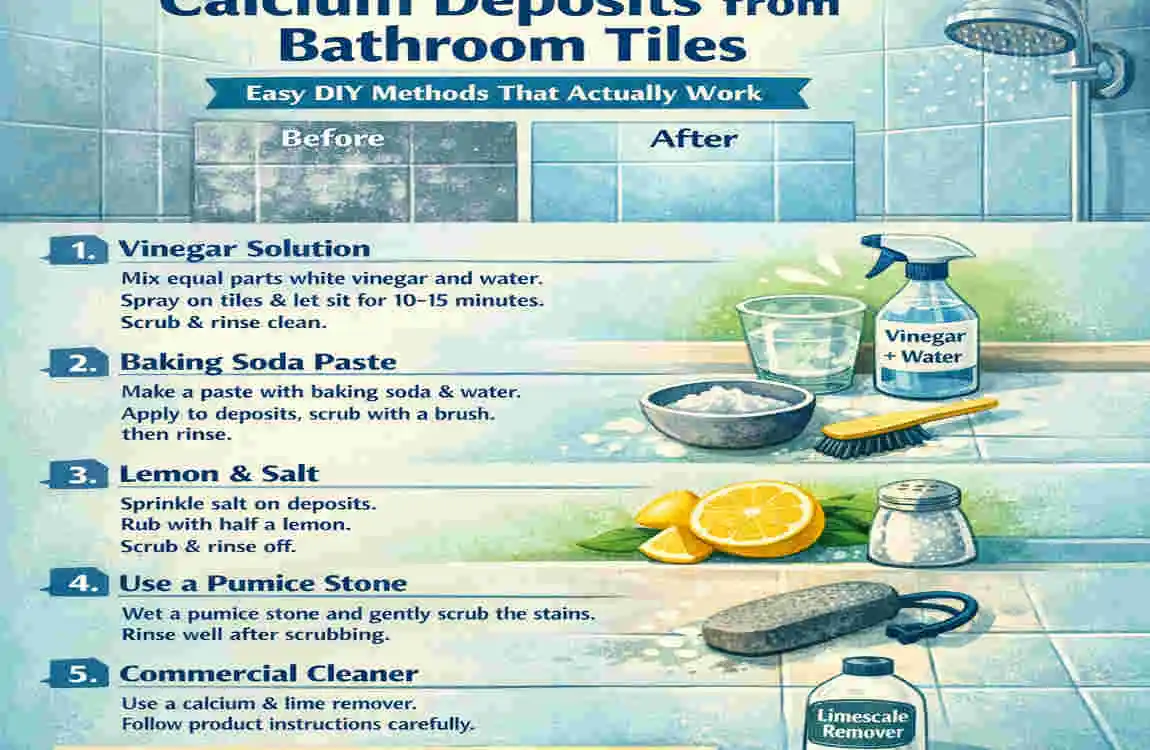 How to Remove Calcium Deposits from Bathroom Tiles: Easy DIY Methods
Fun little fact: Australia has some of the hardest water in the world, while the water in Scotland is so soft it barely leaves a trace. If you’re in a hard-water area, consider yourself in good company—the tap water in London is practically a mineral bath. But you don’t have to live like a limestone cave formation.
Cultural Side Note: The Power of Patience
In Japanese culture, the act of cleaning is seen as meditative—soji, or the practice of sweeping, is about mindfulness. Removing calcium deposits can be that, too. Instead of seeing it as a chore, channel that Zen energy. Turn on a podcast, pour yourself a glass of lemonade (ironic, no?), and watch the scale surrender to the vinegar. It’s oddly satisfying, like watching ice melt.
And if you really hate the smell of vinegar, add a few drops of lavender or tea tree essential oil to the bag. Your bathroom will smell like a spa that also does demolition work.
Reflection: The Quiet Victory of a Clean Surface
The next time you turn on a faucet that flows freely, or pour a cup of coffee that tastes like coffee and not old mineral dust, take a second to appreciate it. Removing calcium deposits isn’t just about aesthetics—it’s about returning your home to a state of effortless function. It’s a small, tangible victory in a world that often feels complicated. Life is already hard enough. Your water shouldn’t be.
So grab the vinegar, roll up your sleeves, and remember: you’re not just cleaning scale. You’re reclaiming your time, your appliances, and your sanity—one chalky spot at a time. Now go rinse.
