What Is The Ideal Ph Of Water

So there I was, staring at a fancy glass bottle of water that cost more than my lunch. The label bragged about a pH of "8.8" with a picture of a serene mountain stream. My bud...

So there I was, staring at a fancy glass bottle of water that cost more than my lunch. The label bragged about a pH of "8.8" with a picture of a serene mountain stream. My buddy, a self-proclaimed health guru, swore it cured his afternoon slump. I took a sip... and honestly? It just tasted like water. Maybe a little smoother, but my wallet definitely felt lighter.
That’s when I fell down the rabbit hole. What is this mystical "pH" number everyone is obsessing over? Is your tap water at home somehow toxic because it’s not a perfect 7? Let’s cut through the hype, shall we?
pH 101: Acid, Base, and Your Aquarium
First, a quick science flashback (don’t worry, no pop quiz). pH simply measures how acidic or alkaline a substance is, on a scale from 0 to 14. A pH of 7 is neutral—think pure distilled water. Below 7 is acidic (like lemon juice), and above 7 is alkaline (like baking soda).
Must Read
Your stomach? It’s a raging acid bath at a pH around 1.5 to 3.5. That’s great for digesting pizza, but terrifying for a sippy cup. So when you drink water with a pH of 8.8, it hits that stomach acid and gets neutralized instantly. Poof. The body is a master regulator.
The "Ideal" Myth: Is it 7.0?
Most people assume the ideal pH of drinking water is a perfect 7.0. Wrong. Pure water is neutral, but it also tastes flat and boring because it’s stripped of minerals. Tap water typically ranges from 6.5 to 8.5, and it’s perfectly fine.
Your body doesn’t care what number your water is. Seriously. Your blood pH is locked in a very tight range of 7.35 to 7.45. If you drink something super alkaline, your kidneys and lungs work overtime to kick the excess out into your urine. Congratulations, you just made very expensive pee.
The Big Marketing Hype (and the tiny truth)
You’ve seen the ads: "Alkaline water balances your body’s pH!" I call bunk. Unless you have a specific medical condition like kidney disease, your body balances itself just fine. Drinking high-pH water won’t "de-acidify" you because your blood doesn’t work that way.
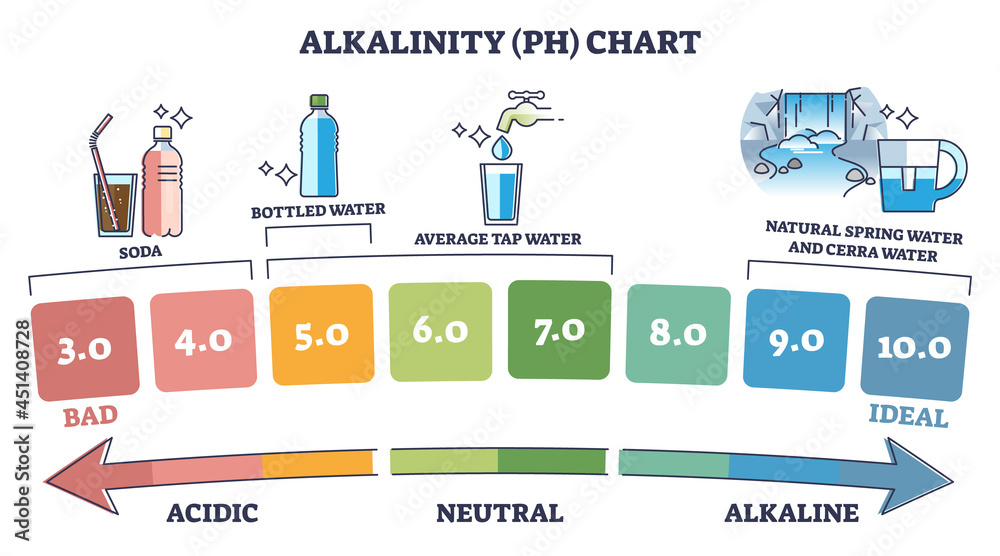 Póster Alkalinity PH chart with water acidity from bad to ideal outline
That said, there is a tiny kernel of truth for some people. A 2012 study suggested that alkaline water with a pH of 8.8 might help deactivate pepsin, an enzyme linked to acid reflux. So if heartburn is your nemesis, it might offer temporary relief. But it’s not a cure, and it’s certainly not a health necessity for the rest of us.
What Actually Matters More Than the Number
Here’s the thing I wish someone told my friend at the fancy water aisle: Mineral content matters way more than pH. Water that naturally has a higher pH (like from a limestone spring) usually contains calcium, magnesium, and potassium. Those minerals are legitimately good for you.
But a bottle of artificially alkalized water? It’s just water zapped with electricity or passed over rocks to raise the pH. It has zero extra minerals. You’re paying for a number that your body ignores. Ouch.
So, What Is the Ideal pH?
After all that, you want a straight answer. Fine. For drinking water, the ideal pH is whatever comes out of your tap that’s safe. The EPA says safe drinking water can be between 6.5 and 8.5. That’s a wide range.
 P H Water Diagram
But if you’re growing plants? Or keeping goldfish? Different story. For a betta fish tank, you want 6.5 to 7.5. For your morning coffee, acidic water (pH 5-6) actually extracts flavor better. For your garden, slightly acidic soil (pH 6-7) is usually best.
Notice a pattern? The "ideal" pH depends entirely on the context. For your body, it’s a non-issue.
The Bottom Line (and a Little Irony)
So my health-guru buddy? He’s still buying the expensive alkaline water. It makes him feel proactive, and hey, placebo effects are real. If drinking fancy pH water gets you to hydrate more, do it. Just don’t fool yourself into thinking it’s medicine.
Me? I’ll stick to filtered tap water. It’s clean, it has trace minerals, and it costs pennies a gallon. My body neutralizes it in seconds, and my wallet stays happy. That feels like the ideal balance.
Now, if you’ll excuse me, I need to go test the pH of my iced tea. For science. (And for the lemons, obviously.)
