How Does An Ice Machine Work

Let’s be honest: until the moment that ice maker in your kitchen or office breaks, you never really think about it. You just expect a cascade of perfect little cubes to fall i...
Let’s be honest: until the moment that ice maker in your kitchen or office breaks, you never really think about it. You just expect a cascade of perfect little cubes to fall into your glass, like magic. But when that magic stops, you suddenly realize how much you relied on that frozen miracle for your iced tea, your hangover cure, or just cooling down a hot slice of pizza.
So, how does this silent, plastic wizard actually work? It’s surprisingly simple, and a little bit hilarious when you break it down.
It All Starts with a Simple Wish (and a Switch)
You open the freezer door, and you yearn for ice. Maybe you hear a faint click or a hum. That’s the machine sensing the ice bin is low.
Must Read
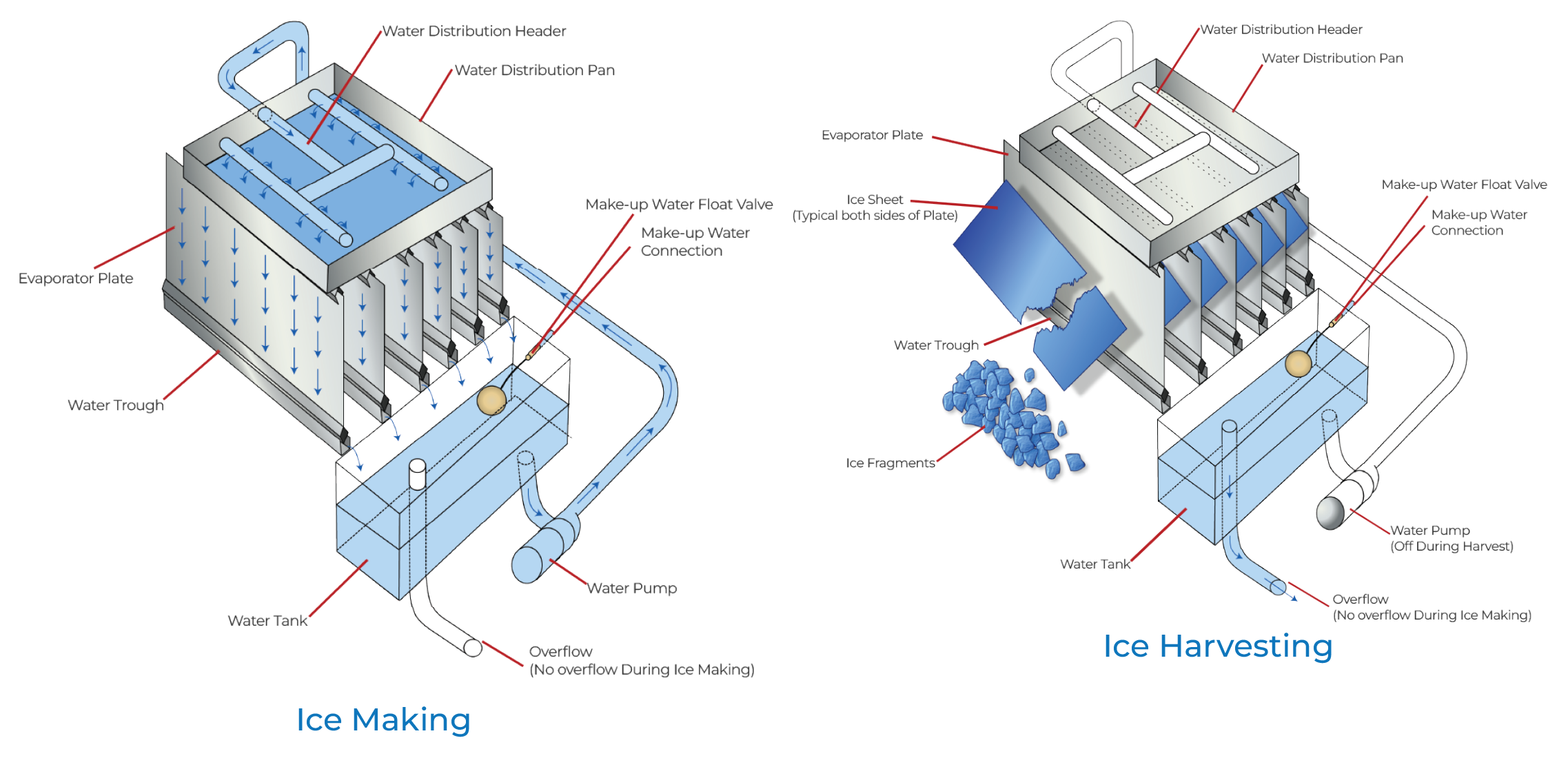
It’s like a tiny, hyper-efficient worker who hates doing nothing. The machine says, “Alright, boss, time to make some rocks.” It then opens a small water valve, letting fresh water flow into a metal tray.
This isn’t just any water. It’s usually filtered water, because ice makers are snobs about taste. They know that tap water can make cubes taste like last week’s gym sock.
The Cold, Hard Truth About Freezing
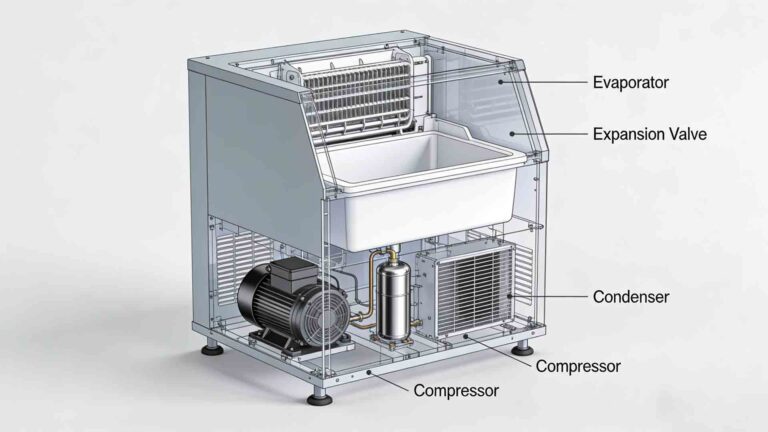
Now, the cooling system kicks in. This is where the freezer gods do their work. The machine circulates a special refrigerant gas through coils that wrap around the ice mold.
Think of it as a snake slowly hugging the water until it freezes. But here’s the clever part: it doesn’t freeze the whole block solid. It freezes from the outside in.
If you’ve ever pulled out a cube that looks clear and has a little cloudy center, you’ve seen this process in action. The clear part? That’s pure, frozen water. The cloudy part is usually trapped air or minerals that got kicked out.
The Big Flip: The Part You Never See
Once the ice is thick enough, the machine does something you’d do if you were trapped in a box: it flips the whole tray upside down. This is the most satisfying part to imagine.
It’s like a gymnast doing a dismount. The tray rotates, and the ice cubes, now slightly thawed at the mold’s surface, plop out into a collection bin below.
 Understanding the Inner Workings of a Commercial Ice Machine: A
If they don’t fall easily, the machine might warm the tray slightly. Yes, it uses a little heat to pop them free. It’s basically saying, “I froze you, now I’ll be nice, but you have to leave.”
Why Are Some Cubes Hollow or Crescent-Shaped?
Ever noticed that weird, crescent moon shape some office ice makers produce? That’s not a design flaw; it’s a feature of a specific type of machine.
Those are made by a “nuggett ice” machine, which actually shaves and compresses ice into little soft pellets. They’re basically snow cones that come out of a spout.
The more common cube-shaped ice comes from a slower, more traditional cycle. It’s like comparing a sports car (fast nuggets) to a luxury sedan (solid, slow cubes). Both get you to a cold drink, but one does it with more drama.
The Never-Ending Party
Once the cubes drop into the bin, the machine resets its little brain. It fills the tray again, freezes again, and flips again. It does this all day and all night, even while you sleep.
This is the silent rhythm of your kitchen. You take a cube out for your whiskey. An hour later, the machine has already made another one to replace it. It’s like a loyal, frozen dog that never complains.
But here’s the joke: if you don’t use the ice, the bin fills up. Then a sensor—usually a light beam or a metal arm—says, “Whoa, we’re full.” And the machine stops.
 How Does a Commercial Ice Maker Work? The 2026 Technical Guide
It’s smarter than most people. It knows when to quit. It won’t keep making ice until it overflows your freezer and buries the frozen peas.
When It Betrays You (The Sad Part)
Of course, like all good appliances, an ice machine will eventually have a tantrum. You’ll open the freezer and find a massive block of ice that looks like a glacier.
That’s a “clump.” It happens when the machine gets too cold, or the drain gets clogged. Suddenly, your helpful little worker has created a frozen monster that you have to chip away with a butter knife.
Or worse, you hear a loud, grinding noise—chunk, chunk, grind—and realize the machine is trying to flip an empty tray. It sounds like a robot having a bad dream. That’s usually a sign you need to call a repair guy, or just swear at it until your drink warms up.
The Takeaway: Celebrate the Cube
So the next time you hear that satisfying thud of ice hitting plastic, give it a nod. That machine just went through a whole freezing cycle just for you.
It used chemistry, physics, and a little bit of stubbornness to turn tap water into a solid, cold friend. It’s a quiet hero, constantly making sure you never have to drink a warm soda again.
And if it ever breaks? Well, now you know exactly how to explain to a friend why you’re suddenly buying bagged ice from the gas station. You can say, “My ice machine is on strike. The flipping mechanism is having an existential crisis.” They’ll nod. They know.
