What Is Purest Form Of Water

Let’s be honest: we all think we know water. It comes out of the tap, it fills our coffee maker, and it pours from the sky. But have you ever stopped mid-sip and wondered, “Wh...
Let’s be honest: we all think we know water. It comes out of the tap, it fills our coffee maker, and it pours from the sky. But have you ever stopped mid-sip and wondered, “What’s the purest form of water, anyway?” It’s a great question, and the answer might surprise you—and even make you smile.
Spoiler alert: it’s not the bottled stuff at the gas station. The purest form of water is actually rainwater—at least, right when it’s born.
Think of it like a fresh start
Picture a raindrop forming high in the clouds. It starts as vapor, a ghostly wisp, free from the dirt, minerals, and chemicals we’re used to on the ground. That little droplet hasn’t touched a rusty pipe or sat in a plastic bottle yet. It’s as close to pure H₂O as nature gets.
Must Read
It’s like a brand-new notebook—no scribbles, no coffee stains, just crisp, clean potential. But then, gravity happens, and that purity gets a little complicated.
Your tap water is a party guest (with baggage)
Now, compare that to the water in your kitchen sink. Tap water is like that friendly neighbor who shows up to a barbecue with a six-pack and a questionable story. It’s safe and it works, but it’s carrying extra stuff: minerals like calcium and magnesium, trace amounts of chlorine, and maybe a hint of whatever’s in the pipes underground.
That’s not a bad thing—it’s actually good for your teeth and bones. But it’s not pure in the scientific sense. It’s a solution, not a solo act.
Distilled water: the shy cousin
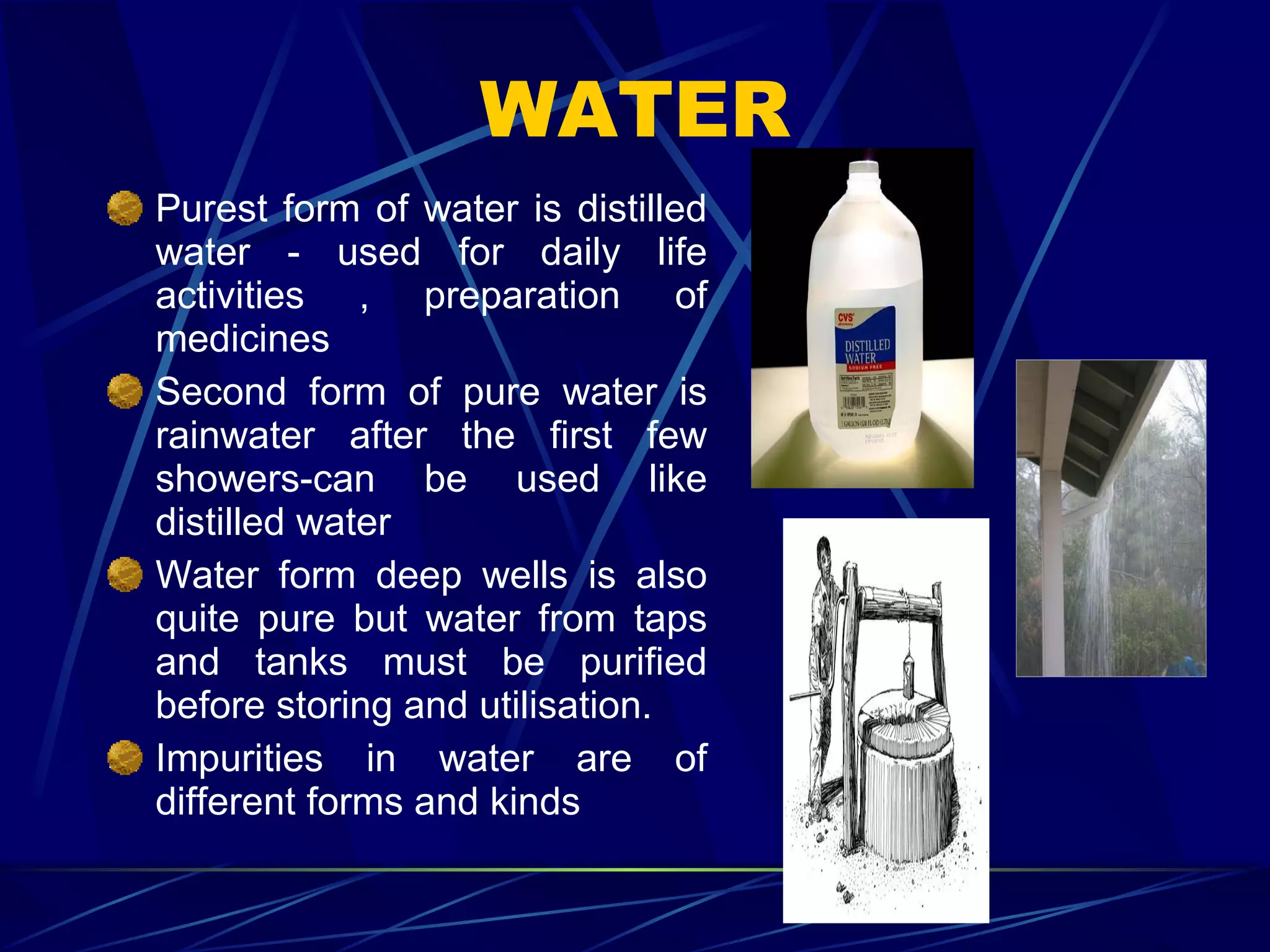
If you want to get as close to pure as possible in your kitchen, you might try distilled water. It’s made by boiling water, catching the steam, and condensing it back into liquid. Think of it as a do-over—all the impurities are left behind, like a bad roommate who missed the rent.
Distilled water is so pure it can taste flat, almost sad. It’s the quiet kid at the party who just stands in the corner. And it’s not great for everyday drinking—your body actually likes a little of those minerals. But for your iron or car battery? It’s perfect.
 Pure Water - What Is It For? (Useful Guide)
Let’s talk about icebergs (because why not?)
You’ve probably heard that glacier or iceberg water is the purest. That’s partly true. Icebergs are made from compressed snow that fell hundreds, even thousands of years ago. That snow was once rainwater from a time before factories and car exhaust. It’s like a time capsule of ancient purity.
But even icebergs aren’t perfect. As they float through the ocean, they might pick up a little salt or sea spray on their outer layers. And melting them means you’re drinking water that’s been frozen in a very long nap—charming, but not exactly “pure” in a lab sense.
The science-lab version of pure
Here’s where it gets nerdy, but stick with me. The only way to get scientifically pure H₂O—with absolutely nothing else in it—is to use a process called deionization. That’s where you zap water with electricity to remove every charged particle. It’s so pure that it’s actually dangerous to drink in large amounts. It can rob your body of electrolytes.
It’s like ordering a pizza with absolutely nothing on it—no cheese, no sauce, just dough. Technically pizza, yes, but nobody dreams about that. Pure water, in the lab, is a tool, not a treat.
So why should you care?
You might be thinking, “Okay, cool story, but does this change how I hydrate?” The answer is a gentle yes. Knowing the purest form of water helps you appreciate what’s actually good for you. You don’t need to chase purity like a unicorn. Your body needs balance, not a chemistry project.
 PPT - WATER PowerPoint Presentation, free download - ID:2410388
When you fill your glass from the tap or your reusable bottle, you’re getting water that’s been treated and tested. It’s the reliable friend who shows up on time. And rainwater, while pure in the sky, picks up pollutants the moment it hits a roof. So please, don’t drink the runoff from your gutter. That’s not purity—that’s a science experiment gone wrong.
A little story from my kitchen
Last summer, my kid asked me why the water from the fridge tasted different than the hose water outside. I said, “Because the fridge water is filtered and purified a bit, but it’s still not the purest stuff in the world.” He looked at me with big eyes and asked, “So what is?” I pointed to the glass of ice I’d just made. “That ice started as tap water, but when it froze, the impurities got pushed to the edges. So technically, the center of each ice cube is the purest water in our house right now.”
He spent the next hour melting ice cubes in a bowl, trying to drink the middle part. It was adorable, messy, and honestly, he didn’t taste a difference. But he felt like a scientist. And that’s the point: purity is a wonderful concept, but everyday water is where the real magic happens.
The warm, fuzzy takeaway
So here’s your fun fact for the next dinner party: the purest form of water you can actually drink is fresh, clean rainwater caught before it touches the ground—but don’t do that unless you live in a pristine forest. For the rest of us, tap water is a champion of convenience and safety.
Water isn’t supposed to be a perfect, single mystery molecule in an empty room. It’s a social creature, picking up little flavors and minerals along its journey. That’s what makes it alive. So go ahead, pour yourself a glass of that tap water, ice cube center and all. It’s pure enough for you—and that’s what matters.
Now, go hydrate. And maybe save the deionized water for your science fair project.
