How To Reduce Water Hardness

So, you’ve got a case of hard water. That’s the stuff that leaves your skin feeling like sandpaper, your coffee tasting like a tragic science experiment, and your showerhead l...

So, you’ve got a case of hard water. That’s the stuff that leaves your skin feeling like sandpaper, your coffee tasting like a tragic science experiment, and your showerhead looking like a stalactite you’d find in a haunted cave. I’m talking about calcium and magnesium—two minerals that are apparently having a party in your pipes without inviting you. They’re the clingiest guests ever, and they leave a white, chalky mess everywhere.
But here’s the real kicker: hard water isn’t dangerous. It won’t turn you into the Hulk or give you superpowers (sadly). It just makes your life mildly annoying—like a sibling who borrows your car and returns it with half a tank of gas and a weird smell. According to the US Geological Survey, 85% of American homes have hard water. That’s basically a national epidemic of bad hair days and dull laundry.
The Boil-and-Wait Gambit (A.K.A. The Old-Fashioned Way)
You can boil your water. It sounds too simple, right? Well, it works—sort of. When you bring hard water to a rolling boil, the calcium carbonate throws a tantrum and turns into solid sediment, which you can then strain out with a coffee filter. It’s like making a terrible, mineral-flavored tea that you then throw away.
Must Read
The downside? This takes forever, and you look like a medieval alchemist hunched over a pot. Plus, you only get a few glasses at a time. Imagine boiling water for your entire morning shower—your electric bill would skyrocket, and your neighbors would think you’re running an illegal brewery. Please don’t boil your shower water.
Enter the Water Softener (The Nuclear Option)
If boiling is a water pistol, a water softener is a tactical nuke. This machine uses a process called ion exchange. Basically, it swaps those pesky calcium and magnesium ions for sodium ions. Yes, salt. Your water gets slightly saltier, but not in a “lick the tap” way—more like a “your soup tastes better” way.
Here’s a fun fact: a standard water softener adds about 20 milligrams of sodium per liter of water. That’s less than a slice of bread. So unless you’re on a strict no-taste diet, you’ll survive. The machines cost a few hundred bucks, but they’re a godsend if you love shiny faucets and soap that actually lathers. Just be ready to haul heavy bags of salt from the grocery store like a water superhero.
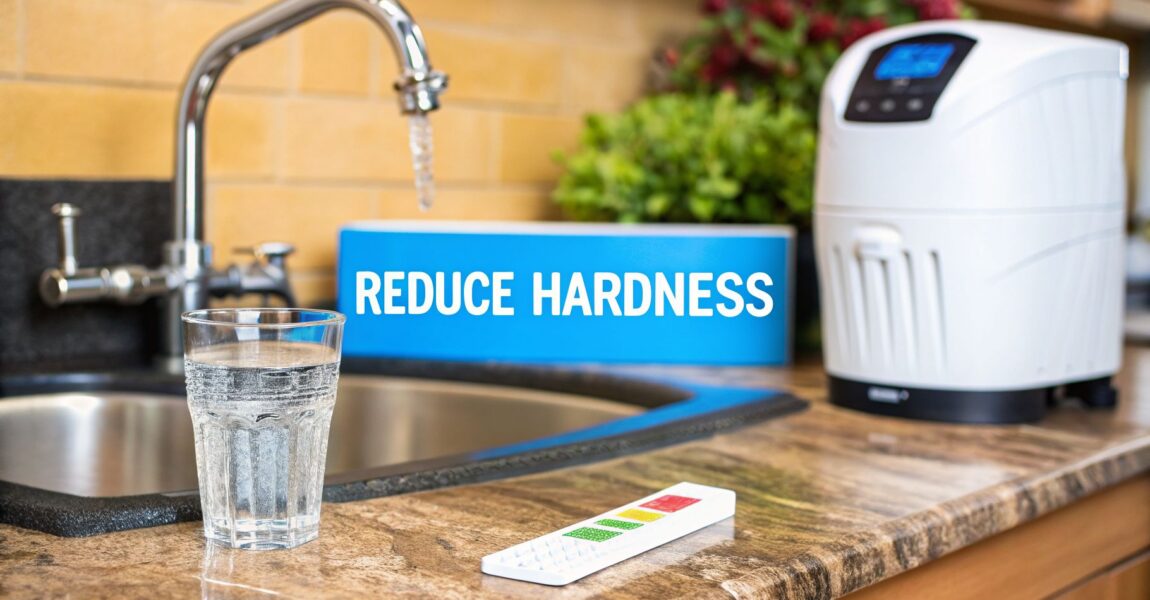 Your Ultimate Guide on How to Reduce Water Hardness at Home
The Magnet Scam (Don’t Fall for It)
You might see ads for magnetic water softeners. They promise to zap your water with electromagnetic voodoo and make it soft. Do not buy these. They are about as effective as using a rubber chicken to fix a leaky pipe. The science says they don’t work. It’s a $100 paperweight that makes your pipes look slightly more futuristic.
I once saw a guy on a forum swear by his magnetic system, claiming it “changed his life.” Then he admitted he hadn’t actually measured the water hardness before or after. Classic confirmation bias. Don’t be that guy. Save your money for something useful, like a good cheese grater.
Vinegar: The Kitchen Sink Hero
You don’t need fancy machines for small-scale softening. White vinegar is the underdog champion. The acetic acid in vinegar dissolves calcium carbonate like a ninja in the night. Run a cup of vinegar through your coffee maker, and it will come out tasting like a dream instead of a chalkboard eraser. Soak your showerhead in a bag of vinegar overnight, and watch the crusty bits float away like tiny mineral ghosts.
Fair warning: your kitchen will smell like a pickle factory for an hour. But that’s a small price to pay for clean glassware that doesn’t look like someone sneezed on it. One shocking stat: 80% of water spots on dishes are just hard water minerals. Vinegar is basically your dishmop’s best friend.
 Your Ultimate Guide on How to Reduce Water Hardness at Home
The No-Device Hack: Baking Soda and a Filter
If you’re cheap (I prefer “frugal”), get a pitcher filter like a Brita. These don’t remove hardness completely, but they cut it down a bit. Add a pinch of baking soda to your wash water—it raises the pH and helps soap work better. This won’t fix a busted pipe, but it will make your laundry less stiff. Think of it as a band-aid for your water woes.
One bizarre fact: hard water can actually increase the lifespan of your pipes by forming a protective layer. So while you’re fighting the mineral war, your plumbing is secretly thanking you. It’s like that annoying roommate who leaves dishes in the sink but also pays rent on time.
The Bottom Line (No Pun Intended)
Look, you don’t have to live with crunchy towels and scaly glassware. You have options: boil, soften, vinegar, or just embrace the mineral madness. If you’re a total nutcase, you could even collect rainwater and use that—but then you’re fighting gravity and weather, which is a whole other circus.
My advice? Start with a simple vinegar rinse. If that sends you into a frenzy of clean, go buy a softener. And whatever you do, skip the magnets. Your water will never be perfectly soft, but it can be okayish. And isn’t that what we all want? A slightly less crusty life? Go forth and conquer the scale. Your coffee maker deserves it.
