How To Read Your Water Metre

Okay, so you’ve just stared at your water metre like it’s a spaceship control panel, right? I get it. Those little dials and number wheels can feel like they’re speaking ancie...

Okay, so you’ve just stared at your water metre like it’s a spaceship control panel, right? I get it. Those little dials and number wheels can feel like they’re speaking ancient Greek. But here’s the truth: reading your water metre is easier than assembling IKEA furniture without losing a screw. And way less frustrating.
First, you need to find the thing. It’s usually hiding in a metal or plastic pit near the street, or tucked in your basement or garage—like a shy gremlin. Pop the lid off carefully (some lids are surprisingly heavy, so don’t throw your back out). If it’s dusty, give it a little blow or wipe. You’re not performing brain surgery here.
Now, look at the face. Most metres have a big row of numbers—like an odometer in a car. Ignore the red numbers or the small clock-like dials for now. Those are testers and fractions, and they love to confuse you. Your mission is the white or black big digits on the left. That’s your total water usage in cubic metres or gallons. Seriously, that’s it.
Must Read
Wait, what’s a cubic metre?
A cubic metre is roughly 1000 litres—or about the amount of water in a small kiddie pool. Fun fact: one cubic metre equals about 220 gallons if you’re old-school (or a Brit with a weirdly specific conversion chart memorised). You don’t need to do math now. Just write down the number you see.
Let’s say your metre reads 03498. That means you’ve used 3,498 cubic metres since it was installed. The last digit (the 8) is the small stuff. It’s okay if it spins slowly—that’s just water molecules being dramatic. The key trick? Ignore the numbers after the decimal point or the tiny sweeping dial unless you’re checking for a leak.
How to check for a sneaky leak
Here’s where it gets playful. Turn off all water inside and outside your house. No toilets running, no washing machine finishing a cycle, no kids sneaking a sip. Then, go stare at your metre. If that little red triangle or star-shaped dial is still spinning? You have a leak. That little bugger is the “leak indicator.” It’s like a tiny angry bird pointing a wing at your problem.
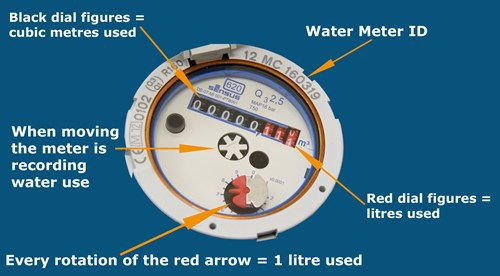 Reading your meter - Kāpiti Coast District Council
Write down the metre reading now. Then wait two hours without using water. Go have a coffee, binge a show, or argue with your houseplant. Come back and check the number again. Did it change? If yes, you’ve got a water gremlin. Call a plumber before your wallet cries.
No spinning indicator and steady number? You’re a water-reading champion. Give yourself a high five—you just saved yourself potential bills and undiscovered garden swamp problems.
Reading the old-school dials (the scary ones)
Some metres—especially ancient ones—have multiple little clocks with spinning hands. They look like a toddler’s art project. Don’t panic. Each dial measures a different decimal place. Start with the largest dial (usually the one marked “100,000” or “10,000”) and work clockwise. Read each hand’s lower number if it’s between two digits. Write them left to right. Boom—you’ve read the riddle.
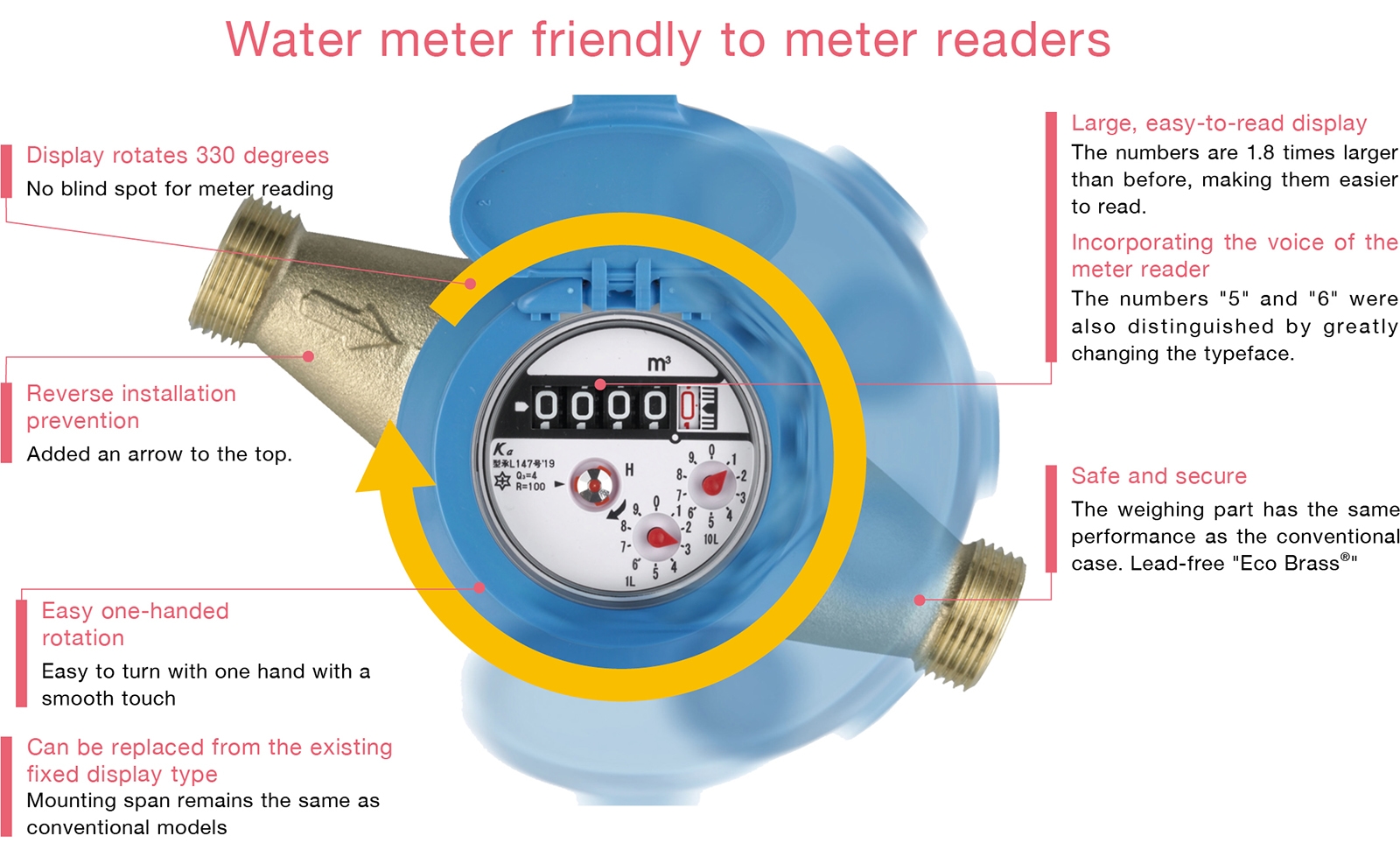 Water Meter Reading Example
Example: if the 100,000 dial points to 3, the 10,000 dial to 9, the 1,000 dial to 4, and the 100 dial to 7, your reading is 3,947. You’ve done it. Now you’re basically a certified plumber-in-training. Or at least you can sound smart at a block party.
But why bother in the first place?
Because your water bill isn’t a magic fortune cookie. Reading your own metre helps you catch billing errors (they happen more than you think) and track if that new sprinkler system is secretly a water-guzzling monster. It also lets you play detective when your landlord or neighbour insists you used 10,000 litres last month. Spoiler: you didn’t—your metre says 1,200.
Plus, it’s a low-key party trick. Imagine casually saying, “Oh, our pool fill set us back 15 cubic metres,” while everyone stares at you like a water wizard. You’ll have nothing to lose except a few minutes of awkward crouching. Go on, give it a read—your future self (and your bank account) will thank you.
And if you get stuck? Just take a photo of your metre and squint at it angrily. Then show a friend or call your utility company. They’ve seen weirder things—I promise. Water metres are simple once you remember: big numbers, ignore the spinny bits, watch for leaky triangles. You’ve got this. Now go kneel down in your backyard like a water-reading warrior.
