How Much Does A Well Cost

So, you’re thinking about drilling a well. Maybe you’re tired of that monthly water bill that feels like a tiny mortgage. Or perhaps you just want to be your own water boss—a...
So, you’re thinking about drilling a well. Maybe you’re tired of that monthly water bill that feels like a tiny mortgage. Or perhaps you just want to be your own water boss—a true aqua-entrepreneur.
Well, let’s dive right into the big question everyone asks: How much does a well cost? Grab a snack, because we’re about to dig into the numbers. And trust me, it’s way more interesting than watching paint dry on a water tank.
The Short Answer (No, You Can’t Just Buy One on Amazon)
Here’s the honest truth: a well isn’t a one-size-fits-all purchase. It’s like buying a car, but instead of picking a color, you’re picking a hole in the ground.
Must Read
Most homeowners end up spending between $3,500 and $15,000 for a fully installed residential well. That’s a wide range, right? It’s like the price of a good used sedan versus a slightly fancier used sedan.
But wait—before you start digging with a spoon in your backyard, let’s break down what makes that price go up or down. Spoiler: it’s mostly about how deep you have to go and what kind of ground you’re drilling through.
Depth: The Deeper You Go, The More Dough You Toss
Drilling a well is a lot like ordering a pizza—the deeper the toppings, the higher the bill. Except instead of pepperoni, you’re paying for steel casing and drill bits.
A shallow well (say, 50 to 100 feet) might cost you $3,000 to $6,000. That’s the budget-friendly option, like ordering a small cheese pizza. But if you live in an area where water hides 300 feet down, you’re looking at $10,000 to $15,000 or more. That’s the “extra-large with all the toppings and a delivery fee” price tag.
And here’s a little kicker: some wells go 500 feet deep. At that point, you’re not just drilling for water—you’re practically drilling for a subterranean vacation home.
The Ground Type: Hard Rock vs. Soft Dirt
Think of drilling as a battle between your wallet and the earth’s crust. Soft soil? Easy peasy. Think sandy soil or clay—the driller’s happy place.
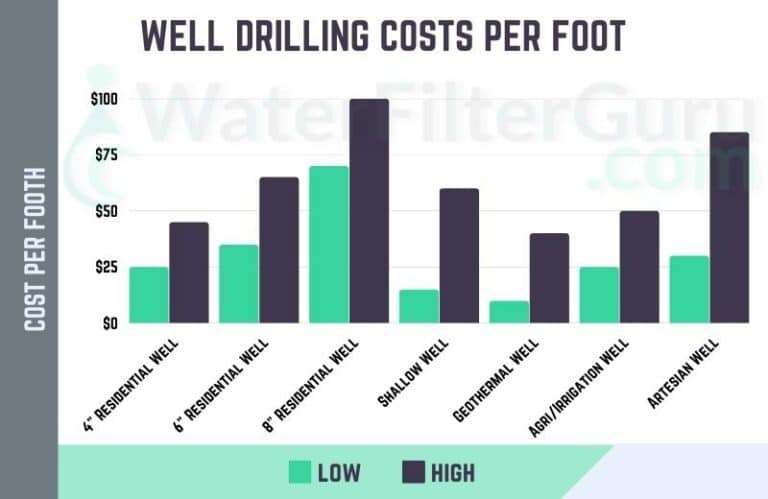
But if you hit solid rock—like granite or shale—the price jumps because it’s slow and tough. Drilling through rock can cost $50 to $75 per foot, while soft ground might only run $30 to $50 per foot. It’s like the difference between slicing butter and trying to cut a frozen steak with a plastic knife.
![How Much Does It Cost to Drill a Well? [2025 Data] - Get A Site Plan](https://getasiteplan.com/wp-content/uploads/2024/12/well-drilling-price-range-per-foot.jpg) How Much Does It Cost to Drill a Well? [2025 Data] - Get A Site Plan
How Much Does It Cost to Drill a Well? [2025 Data] - Get A Site Plan
So before you get a quote, ask your driller: “What’s our ground situation?” If they say “rocky,” just mentally add a few hundred bucks to your budget. And maybe a stress-relief massage.
The Parts That Make It Cost More (But Totally Worth It)
You don’t just get a hole and a straw. A well is a whole system. You need a pump, a pressure tank, and something called a “pitless adapter” (which sounds like a plumbing superhero, honestly).
A decent pump and tank alone can cost $1,000 to $2,500. Installation adds more. And if you want fancy stuff like a water filtration system? That’s another $1,000 to $4,000. Your well water might be pure, or it might taste like a rusty penny. Filters fix that.
Also, don’t forget the permit. Yes, you need a permit to poke a hole in the earth. It usually costs between $200 and $800. It’s a little annoying, but it’s better than getting a fine from a grumpy inspector named Gary.
Hidden Costs: The “Whoops, I Forgot About That” List
Curious about water testing? You’ll need it. That’s about $100 to $300. And if you’re in a remote area, the driller might charge a mobilization fee (fancy talk for “I drove a huge truck to your house”). That can be $500 to $1,000 just for showing up.
Oh, and if the driller hits a dry hole? Yeah, that happens. They usually charge per foot whether they find water or not. It’s like paying for a meal you never got to eat. Always ask about “dry hole” policies before they start. Seriously. It’s the most important question you’ll ask all year.
The Good News: You’re Investing in Freedom
Okay, so a well might cost a pretty penny upfront. But once it’s in, your water is basically free (minus a tiny electricity bill for the pump). No more monthly water bills. No more worrying about city water restrictions during a drought.
 How Much Does a Well Cost? (2024 Well Drilling Cost Guide)
Plus, well water often tastes amazing. It’s like nature’s bottle service, delivered straight to your sink. Your friends will be jealous. Your plants will throw a party.
And here’s the kicker: a well adds value to your property. If you ever sell your house, a working well is a huge selling point. It’s like having a gold mine in your backyard—except it’s wetter and doesn’t attract dwarves.
Final Numbers (So You Can Plan Your Budget)
Let’s wrap this up with some ballpark totals. For a typical 200-foot well in average soil, with a pump and tank, you’re looking at $8,000 to $12,000. That’s about the price of a nice vacation to Hawaii—but this vacation lasts forever and gives you water.
If your situation is fancy (deep, rocky, complex), budget up to $20,000. That’s a lot, yes. But it’s also a one-time cost for decades of water. Do the math: $20,000 divided by 30 years is less than $600 a year. That’s cheaper than most cell phone plans.
So go ahead. Call a local well driller. Get a quote. And remember: you’re not just paying for a hole in the ground. You’re buying independence, great-tasting water, and a really good story to tell at parties.
The Uplifting Ending (I Promised You One, Didn’t I?)
Look, life is full of costs—rent, gas, avocado toast. But a well is one of those rare things that actually pays you back in peace of mind. Every time you turn on the tap and hear that beautiful, clear water flow, you’ll smile.
And you’ll probably say, “I drilled a hole to the center of the earth and all I got was this awesome water.” That’s a win. So dig in, friend. Your own personal aquifer is waiting. And it’s gonna be so worth it.
Now go hydrate like a champion. You’ve earned it.
