What Is A Ro Water Filter

You’ve seen the acronym RO on fancy water bottles and influencer kitchen setups. It stands for reverse osmosis, a process that sounds like a science experiment but is actually...

You’ve seen the acronym RO on fancy water bottles and influencer kitchen setups. It stands for reverse osmosis, a process that sounds like a science experiment but is actually your ticket to drinking the purest water of your life. Think of it as a bouncer at the coolest club in town, only letting H2O molecules past the velvet rope while kicking out everything else.
The Science, Simplified (No Lab Coat Required)
Imagine pushing water through a super-fine mesh screen that even a virus couldn’t squeeze through. That’s reverse osmosis in a nutshell: it uses pressure to force water across a special membrane that blocks contaminants bigger than a water molecule. It removes up to 99% of dissolved solids, including lead, chlorine, fluoride, and even those tiny pesticide residues you didn’t know were there.
It’s like the final boss of water filtration. While a basic pitcher filter is a friendly sidekick, RO is the superhero that takes on heavy metals and microplastics. Your tap water goes in murky with unknowns, and emerges crystal clear, tasting like it was harvested from a mountain spring in a Scandinavian commercial.
Must Read
The Setup: More Than Just a Box Under Your Sink
A typical RO system looks like a friendly robot under your kitchen cabinet. It has a series of pre-filters (to catch big stuff like sediment and chlorine), the main membrane (the star of the show), a storage tank, and a final polishing filter. Yes, it takes up space, but so does your air fryer, and this one gives you health.
Installation is usually a weekend DIY project for the handy, or a one-hour job for a plumber. Most modern systems come with a sleek dedicated faucet that sits next to your kitchen tap. It’s a subtle flex that tells your guests you care about hydration on a molecular level.
Why You Actually Want This (Beyond the Hype)
Let’s talk taste. You know that weird, slightly metallic or chemical note in tap water? RO nukes that. Your morning coffee will taste like actual coffee because there’s no chlorine competing for your taste buds. Tea lovers report a profound clarity—it’s the difference between a watercolor sketch and a high-definition photograph.
For the wellness curious, it’s a game-changer. If you cook pasta or rice with RO water, foods absorb less minerals, so they taste cleaner and lighter. Plus, your skin and hair might thank you if you use RO water in your humidifier or steamer—no white dust settling on your nightstand like a tiny snowstorm of minerals.
Practical Tips for the RO Curious
First, know that RO water can be slightly acidic (pH around 6.0–6.5) because CO₂ dissolves into it. If you’re a pH-balance warrior, look for a system with a remineralization filter that adds back calcium and magnesium. It turns your pure water into a “mountain-plus” experience.
 RO Water Filters: The Ultimate FAQ Guide - NEWater
Second, RO systems produce wastewater—typically about 3 gallons of rejected water for every 1 gallon of pure water. Modern efficient models (like those with a permeate pump) are much better, wasting only 1:1. Use that wastewater for your houseplants (they don’t mind the minerals) or your garden.
Finally, change your filters every 6–12 months. Mark it on your calendar with a fun sticker. A neglected filter is like wearing yesterday’s socks—nasty and counterproductive.
Cultural Connections: The Buddha, The Artist, and The Brawler
In Japan, ultra-pure RO water is used in high-end washoku (traditional cuisine) to let the flavor of the ingredient shine. In California, every wellness influencer has a glass jug of RO water with lemon slices, photographed against a minimalist marble counter. It’s become a quiet status symbol: I value what I put inside me.
Even your favorite Fight Club reference works here. Remember Tyler Durden’s monologue about soap? RO is the opposite of that chaos—it’s deliberate purification. You are not your job, but you are the water you drink.
Fun Facts to Impress at Dinners
Did you know that NASA uses reverse osmosis to recycle astronauts’ urine into drinkable water on the International Space Station? Yes, your RO system is basically a watered-down (pun intended) version of space technology. Drink up, future astronaut.
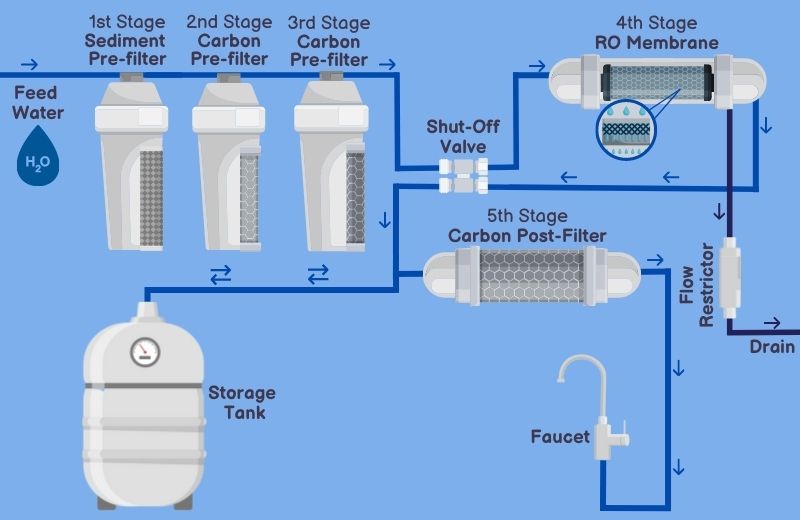 Reverse Osmosis Water Filter Diagram
Also, many top-tier coffee shops and craft breweries use RO as their base water. They then add back specific minerals to create water profiles that highlight certain flavor notes in beans or hops. You’re basically brewing with designer water.
The One Thing Nobody Tells You
RO water can make your body want more because it’s so clean and easy to absorb. You might find yourself drinking double what you did before. That’s not a bug—it’s a feature. Hydration becomes addictive when it tastes this good.
But here’s the gentle reality: you don’t need RO to survive. Tap water in most developed countries is perfectly safe. RO is a luxury of clarity, not a necessity. It’s for the person who notices the subtle difference in a glass of water, the same way they notice a perfect bass line in a song.
Connecting It to Daily Life
At the end of a long day, when you fill a frosty glass from your RO faucet, you’re not just drinking water. You’re drinking a moment of quiet control. In a world of noise, pollution, and endless notifications, this one sip is purely yours—humble, transparent, and exactly what it should be. No additives, no compromises. Just you and the essence of water.
So go ahead. Invest in the filter that matches your vibe: clear, refined, and a little bit extra. Your future self, basking in the glow of a perfect iced tea, will thank you.
