Which Ultrapure Water System Suits My Lab

Choosing an ultrapure water system for your lab is a bit like choosing a coffee machine for your kitchen. You could boil a pot on the stove, but that doesn’t make a latte, doe...

Choosing an ultrapure water system for your lab is a bit like choosing a coffee machine for your kitchen. You could boil a pot on the stove, but that doesn’t make a latte, does it? In the lab, your experiments are way pickier than your morning caffeine habit. If your water isn’t pure enough, your results go from “I’m a genius” to “I’m going to cry into this beaker.”
Let’s be real: most of us start out with a simple jug of distilled water. It’s the lab equivalent of that sad instant coffee packet in the break room. It works in a pinch, but your sensitive experiments will absolutely taste the difference. The moment you run a mass spec or a cell culture, that cheap water will betray you with a spike of ions.
The Tap Water Tango
First, you need to know what’s coming out of your actual tap. Is it hard water, full of calcium and magnesium like a mineral bath? Or is it soft, but loaded with chlorine that smells like a swimming pool? Think of your feed water as the raw potato—you need to peel it before you can make perfect fries.
Must Read
A pretreatment step (like a reverse osmosis system) is your potato peeler. It removes 90-99% of the junk. Without it, you’re asking your final polishing system to do the heavy lifting, which is like asking a sushi chef to also clean the sewer. It’s not fair, and it costs you more money in the long run.
The Two Types of “Pure”
Here’s where the jargon hits. You have Type 3 water, which is just good for washing glassware or rinsing stuff. It’s the lab’s “good enough” water—like using a paper towel to wipe up a spill. Then there’s Type 2, which is for buffers and general chemistry. It’s your reliable everyday water, like a decent drip coffee.
But the star is Type 1 ultrapure water. This is the espresso shot of water. It’s so pure it has a resistivity of 18.2 megohm-cm, which is science-speak for “it’s practically a ghost.” If you’re doing trace metal analysis, DNA work, or HPLC, you need this. Don’t pretend you can get away with less.
I once watched a colleague try to use distilled water for a qPCR experiment. The results looked like a Jackson Pollock painting. He spent a week blaming the primers before we realized his water had more bacteria than a petri dish. Don’t be that person.
Volume vs. Patience
How much water do you use per day? If you only need a few liters for sensitive assays, a benchtop system that makes Type 1 water on demand is perfect. It’s like a single-serve Keurig—efficient, but you’ll be refilling the tank constantly. If your whole lab is guzzling water for autoclaves and media prep, you need a larger, centralized system.
But here’s the kicker: most systems store Type 1 water in an internal tank. Stored water gets dirty—bacteria grow, CO2 dissolves, and the resistivity drops. If your system has a tank, it better have a recirculation pump and a UV light. Otherwise, you’re just aging your fancy water into stale sadness.
A funny thing happens when labs share a system. Someone always fills a beaker, then forgets the beaker is there for three days. The next person uses that water without checking. That’s how contaminated results happen. Label everything, and maybe ban open beakers near the water dispenser.
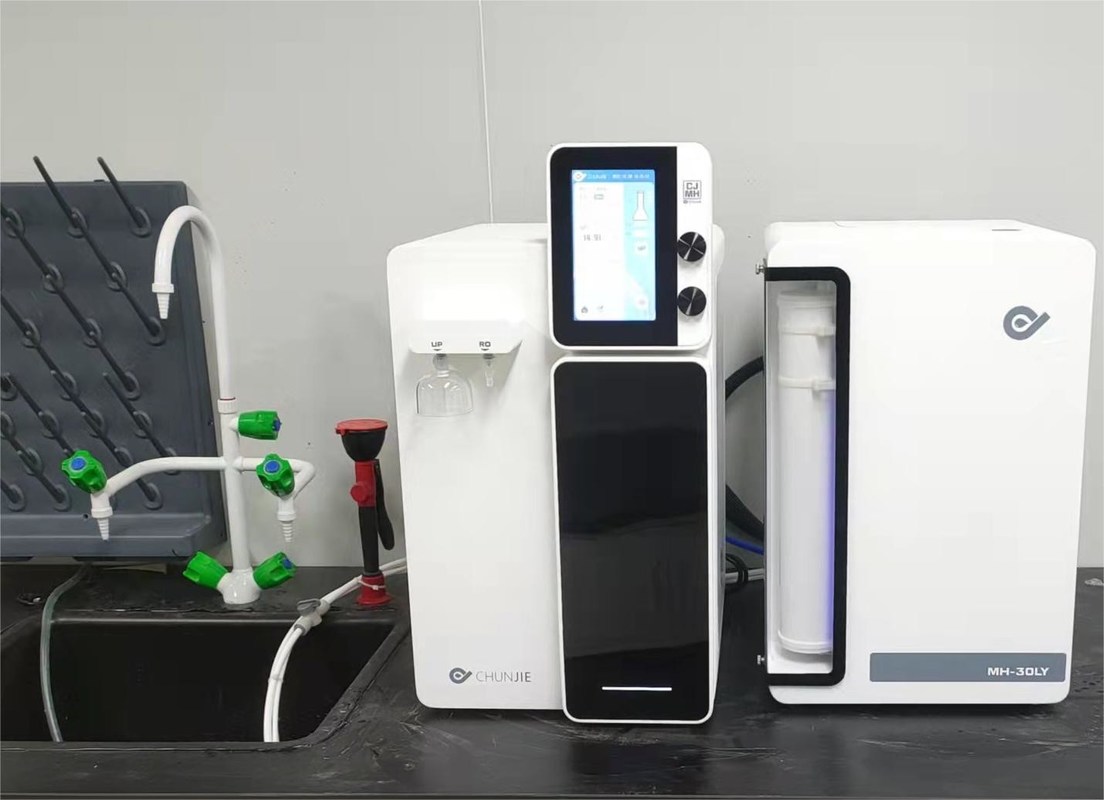 High End Ultrapure Water Systems Machine 20L/H Laboratory Pure Water
The Filter Replacement Horror Show
Everyone loves the low upfront cost of a cheap system. Then you see the price of replacement cartridges and laugh nervously—like buying a free printer that costs $200 in ink. A good system has consumables that last between six months and a year. A bad system will drain your budget faster than a subscription to every streaming service.
Also, factor in how much water you waste. Some reverse osmosis systems flush 4 gallons of water down the drain for every 1 gallon of pure water they make. That’s tragic if you pay for water. Look for a system with a high recovery rate—your planet and your wallet will thank you.
Oh, and the water quality monitor? Don’t ignore it. It’s not a decorative blinking light. If it says low resistivity, that’s your water system crying for help. I once saw a lab run experiments for two months with a dead monitor. Their error rate was… educational.
The Vendor Visit Vibe
When a salesperson comes in, don’t let them dazzle you with shiny brochures. Ask them how long the filters last in your specific water, not in their perfect demo. They’ll say “it depends,” which is code for “we don’t know your situation.” Press for real numbers based on your local tap water report.
Also, test the service support. Is there a 24-hour hotline? If your system breaks on a Friday before a big experiment, do you fix it yourself with a wrench and tears? I’ve done that. It’s not fun. Choose a vendor who responds faster than a postdoc eats leftover pizza.
Finally, think about your future experiments. Are you planning to switch to ICP-MS next year? Then buy a system that handles ultra-low metals now. Upscaling later is miserable. It’s like buying a bicycle when you know you’ll need a truck—you’ll just end up frustrated and selling it on eBay.
At the end of the day, the best system is the one you actually maintain. A fancy, expensive system with clogged filters is worse than a basic one you change on time. Water purity is a habit, not a purchase. So pick your system, schedule your swaps, and go enjoy your perfectly pure experiments. Your data will smile back.
