Tankless Whole House Reverse Osmosis System

So, you’ve been drinking tap water for years. Congratulations—you’re basically a living chemistry experiment. Let’s talk about the Tankless Whole House Reverse Osmosis System....

So, you’ve been drinking tap water for years. Congratulations—you’re basically a living chemistry experiment.
Let’s talk about the Tankless Whole House Reverse Osmosis System. Yes, it’s a mouthful, but so is a glass of unfiltered well water—just with more minerals and less regret.
Imagine your home as a giant water bottle. Now imagine a tiny, furious robot inside it, aggressively pushing every molecule of water through a microscopic sieve. That’s reverse osmosis in a nutshell.
Must Read
But the tankless part? That’s the real magic. Traditional RO systems have a big storage tank that looks like a silver R2-D2 with a plumbing problem. A tankless system says, “Nah, I’ll make it fresh on the spot.”
Why Your Old Water Filter is Basically a Paper Hat
You think your Brita pitcher is doing work? Please. That thing removes a bit of chlorine and some bad vibes. A whole-house RO system removes everything—lead, arsenic, fluoride, pesticides, and even that weird taste from your neighbor’s failed homebrew.
I’m talking about water so pure it makes distilled water seem like a muddy puddle. It strips out 99% of dissolved solids. That’s right—99%! The only thing left is H₂O and a lingering sense of superiority.
But here’s a surprising fact: reverse osmosis was invented in the 1950s. They used it to desalinate ocean water for submarines. So basically, you’re drinking water that was once deemed safe enough for a bunch of sailors playing poker underwater.
The Tankless Revolution: No Waiting, No Tanks, No Drama
Why does a tankless system matter? Because waiting for water is for people who still use dial-up internet. Traditional RO systems fill a tank gradually, then release it as you drink—like a sad, slow faucet.
A tankless system uses a pump and smart sensors to produce water on demand. Turn the tap, and boom—pure water sprays out like a firehose at a fancy spa. It’s instant gratification for your hydration.
Plus, no tank means no bacteria party. Storage tanks can become a petri dish for slimy biofilm. A tankless system is basically a “no vacancy” sign for germs.
But Is It Actually “Whole House”?
Yes, and it’s glorious. Every faucet, every shower, every ice maker in your fridge is now serving up water that would make a Swiss glacier jealous.
Think about it: your shower water is no longer a chemical soup. Your hair will feel like silk. Your skin will stop fighting you. You’ll step out of the shower smelling like pure possibility instead of chlorinated regret.
Even your toilet gets fancy. You’ll flush with water so clean it could be bottled. (Please don’t bottle your toilet water. That’s still weird.)
The Hidden Downsides (Because Nothing Is Perfect, Karen)
I’ll be honest: this system is not cheap. Installing a tankless whole-house RO system can cost anywhere from $2,000 to $5,000. That’s the price of a used Honda Civic, but instead of driving, you’re drinking.
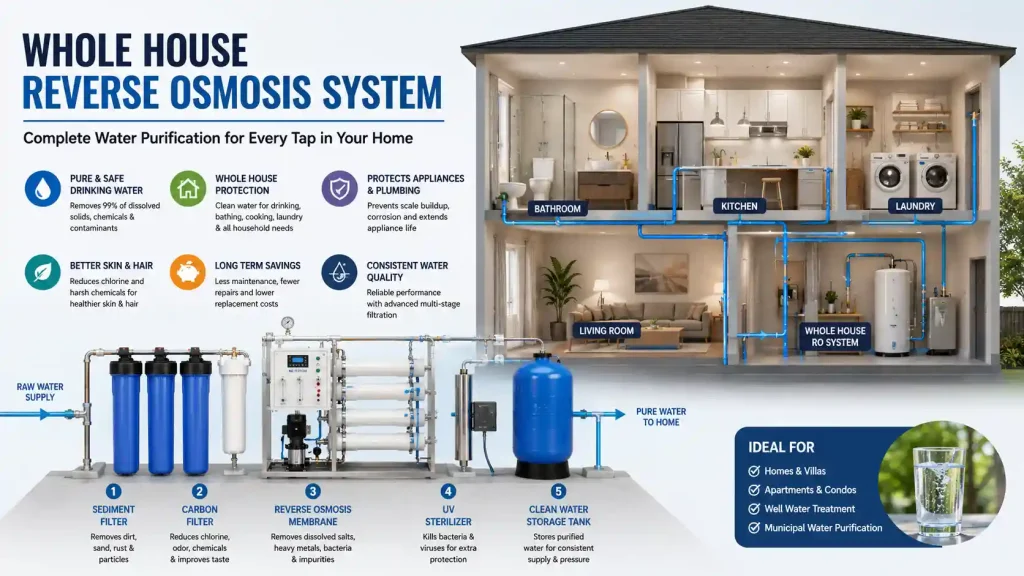 Whole House Reverse Osmosis System for Pure Water - Basidewt-Best Whole
Also, it wastes water. For every gallon of pure water you get, about 3 to 4 gallons go down the drain as “brine.” That’s like paying for a pizza and throwing away half the crust. But hey, your plants might love the salty runoff—or die. Science is hard.
And you’ll need to change filters every 6 to 12 months. It’s like having a needy pet that only eats sediment and carbon blocks.
Who Actually Needs This Monster?
If you live in a place where the tap water tastes like a swimming pool and smells like a biology lab, this is for you. Rural well water? You’re a prime candidate—well water often contains iron, sulfur, and the ghost of a dead cow.
If you have a family and hate buying plastic water bottles, this system pays for itself in a few years. Plus, you’ll feel like an eco-warrior. “I saved the planet one tankless RO drip at a time.”
But if your water is already decent? Honestly, you might be overkilling it. It’s like using a flamethrower to light a candle.
Fun Fact: This System Might Make You Annoying
Once you install it, you’ll become that person who brings their own water to parties. You’ll sniff tap water at restaurants and mutter, “My system does five stages of filtration.” People will roll their eyes, but they’ll also secretly ask for a sip.
Your friends will joke that you’re turning into a “water snob.” Own it. Serve them ice cubes made from your pure water. Watch their faces melt as they realize they’ve been drinking peasant water their whole lives.
Eventually, you’ll install a second one for your dog. Yes, that’s a real thing. People do it. And your dog will judge you if you don’t.
The Bottom Line (Or, Should You Buy One?)
A tankless whole-house reverse osmosis system is the Ferrari of water filters. It’s expensive, slightly ridiculous, and wastes some fuel—but it’s also thrillingly pure. If you can afford it and your water is nasty, go for it. Your taste buds will throw a parade.
If you can’t afford it, just boil your tap water and pretend it’s “artisanal.” No one will know. Except for that one friend who installed the tankless system. He knows. He always knows.
Now, if you’ll excuse me, I need to go drink a gallon of my pristine, tankless-prepared water. My bladder is not happy, but my soul is. Cheers.
