Is Water Softener Salt The Same As Pool Salt

Let’s talk salt. Not the boring kind on your fries. I mean the salt you dump into your water softener versus the salt you toss into your swimming pool. They look similar. They...

Let’s talk salt. Not the boring kind on your fries. I mean the salt you dump into your water softener versus the salt you toss into your swimming pool. They look similar. They both come in bags. But are they the same? Spoiler alert: Nope. Not even close.
The Salty Showdown
Water softener salt and pool salt are like distant cousins at a family reunion. They share a last name, but they’ve got totally different personalities. One wants to make your water silky. The other wants to make your pool sparkly. Mix them up, and you’ll have a mess on your hands.
Water softener salt is a hard worker. It’s all about removing calcium and magnesium from your home’s water. Think of it as a tiny bouncer for your pipes. Pool salt, on the other hand, is a laid-back beach bum. It’s used by saltwater pool systems to generate chlorine through electrolysis. It doesn’t scrub hard water; it just chills and creates a gentle sanitizer.
Must Read
The Chemistry of Confusion
Here’s where it gets funny. Both are mostly sodium chloride (NaCl). That’s table salt minus the fancy iodine. But the devil is in the details—and the additives. Water softener salt often contains rust inhibitors or other chemicals to keep your water heater safe. Pool salt? It’s usually 99.8% pure, with no additives at all.
Pour water softener salt into your pool, and those rust inhibitors can cloud the water or stain your liner. It’s like putting dish soap in your car’s gas tank. Sure, it’s liquid, but please don’t. On the flip side, use pool salt in your water softener, and you might get a sludge bucket. The fine grains can clog your system faster than a toddler with a sock.
The Great Grain Game
Look at the crystals. Water softener salt comes in chunky pellets, cubes, or coarse nuggets. They’re big and slow-dissolving. Perfect for sitting in a brine tank. Pool salt is much finer—like kosher salt’s cousin. It dissolves quickly in pool water. Use the wrong grain size, and you’ll either clog your filter or float on a salt cloud.
Here’s a quirky fact: some pool owners have accidentally bought water softener salt in a pinch. They dump it in, and the pool turns murky green overnight. Why? Those additives feed algae like candy. It’s a science experiment nobody asked for. Meanwhile, softener users who grab pool salt risk a gooey, jam-like residue in their tank. Gross, right?
Can You Swap Them in an Emergency?
If the zombie apocalypse hits and you’re out of the right salt, maybe. But only if you’re desperate. Use water softener salt in your pool for one day if you must, then drain and refill. Use pool salt in your softener if you’re out for a week—but expect to clean the tank afterward. You’ll be scrubbing like a mad scientist.
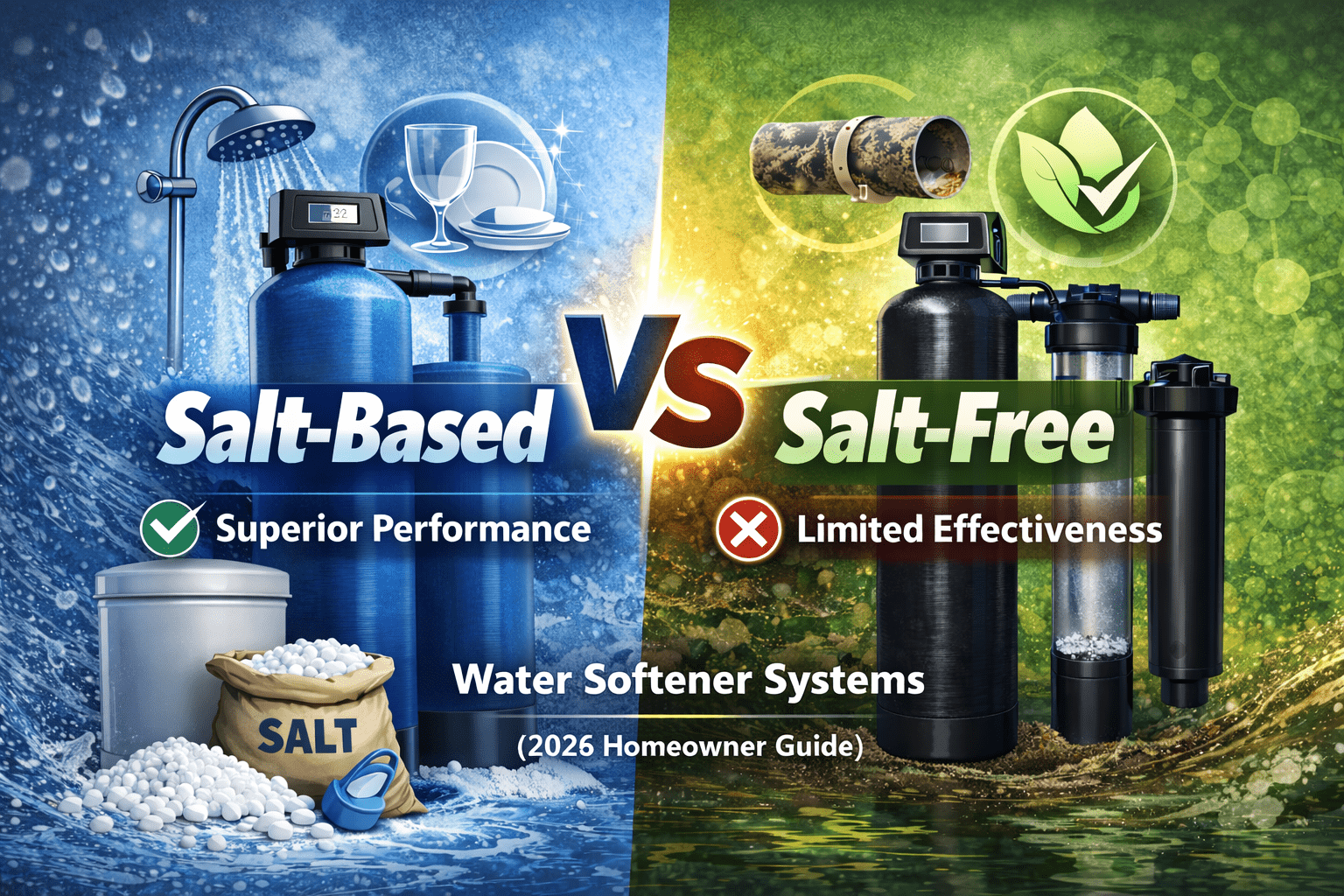 Salt-Based vs Salt-Free Water Softener Systems (2026 Homeowner Guide
The real takeaway? Don’t be lazy. Buy the right bag. Your appliances will thank you. Your pool will glisten. And you’ll avoid that awkward moment at the hardware store where you stare at two identical bags and guess.
Why This Topic Is Just Fun
Salt is boring. Right? Wrong. We’re talking about a mineral that literally makes your water behave. One salt fights off hard minerals. Another salt turns your pool into a gentle sea. It’s like asking if a wrench and a screwdriver are the same. They both turn things—but one will strip your faucet if you use it wrong.
Plus, there’s a weird history. Ancient Romans used salt to purify water. Now we have bagged salt for home comfort and backyard luxury. That’s a 2,000-year glow-up. And you thought you were just buying a bag of white crystals.
The Bottom Line (No Pun)
Next time you’re at the store, read the label. Water softener salt says “for water conditioning.” Pool salt says “for swimming pools.” Simple. If you mix them up, you’ll either end up with a cloudy pool or a clogged softener. Neither is a good summer story.
So, no, they are not the same. But now you know. You can impress your friends at the next barbecue. “Hey, did you know water softener salt has rust inhibitors?” They’ll look at you like a wizard. You’ll smile. Because you read this article. And now you’re the salt expert. Use your power wisely.
