Whole House Water Filter Systems For Well Water

So, my friend Mark calls me the other day, sounding like he’s just discovered a dead body in his basement. “The water,” he whispers, “it smells like a wet dog that fought a su...

So, my friend Mark calls me the other day, sounding like he’s just discovered a dead body in his basement. “The water,” he whispers, “it smells like a wet dog that fought a sulfur demon.” I laughed. Then I visited. He was right. His well water, once pure and crisp, now looked like rusty tea and tasted like a penny’s worth of regret.
That’s the thing about well water: it’s a total wildcard. You’re not on the city’s treated grid; you’re drinking straight from Mother Nature’s chaotic pantry. One day it’s fine, the next you’re showering in what feels like diluted swamp juice. And that’s exactly where a whole house water filter system steps in—not just saving your taste buds, but your sanity, your plumbing, and your skin.
What’s the big deal with “whole house” anyway?
Let’s clear something up—yes, a pitcher filter in your fridge works, but it’s like using a spoon to bail out a sinking ship. A whole house system treats every single drop that enters your home. We’re talking about the water running to your shower, your washing machine, your toilet, and—most importantly—your kitchen sink. It’s not just about drinking; it’s about living in water that doesn’t fight you.
Must Read
Well water has hidden friends: iron, manganese, sulfur, sediment, and sometimes bacteria. They’ll stain your laundry orange, turn your white sinks rusty, and leave your hair feeling like straw. A good system tackles all of that at the point of entry, before the water even sees your pipes. (Imagine your pipes never clogging with orange slime again. Dreamy, right?)
The “Stage” Show: What a decent system includes
You don’t need a PhD in plumbing, but you should know the main stages. Most systems for well water have two to three big steps. First, there’s a sediment filter—it catches sand, dirt, and rust chunks. Think of it as the bouncer at the club, keeping the riff-raff out.
Next—and this is the hero for smelly water—is an activated carbon filter. This guy grabs the chlorine (if you have any), bad tastes, and those rotten egg sulfur odors. Without it, your coffee will taste like a dirt nap. And finally, many systems add a water softener or an iron filter, because well water loves to be hard. Hard water means scale buildup in your water heater, soap scum on your dishes, and that squeaky feeling on your skin that’s actually not clean.
But which one for you? Let’s get real.
Here’s the ironic part: the answer is always “it depends.” You have to test your water first. Grab a home test kit or send a sample to a lab (it’s cheap, I promise). If you have high iron, skip a basic filter and go for an oxidation media filter. If your water is just smelly and a little sandy, a combo sediment-carbon setup works fine.
I tell everyone: don’t buy a $100 system for a $10,000 problem. But also don’t drop two grand on a whole house UV system if your water just has a faint dirt taste. (Yes, UV is amazing for bacteria, but it’s overkill if your well is properly sealed and tested regularly.)
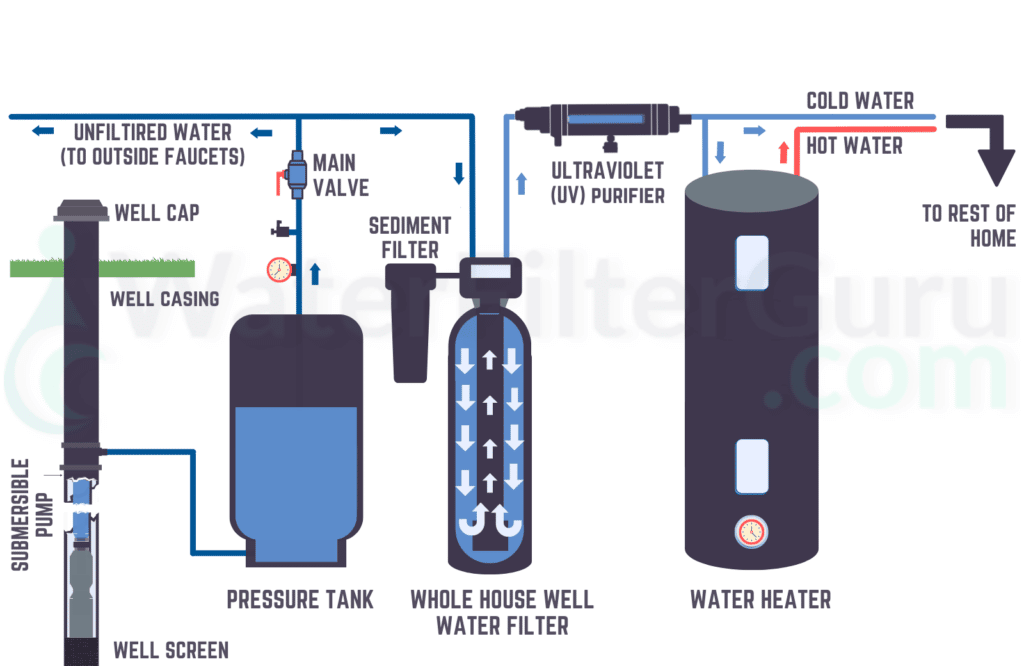 Filtration Diagram
Installation: DIY or cry for help?
Look, I’m not handy. I once hung a picture frame off-center and called it “abstract.” But a whole house filter is surprisingly doable for a weekend warrior. They usually come with a bypass valve and clear housing so you can see the gunk. Just shut off your main water line, cut a piece of copper or PEX pipe, and screw it in. Watch a YouTube video, have a beer nearby, and you’re golden.
If you’re like my neighbor Steve who tried to fix his own faucet and ended up flooding his crawlspace, call a plumber. Seriously. A professional installation runs $200–$400, but it beats a $3,000 water damage claim. (And your marriage will thank you.)
Maintenance—the part nobody talks about
Here’s the secret: filters get dirty. Shocking, I know. A sediment filter needs changing every 3–6 months; a carbon filter every 6–12 months. If you ignore it for a year, the system becomes a mold farm. Not cute. Set a reminder on your phone, or buy a system with a digital alert. Your water will taste like regret if you don’t.
Also, don’t buy cheap knockoff cartridges. Trust me. I bought generic ones once, and within a month the housing cracked and sprayed water everywhere. It was like a scene from “Jaws” but with my laundry room. Stick with the brand that matches your unit, or at least check the micron rating.
Is it worth the money?
Absolutely. A decent whole house filter for well water runs $300–$1,000, plus installation. That might sting, but compare it to replacing your water heater every three years because scale ate it alive. Or think about the cost of bottled water for your whole family for a decade. You’ll save your appliances, your clothes, and your skin—and nobody wants to shower in smelly water before a date.
I’ll leave you with this: Mark finally installed a system. His water now tastes like… well, water. Clean, crisp, and undramatic. He even texted me a photo of his sparkling shower head with the caption: “I can see again.” So, if your well water is acting up, don’t just pour a glass and grimace. Give it a whole house filter. Your dog will stop giving you that judgmental side-eye.
