Is Tap Water In A Glass Homogeneous Or Heterogeneous

Let’s be honest: you’ve probably stared into a glass of tap water while waiting for your coffee to brew and wondered, “Is this stuff actually one thing, or a tiny party of dif...

Let’s be honest: you’ve probably stared into a glass of tap water while waiting for your coffee to brew and wondered, “Is this stuff actually one thing, or a tiny party of different stuff?” It’s the kind of question that sounds like a bar trivia trap, but it actually sits at the heart of how we think about the world around us. We’re talking about homogeneous versus heterogeneous mixtures, and your humble glass of H₂O is the perfect teacher.
First, a quick science snack. A homogeneous mixture looks the same throughout—think perfectly stirred coffee or filtered air. A heterogeneous mixture, by contrast, has distinct parts you can see, like a chunky salsa or a bag of mixed nuts. So where does tap water land? On the surface, it looks homogeneous, but the devil—and the delight—is in the chemical details.
The Case for Homogeneous: The Sleek, Modern View
If you pour tap water into a clean glass, it appears uniform: clear, with no visible layers or floating bits. To your naked eye, it’s a single, consistent phase—a liquid that doesn’t separate like oil and vinegar. By this visual test, it’s undeniably homogeneous.
Must Read
But chemistry begs to differ. Pure water (H₂O) is a compound, not a mixture. Tap water, however, is a solution—a special type of homogeneous mixture where substances (minerals, gases, tiny pollutants) are dissolved at the molecular level. Salt dissolved in water is invisible, yet it’s there. This makes tap water a homogeneous mixture by scientific definition: its composition is uniform throughout, even if it contains multiple ingredients.
Fun Fact: The Mineral Mix
Did you know that the “taste” of your tap water is largely due to dissolved calcium and magnesium? New York City’s water is famously soft and sweet, while London’s is famously hard and mineral-rich. Yet both are considered homogeneous under a microscope. The mixture is so well-blended that you can’t pick out the calcium “chunks” with a spoon.
The Case for Heterogeneous: The Realist’s Rebellion
Now, pour that same tap water into a glass and let it sit for an hour. Notice that tiny sediment settling at the bottom? That’s the game-changer. Sediment, tiny rust particles, or even microscopic air bubbles can create visible, separate phases over time. This makes the water technically heterogeneous—because you can see distinct zones.
And let’s not forget the dissolved gases. Carbon dioxide, oxygen, and nitrogen are invisibly mixed in, but they can form bubbles against the side of the glass. Those bubbles are a separate gaseous phase, making the system heterogeneous in the strictest sense. A single glass can host a liquid phase and a gas phase at the same time.
Cultural Cheat Sheet: Water in Pop Culture
Remember the scene in Butterfly Effect where the character’s water suddenly turns murky? Or the classic trick of “cloudy water” that clears from the bottom up? That’s a visual metaphor for heterogeneity. Even the ice cubes in your drink are a heterogeneous touch—solid water floating in liquid water. Tap water without ice? Still playing host to micro-particles.
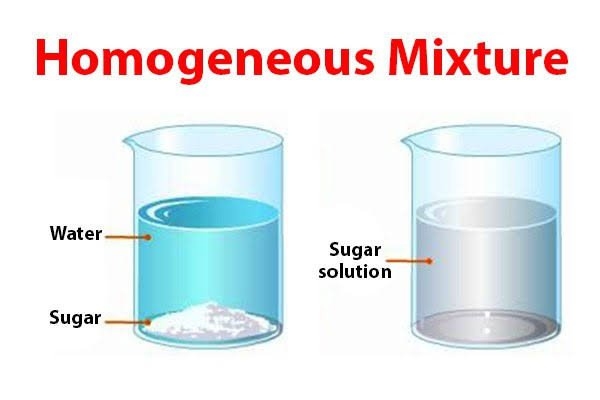 Examples Of Liquid Homogeneous Mixtures
The Practical Reality: You’re Drinking a Dynamic System
Here’s the truth your science teacher might have skipped: Tap water is both. At the moment of pouring, if it’s clear and you’re not seeing floaters, it behaves as a homogeneous solution. But leave it overnight, and the settling sediment or evaporating gases reveal its heterogeneous heart. It’s a shape-shifter.
For your daily life, this matters when you’re making tea, coffee, or even a simple glass of water. Hard water (rich in minerals) can leave a powdery ring on your mug—a heterogeneous trace. Soft water, on the other hand, tends to stay more uniformly clear. Your kettle’s limescale is the ultimate proof: it’s the solids separating from the solution.
Practical Tips for the Curious Sipper
Want to settle the debate at home? Here are three easy tests: First, shine a flashlight through your glass of tap water. If you see tiny floating specks (called “Tyndall scattering”), you’ve got a heterogeneous colloid in action. Second, let a glass sit for 24 hours and look at the bottom. See fine particles? That’s heterogeneity claiming victory. Third, taste test different glasses from the same tap—if the flavor slightly changes from morning to night (due to sediment stirring up), you’re tasting a mixture that isn’t perfectly uniform.
The Philosopher’s Glass
In a way, tap water mirrors modern life. It appears seamlessly homogeneous from a distance, but zoom in and you find layers, particles, and invisible components that make it unique. It’s both a unified whole and a collection of parts, depending on how closely you look.
That glass of water on your nightstand isn’t just about hydration. It’s a daily reminder that simplicity is often an illusion. The next time you take a sip, pause for a second. Appreciate that what seems like “just water” is actually a tiny, dynamic universe—dissolved minerals from ancient mountains, gases from the air, and maybe a whisper of sediment from the pipes. It’s a mixture in every sense of the word, and that’s what makes it perfectly real.
So, is it homogeneous or heterogeneous? The answer is, yes. And that’s exactly how life should be: a little bit of both, always changing, and always worth a second look.
