How Much Does A Whole House Water Filtration System Cost

Let’s talk about water. Not just any water, but the stuff that comes out of your tap. It might look clear, but could be hiding a wild, weird story. The question on everyone’s...

Let’s talk about water. Not just any water, but the stuff that comes out of your tap. It might look clear, but could be hiding a wild, weird story.
The question on everyone’s lips? How much does a whole house water filtration system cost? Buckle up. The answer is a rollercoaster ride of numbers.
Think of it like buying a car for your plumbing. You can get a zippy little smart car, or a luxurious, tank-like SUV. The price tag reflects the adventure you want.
Must Read
The Real Price Tag: A Shockingly Wide Range
Here’s the bare-bones truth: a basic system can start around $1,000. That’s installed, usually. You’re getting the “house brand” of clean water.
But wait. The fancy stuff? The systems that make your water taste like mountain spring? They can easily hit $5,000. Some mega-systems go past $10,000.
Why such a gap? Because water is a drama queen. What’s in your water determines what you need to kick out.
Your Water’s Secret Life (And Why It Costs Money)
Do you have hard water? That’s the stuff that leaves white crust on your showerhead. It’s mineral buildup, and it’s annoying.
Maybe you’ve got chlorine that smells like a public pool. Or iron that stains your sinks a rusty orange. Each villain requires a different hero.
The more villains in your water supply, the more expensive the hero system. It’s a simple, weird math problem.
The $800 Question: What’s Inside the Box?
Your system is actually a team of filters. A sediment filter catches sand and dirt. A carbon filter gobbles up chlorine and bad tastes.
Some add a salt-based softener. That’s a big tank that makes your water feel silky. It also makes your soap lather like crazy. Fun fact: soft water can make you feel like you never rinsed off.
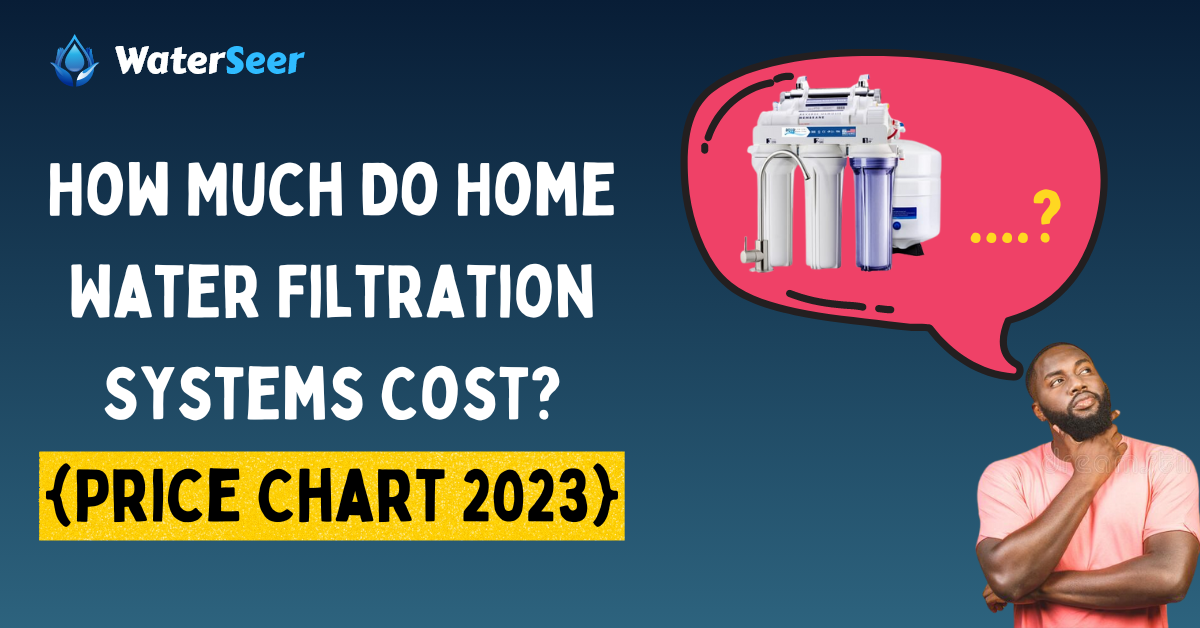 How Much Do Home Water Filtration Systems Cost? {Price Chart}
Then there’s the reverse osmosis system—the king of clean. It pushes water through a membrane so fine, it’s basically water jail for contaminants. This upgrade is not cheap.
The Labor: Where Your Money Really Goes
Buying the filter box is only half the story. Installation costs are like the sneaky service charge on a concert ticket. Expect to pay $500 to $1,500 for a pro to hook it up.
Why so much? They have to find your main water line, cut it, and install a big metal tank. It’s plumbing surgery. One wrong move and you’ve got a basement lake.
Some folks DIY it. If you’re handy, you can save a bundle. But if you’re like me, you’ll pay someone to avoid a flood.
The Ongoing Cost: The “Hidden” Bill
Here’s a quirky truth: filters don’t last forever. You have to replace them. Think of it as paying a subscription for clean water.
A simple sediment filter can cost $20 a year. A fancy reverse osmosis membrane? That’s $150 every few years. It adds up.
Don’t forget salt for water softeners. A bag costs about $10. If you have a big family, you might buy a bag every month. It’s like feeding a hungry, thirsty pet.
The “Waste” Factor: A Funny Little Detail
Reverse osmosis systems are thirsty. For every gallon of clean water, they waste about three gallons. That water goes down the drain.
 Whole House Water Filter Costs for 2025-2026
Imagine filling a bucket with clean water, but dumping three buckets of perfectly fine water away. It feels wasteful. But the water that comes out is so pure, it’s almost magical.
Some systems are more efficient. They waste only one gallon for every gallon of clean water. Those cost more, of course. Because everything has a price.
Is It Worth It? Let’s Get Playful
Imagine taking a shower with water that doesn’t smell like a pool. Your skin feels happier. Your hair stops acting like a haystack. That’s priceless, right?
Your appliances love it too. A whole-house system can make your washing machine, dishwasher, and water heater last years longer. Hard water is a silent killer of machines.
And coffee? It tastes better. Tap water becomes the best drink in the house. You’ll suddenly become a water snob, and you’ll love it.
The Final Number: A Fun Summary
So, the cost? $1,000 to $10,000. It’s a wild range because water is a wild party. The size of your house, the quality of your water, and your desire for luxury all matter.
Think of it this way: you’re not just buying a filter. You’re buying a ticket to a cleaner, tastier life. You’re buying your shower back from the chlorine monster.
Curious? Call a local water company. Ask them to test your water. The results will tell you exactly what you need. And then, you can decide if your water is worth the investment—or if you’ll just keep buying bottled water.
Either way, you’ll never look at a glass of tap water the same way again. Isn’t that a fun thought?
