How Much Does A Whole House Filtration System Cost

The other day, my friend Karen—you know the type, always bragging about her "pure" tap water—invited me over for coffee. She poured me a cup with this smug little smile, and I...

The other day, my friend Karen—you know the type, always bragging about her "pure" tap water—invited me over for coffee. She poured me a cup with this smug little smile, and I swear, it tasted like a mountain spring had personally delivered it. Meanwhile, my own tap water at home smells vaguely like a swimming pool, and I’m pretty sure it’s slowly calcifying my insides. That got me thinking: how much does a whole house filtration system actually cost? Because, let's be honest, I want that mountain spring vibe, not the "mineral deposit" special.
So, I dove into the world of sediment filters, carbon tanks, and brine tanks—and yes, it’s as sexy as it sounds. But here’s the kicker: the price tag for a whole house system isn’t just one number. It’s more like a choose-your-own-adventure, and your wallet is the main character. Depending on what’s in your water—hardness, iron, that weird metallic taste—you could spend anywhere from a few hundred bucks to several grand. And nobody tells you the installation can feel like a second mortgage.
The Bare-Bones Starter Pack: $500 – $1,500
If you’re on a tight budget and your water is only mildly offensive (say, a little chlorine or sediment), a basic whole house filter might do the trick. These systems typically use a single carbon filter or a sediment filter, and they cost between $500 and $1,500 for the equipment alone. You’ll probably need to replace the cartridges every few months, which adds about $50–$100 a year—annoying, but not wallet-crushing.
Must Read
Installation? If you’re handy with a wrench, you can DIY it for the cost of some PVC pipe and a few fittings (maybe $50). But if you hire a plumber—and let’s be real, most of us shouldn’t mess with copper pipes—expect to pay $200 to $600 extra. Pro tip: ask your plumber if they’ll install it while complaining about your neighbor’s lawn; that’s free.
The Hard Water Heroes: $1,500 – $4,000
Now, if your water leaves cloudy spots on your glasses and turns your shower into a chalky nightmare, you’re dealing with hard water. You need a water softener—usually a separate tank that exchanges calcium and magnesium for sodium. A decent whole house system with a softener runs $1,500 to $4,000 for the gear. Don’t forget the salt pellets, which cost about $100–$200 a year. (Yes, it’s like feeding a hungry, salty pet.)
Installation for these? It’s more complex because you need a drain line and electrical connection. Hiring a pro will set you back another $500 to $1,200. And here’s the ironic part: the softer your water, the more soap you’ll need to get clean. You’ll be spending extra on soap, but your hair will feel like silk—choose your battles.
 Home Water Filtration Systems: Types, Costs, and Eco-Friendly Options
The Whole Enchilada: $4,000 – $10,000+
Okay, you want the premium treatment—like Karen’s mountain spring, but for your entire house. That means a reverse osmosis (RO) system for drinking water, plus a sediment filter, a carbon filter, and possibly a UV lamp to kill bacteria. These multi-stage beasts can cost $4,000 to $10,000 for the equipment. Need a tank? Add another $500. Want it to look sleek? That’s extra, naturally.
Installation for a full RO system is not for the faint of heart—or the faint of wallet. Expect to pay $1,000 to $2,500 for professional setup, including running a separate faucet and drainage. And the ongoing costs? Filters need replacing every 6–12 months, which adds up to $200–$400 per year. But hey, you’ll never buy bottled water again—so if you drink 500 bottles a year at $1 each, you break even in about two decades. Totally worth it, right?
The Hidden Costs Nobody Talks About
Here’s where it gets sneaky: maintenance and energy. Some systems use electricity for pumps or UV lights, adding maybe $50–$150 to your annual utility bill. And if your water pressure drops because of the filter, you might need a booster pump—that’s another $300–$800. Oh, and if your water has iron bacteria? You’ll need a chlorinator or aeration system, which can add $1,000 to $3,000. Ironic, isn’t it? The cleaner your water wants to be, the more it costs to get there.
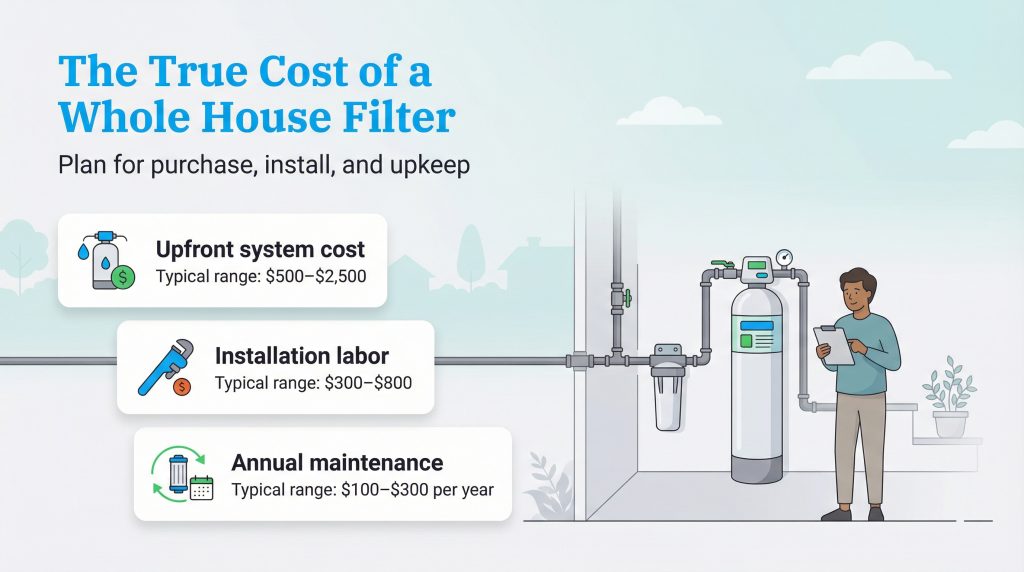
 Whole House Water Filter Costs for 2025-2026
Let’s not forget the shipping and taxes. A $3,000 system can easily become $3,300 with tax and freight. Plus, some companies charge a "custom installation fee" if your pipes are weird. And trust me, your pipes are weird. They always are.
So, Should You Do It?
Honestly, if your water tastes okay and doesn’t ruin your appliances, a simple under-sink filter ($100–$200) might be enough. But if you’re tired of scrubbing hard water stains—or worse, drinking chlorine-flavored coffee—a whole house system is a solid investment for your health and sanity. Just don’t forget to budget for the installation guy who will inevitably sigh when he sees your water heater.
At the end of the day, you’ll spend anywhere from $700 (bare-bones DIY) to $12,000 (the works). My advice? Test your water first—most hardware stores sell a $20 kit. Then, buy a system that matches your actual problems, not your dreams. And if you’re like me, just buy a pitcher filter and pretend your tap is fancy. Save the $10,000 for something less boring—like a vacation. (But don’t tell Karen I said that.)
