How To Tell If Your Water Softener Is Not Working

So, you bought a water softener. You wanted that silky, luxurious water. The kind that makes your hair feel like a shampoo commercial. But lately… something feels off. Is your...

So, you bought a water softener. You wanted that silky, luxurious water. The kind that makes your hair feel like a shampoo commercial. But lately… something feels off. Is your trusty salt-chomping machine actually slacking off?
Let’s be real. A broken water softener is a sneaky traitor. It doesn’t scream for help. It just quietly ruins your laundry. But don’t worry! We’re going to play detective. Here’s how to catch your softener slacking.
Your Skin and Hair Will Snitch
Touch your skin right after a shower. Does it feel tight? Or dry like a lizard? That’s a huge red flag. Soft water makes your skin slippery and hydrated. Hard water leaves a nasty, soap-scum residue behind.
Must Read
Now the hair test. Run your fingers through your wet hair. Does it feel waxy? Or straw-like? If you can’t get a comb through it without a fight, your softener is officially on strike. Your hair is literally screaming for soft water.
Fun fact: Hard water minerals bond with your hair proteins. It creates a weird, sticky film. So if you suddenly look like you used three bottles of 80s hairspray, blame the machine.
Watch Your Dishes Like a Hawk
Pull a glass from the dishwasher. Hold it up to the light. Do you see spots? Or a cloudy, milky film? That’s not a fancy design. That’s mineral deposits getting cozy with your stemware.
Your water softener’s job is to kick calcium and magnesium out of the water. When it fails, those minerals crash the party. They leave white crust on your kettle. They form weird rings in your toilet bowl. Nobody invited them!
One more quirky tell: Soap scum. If your bathtub looks like a crime scene of white grime, your softener is snoozing. Real soft water makes soap foam like a dream. Hard water makes it form that stubborn, ugly slime.
Your Soap Has a Meltdown
Pour some liquid soap into your hand. Try to lather it up. Does it refuse to foam? Does it feel like you’re rubbing slime on your skin? That’s a classic sign. Hard water kills suds instantly.
 9 Signs Your Water Softener Isn't Working (+Solutions)
This means you’re using up to twice the amount of soap for nothing. Your wallet is crying. The environment is crying. And your softener is just sitting there, laughing. A properly working unit makes a tiny bit of soap generate mountains of bubbles.
Here’s a fun home experiment. Fill a clear bottle halfway with tap water. Add a few drops of dish soap. Shake it hard. If the water is clear and the bubbles disappear fast, you have hard water. If it’s milky with rich foam, your softener is still a hero.
Your Clothes Are Telling Lies
Pull a white t-shirt out of the wash. Does it look gray or dingy? Hard water causes mineral buildup in fabric fibers. It traps dirt inside. Your shirts will look permanently tired.
Feel the fabric. Is it stiff? Scratchy? Like sandpaper against your skin? That’s not a bad fabric softener. That’s hard water minerals making your clothes armor. Soft water clothes feel fluffy. They last longer. They keep colors bright.
Ever notice your white socks turning a weird yellow? That’s iron in your water. A working softener can filter out small amounts of iron. If you see rust stains, your system is probably broken. Or it forgot to regenerate.
Listen to the Machine
Walk over to your softener. Put your ear next to it. Do you hear a gentle whirring or a soft hissing? That’s normal. It’s regenerating, which is its nightly detox.
Dead silence is bad. Dead silence means your motor is busted. Or your timer is fried. Also, check for a “salt bridge.” That’s when salt forms a hard crust over the water. It looks solid but is hollow underneath. Tap it with a broom handle. If it sounds hollow, you’re in trouble.
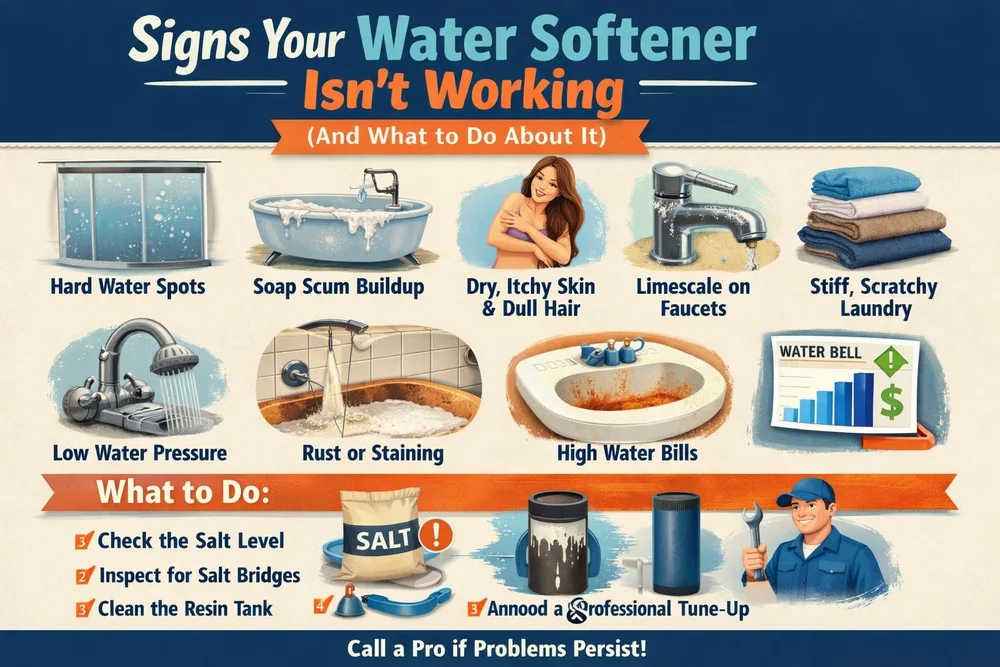 Signs Your Water Softener Isn't Working (And What to Do About It)
Funny fact: A salt bridge is basically your water softener making a concrete ceiling. The salt can’t reach the water. It’s like the machine is building a tiny, inconvenient igloo. Break it up or call a pro.
The Salt Level Lies
Open the brine tank. Look inside. Is the salt level low? Obviously, that’s a problem. But here’s the funny part: Even full tanks can be a trick. If the salt is “mushing” into a wet, sludge-like paste, your tank has too much water. This is called “salt mushing.”
Salt mushing happens when the softener overfills with water during regeneration. It creates a gross, salty soup that can’t clean the resin properly. Your water stays hard. You just have a tub of rock-paste.
The fix? Clean out the tank completely. Start fresh with new pellets. It’s like giving your machine a colon cleanse. It feels weird, but it works.
The Ultimate Test
Buy a simple water hardness test kit. They cost about ten bucks. Fill a vial, add a drop, and watch the color change. Blue means soft. Red means hard. It’s like a science experiment you can do in your pajamas.
Another pro move: Call your local water company. Ask for the current hardness level. Compare it to what your softener is outputting. If the numbers are the same, your machine is a fancy paperweight.
Here’s the bottom line. A broken softener is annoying. But it’s also a tiny mystery. You are the detective. Your dry skin, spotty glasses, and crunchy socks are all clues. Pay attention. Fix the machine. Then enjoy the most luxurious, bubbly shower of your life. You’ve earned it.
