How Much Water Is Wasted With Reverse Osmosis

So the other day, my buddy Tom—the guy who actually reads the manual for his toaster—invited me over for a taste test. He’d just installed a fancy reverse osmosis (RO) system...

So the other day, my buddy Tom—the guy who actually reads the manual for his toaster—invited me over for a taste test. He’d just installed a fancy reverse osmosis (RO) system under his sink, and he was proud. “Taste this,” he said, handing me a glass of water so pure it looked like liquid glass. I took a sip. It was… water. Crisp, clean, totally neutral. “Pretty good, right?” Tom beamed. Then he led me to the sink, pointed at a small plastic tube snaking into the drain, and said, “But see that? For every cup you just drank, three cups went straight down there. Wasted.” I nearly choked on my pure water.
That’s the dirty little secret of reverse osmosis, my friend. It’s a water-thirsty beast. RO systems work by forcing water through a semi-permeable membrane that catches everything—lead, chlorine, fluoride, even microscopic plastic bits. But the membrane is a diva: it needs a constant flush to stay clean. That flush water? Yep, it goes down the drain. For every gallon of pristine, “product” water you get, an RO system typically dumps 2 to 4 gallons of brine—aka reject water—into your pipes. If you’re in a drought-prone area, that’s not just wasteful; it’s painful.
How much water are we really talking about?
Let’s do the math (don’t worry, I’ll keep it short). The average household uses RO for drinking and cooking—maybe 3 to 5 gallons of product water a day. But with a typical efficiency ratio of 1:3 (product to reject), that’s 9 to 15 gallons wasted daily. Over a year? That’s 3,285 to 5,475 gallons of perfectly good tap water flushing down your drain. You could fill a small swimming pool. Or water your lawn. Or, you know, not waste it.
Must Read
And here’s the kicker: most people don’t even realize it. They see the cheap $200 unit at the big box store and think, “Oh, I’ll save money on bottled water!” Meanwhile, they’re quietly paying for four times the water on their utility bill. Irony, anyone?
But is it really “wasted”?
Okay, let’s be fair—some RO advocates argue that reject water isn’t truly wasted because it still goes through your city treatment plant. Sure, it’s not gone, but it’s been unnecessarily processed and pumped again. Imagine filling a bucket with clean water, then pouring 80% of it down the drain just to get the 20% you want. That’s the reality. Plus, in areas with severe water scarcity like California or Arizona, every gallon matters. Denial is a river in Egypt… and also a river of wasted water from your RO system.
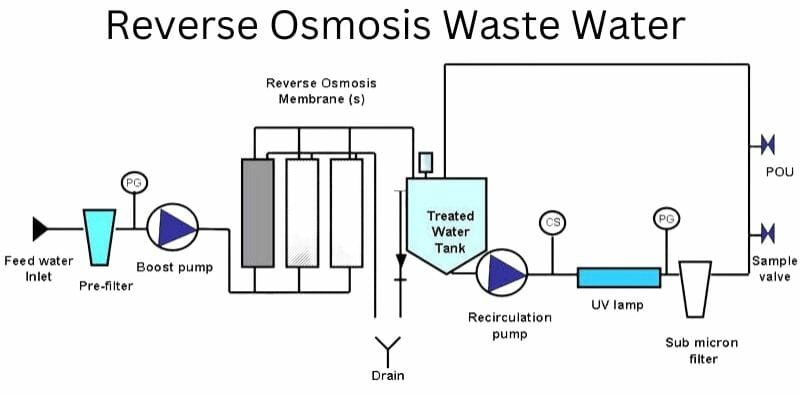 Reverse Osmosis Waste Water: The Facts!
What can you do about it?
Before you throw your RO system out the window, take a deep breath. There are ways to shrink that waste. First, look for a high-efficiency RO system (like models with a permeate pump). These can boost the ratio to 1:1—meaning for every gallon you drink, only one gallon goes to waste. They cost more upfront, but your water bill will thank you. Second, consider reusing the reject water. I’m serious! Catch it in a bucket and use it for watering houseplants, washing your car, or flushing the toilet. Just don’t drink it—it’s high in concentrated minerals, but fine for non-potable uses.
Another option? Skip the whole-house RO and only install it under your kitchen sink for drinking water. Or, if your tap water is already decent, consider a simpler filter like a carbon block or a countertop distiller—they waste far less water. Your wallet and the planet will high-five you.
 RO Water Waste: How Much Water Does Reverse Osmosis Waste?
The bottom line
Reverse osmosis is incredible at making water pure—I’ll give it that. But it’s like using a firehose to fill a teacup. The waste is real, and it’s huge. The next time you see a shiny RO unit, ask yourself: Is the purity worth the eighty-percent sacrifice? For most of us, the answer is “sometimes, with a few tweaks.” So go ahead, enjoy your crisp, glass-like water. Just don’t pretend you’re not sending three glasses of perfectly good water down the drain for every one you drink. But hey, at least you’re not buying plastic bottles, right? Right?
Now, if you’ll excuse me, I need to go collect some reject water for my fern. He’s been looking a little thirsty.
