How Much To Install A Reverse Osmosis System

The other week, my buddy Dave—a man who proudly drinks tap water that tastes like a swimming pool met a limescale quarry—called me in a panic. His new espresso machine had clo...

The other week, my buddy Dave—a man who proudly drinks tap water that tastes like a swimming pool met a limescale quarry—called me in a panic. His new espresso machine had clogged twice, and the repair guy said his water was a “mineral tragedy.” Dave was now Googling reverse osmosis systems like a man possessed, but the first price he saw made him spit out his (still-dodgy) coffee. “Is this thing made of gold?” he yelled down the phone. And I had to laugh, because that’s the exact moment I knew I needed to write this.
Because let’s be real: figuring out how much to install a reverse osmosis system feels like trying to read a menu in a foreign language. You see numbers like $150 and then suddenly $2,000, and you have no clue where the line is between a bargain and a scam. And yes, your friend with the Berkey filter is already judging you. So let’s cut through the noise and talk dollars—with a side of sanity.
The Big Ballpark: $200 to $2,500 (and yes, that’s a huge window)
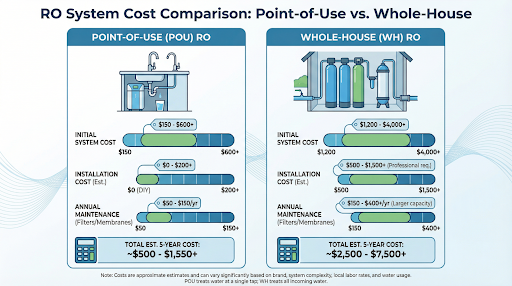
If you ask a plumber for a quote, they might start at $200 for a basic under-sink unit you install yourself. But if you want a “whole house” system that makes your showers feel like Evian, you’re looking at $1,500 to $2,500 installed. That’s the range where your bank account starts to cry, but your tea tastes like a hug. Why the gap? It all comes down to three things: the type of system, the labor, and how fancy your house wants to be.
Must Read
The Cheap Route (Under $400): DIY Under-Sink Systems
You can grab a decent under-sink RO system on Amazon for $150 to $350. Brands like APEC or iSpring are the reliable workhorses here. But here’s the catch: “installation” usually means you, a YouTube tutorial, and probably a few curse words about leaking hoses. If your kitchen sink has a dedicated hole for a separate faucet (the skinny metal one), you’re golden. If not, you’ll either drill a hole or pay a handyman an extra $80–$120.
I did this myself last year. Saved about $150 on labor, but spent a sunny Saturday afternoon contorted under the sink while my cat watched with pure judgment. Worth it? Mostly. But if you’re not handy, that $150 labor fee is the best money you’ll ever spend. (Seriously, your back will thank you.)
The Middle Ground ($500–$1,000): Professional Under-Sink Install
This is where most people land, and it’s the sweet spot for a reason. A professional plumber will charge you $350–$600 for the unit itself (markup included) plus $150–$400 for installation. Why that range? Depends on whether they need to mount a drain saddle, drill a hole in your granite countertop, or run a line through a cabinet that’s already full of cleaning supplies.
 How Much Does a Reverse Osmosis System Cost? (2026)
And here’s a little secret: if you already have a water filter system under the sink, the plumber will charge less because they can reuse the existing faucet hole. That saved my friend Carla $125. She also got a free lecture about her “fossilized” old filter. Pro tip: always ask if the quote includes a “free inspection” of your current plumbing. Most plumbers will say yes, then upsell you on a system—but at least you get a clearer picture.
The Luxury Ride ($1,200–$2,500): Whole House or Tankless
Now we’re talking about systems that connect to your main water line. These beasts filter water for every tap, shower, and ice maker. Expect to pay $800–$1,500 for a quality tankless RO unit (like from Waterdrop or Aquasana) plus $400–$1,000 for installation. Why so much for labor? Because they might need to cut into copper pipes, add a pressure tank, or install a permeate pump. And if you have a basement with tight crawl spaces, double the labor estimate and add a therapy session.
I watched a plumber install one of these in a friend’s new build. Took him five hours and two trips to the hardware store. He charged $950 for the labor, and honestly? For the amount of swearing he did, it was a bargain. The takeaway: unless you’re a DIY wizard with a plumbing license, leave whole-house systems to the pros.
 How Much Are Reverse Osmosis Systems? Pricing and Installation Guide
The Hidden Costs That Bite You in the Back
Nobody tells you about the extra $50–$150 for things like a brass faucet (instead of plastic), long supply lines, or a “TDS meter” to test your water. And don’t even get me started on replacement filters. Yearly filter packs run $60–$150, and the RO membrane itself needs replacing every 2–3 years for about $60–$120. So after year one, your “cheap” $250 system just became a $400 investment. But compared to buying bottled water? You’ll break even in about 18 months if your family drinks a lot. (Do the math—it’s worth it, I promise.)
The Final Gulp: Is It Worth It?
If your water tastes like chlorine, leaves white spots on your glasses, or makes your kettle look like a fossil exhibit, a reverse osmosis system is a beautiful upgrade. For most homes, a professionally installed under-sink system for $500–$800 is the perfect balance. You get clean, crisp water without taking out a second mortgage. And you won’t have to listen to your friend Dave complain about his clogged espresso machine anymore.
So grab a glass of whatever you’re drinking now, think about it, and remember: the best price isn’t always the lowest—it’s the one that comes with clean water and a plumber who shows up on time. Cheers to that.
