How Much Does A Water Filtration System Cost

So, my buddy Dave—yes, that Dave, the one who buys a new gadget every time he sneezes—called me last week in a panic. His tap water suddenly tasted like a swimming pool mixed...

So, my buddy Dave—yes, that Dave, the one who buys a new gadget every time he sneezes—called me last week in a panic. His tap water suddenly tasted like a swimming pool mixed with an old penny. He spent the next four hours online, spiraling down a rabbit hole of reverse osmosis tanks and UV lights. By midnight, he’d convinced himself he needed a system that costs more than his used car. Sound familiar?
Before you freak out like Dave, let’s get one thing straight: water filtration costs vary wildly, and you don’t need a second mortgage to drink clean water. I’m talking to you, the person staring at your faucet with suspicion right now. The price tag isn’t just about the box—it’s about what’s in your tap, your DIY skills (or lack thereof), and how fancy you want to get. Let’s break it down without the salesman’s smile.
The entry-level heroes: Pitchers and faucet filters
Remember that Brita pitcher your college roommate had? Yeah, that’s still the cheapest way to dip your toes in. A basic pitcher filter runs you about $20 to $40 upfront, with replacement cartridges costing $5 to $10 per month. Not bad for kicking chlorine and bad taste to the curb.
Must Read
But here’s the irony: if you drink a ton of water, you’ll be refilling that thing like a hamster on a wheel. Ugh, the patience it takes. A faucet-mounted filter is the next step up—around $30 to $60—and it clicks on in seconds. Just don’t lose that little switch that diverts the flow, or you’ll be drinking unfiltered regrets.
Countertop and under-sink models: The middle ground
Okay, let’s talk about the countertop filters—the unsung heroes of the kitchen counter. These sleek canisters sit next to your sink and connect with a simple hose. You’re looking at $60 to $200 initial cost, with filters lasting 6 to 12 months. They handle sediment, chlorine, and even some heavy metals. Not bad, right?
If you want to hide the gear, an under-sink system is your jam. You’ll pay $100 to $350 for the unit, plus installation if you’re not handy with a wrench. (And let’s be real—most of us aren’t.) The secret sauce? Replacement filters run $30 to $100 a year. That’s less than a fancy Starbucks habit, people.
Pro tip on the side: If you rent, go countertop. Landlords hate permanent holes in cabinets. I’ve seen friendships end over drilled granite. Don’t be that person.
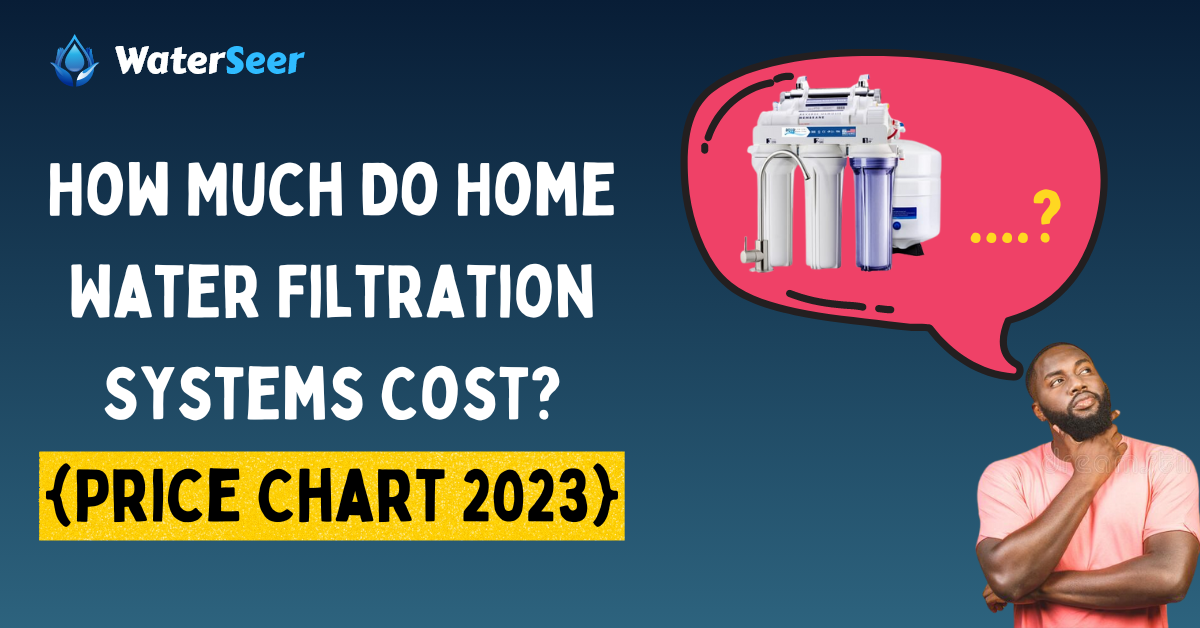 How Much Do Home Water Filtration Systems Cost? {Price Chart}
The big guns: Reverse osmosis and whole-house systems
Now we’re in Dave territory. A reverse osmosis (RO) system is the Lamborghini of water filters—it strips nearly everything, including fluoride and heavy metals. Expect to pay $150 to $600 for a good under-sink RO unit. But here’s the kicker: annual filter replacements can cost $100 to $200, and these things waste water (about 3 gallons for every 1 gallon purified). Ouch, Mother Nature says hi.
And then there’s the whole-house filtration system—the “I’m done messing around” choice. This beast treats every tap, shower, and toilet in your home. Prices start around $500 for basic sediment filters and shoot up to $3,000+ for multi-stage systems with UV sterilization. Installation? Another $200 to $800 if you hire a plumber. Your water will feel like a spa, but your wallet might cry.
Hidden costs nobody warns you about
Let me drop some irony on you: the cheapest filter might cost you more in the long run. Those $10 pitcher cartridges? If you replace them late, bacteria can grow. Suddenly, you’re paying for bottled water anyway. Brilliant. Also, don’t forget installation fees, plumber visits, and annual maintenance. A $300 DIY project can become $600 if you cross-thread a pipe and flood your kitchen. Ask me how I know.
Another sneaky cost: filter subscription plans that auto-ship every three months. They’re convenient, but you’ll end up with a closet full of cartridges you forgot to cancel. I have six. They’re my retirement fund now.
 Whole House Water Filter Costs for 2025-2026
So, how much should you actually expect to pay?
Here’s the straight talk, friend. For a single faucet or pitcher, budget $30 to $70 per year (including replacements). For a good under-sink system, expect $200 to $500 in year one, then $50 to $100 yearly after that. Whole-house systems? $1,000 to $4,000 upfront, with $100 to $300 annual upkeep. That’s real money, but so is your health.
Don’t buy the most expensive one just because. Test your water first! A $10 test kit tells you if you have lead, chlorine, or just hard water. If it’s just taste, a $30 pitcher is your bestie. If it’s heavy metals, go RO. And please, ignore the salesman who says you need a “whole-home hydrogen infusion system.” You don’t.
The bottom line (and a little hug)
Dave ended up buying a $400 under-sink RO system, installed it himself, and now sends me videos of his sparkling water every week. He’s proud, and honestly, that’s fine. But you? You can get clean, safe water for less than $100 a year if you keep it simple. The filter on your fridge might even be good enough—just check the manual.
So, stop overthinking. Grab a test kit, pick a budget, and remember: clean water doesn’t need to drain your bank account. And for the love of all that is holy, don’t call Dave for advice. He’ll talk you into a water sommelier program. I swear to you, he already has a diploma.
