How Much Water A Person Should Drink A Day

Ever feel like you’re drowning in advice about water? You hear “drink eight glasses a day” so often it’s basically a broken record. But is that magic number really true for yo...
Ever feel like you’re drowning in advice about water? You hear “drink eight glasses a day” so often it’s basically a broken record. But is that magic number really true for you? Let’s chill out and get curious about where this whole hydration thing actually comes from.
The Famous “8x8” Rule: Where Did It Even Come From?
You’ve probably heard the “eight 8-ounce glasses” rule. That’s about 1.9 liters—not quite a full gallon, but close. Turns out, that number isn’t some ancient hydration law.
A 2002 study from the American Journal of Physiology basically called it a myth. The researchers found zero scientific evidence for the “8x8” prescription. It might have started as a vague dietary guideline decades ago, and it just stuck because it’s easy to remember.
Must Read
So if that’s not the holy grail, what is? Your body is actually a pretty smart machine, and it gives you clues all day long.
What Science (And Your Pee Color) Actually Says
The National Academies of Sciences, Engineering, and Medicine says men need about 3.7 liters (roughly 15.5 cups) and women need about 2.7 liters (about 11.5 cups) of total water daily. But wait—up to 20% of that comes from food, not just your water bottle.
Think about it: a juicy apple or a bowl of soup is basically stealth hydration. Your coffee and tea count too, despite the old rumor they’d dehydrate you. Studies show caffeinated drinks are a net positive for fluid balance, especially if you’re not chugging ten cups.
The real VIP? Your urine color. Pale yellow like lemonade? You’re golden. Dark like apple juice? Time to grab a glass. Clear like tap water? Ease up a bit—you’re probably fine, but you don’t need to obsess.
 How Much Water Should You Drink A Day For A Healthy Body - Scoopify
Why It’s Cool That There’s No “One Size Fits All”
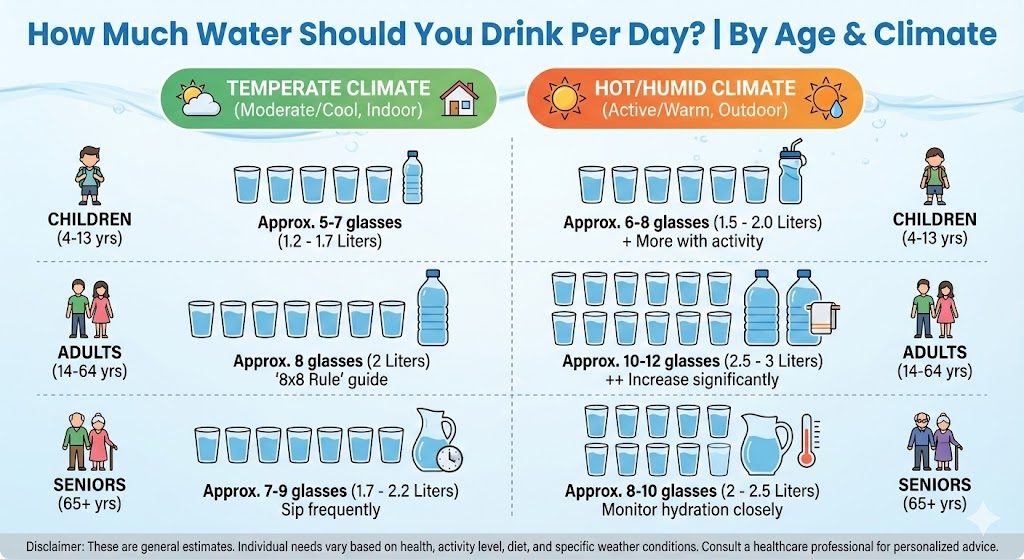
Here’s the fun part: your water needs change more than your playlist. If you’re sweating buckets at a hot yoga class, you need more water than someone binge-watching Netflix all day. Age, climate, and activity level totally shake things up.
For example, a 150-pound person who runs for an hour loses about 1-2 pounds of water through sweat. That’s roughly 16 to 32 ounces you need to replace. Compare that to a day spent sitting in an air-conditioned office—you might only lose half that amount just breathing and talking.
Think of your body like a houseplant. A cactus needs way less water than a fern, right? You’re the same way. A big, active person in a dry climate is a fern; a smaller, sedentary person in humid air might be a succulent. Listen to your thirst—it’s your plant’s leaves telling you if the soil is dry.
Fun Comparisons to Keep You Hooked
Imagine you’re a human-sized sponge. If a dry sponge gets half a cup, it expands nicely. But dump a whole gallon on it, and it just drips everywhere—your kidneys pee out the extra. A 2010 study found that drinking beyond thirst doesn’t help focus or energy; it’s just expensive, fancy urine.
 B Fit B Hydrated - The Braden Aboud Memorial Foundation
Or think about a goldfish. It lives in water, but even a goldfish can get stress if the water changes too fast. Your body loves a steady, consistent sip throughout the day, not a sudden waterfall. Would you rather chug a river at noon or sip a lazy stream every hour?
Here’s the kicker: even mild dehydration (2% of your body weight) can make you feel foggy-headed. A 2019 study showed that task performance drops roughly 12% when you’re just a little dry. But being overhydrated (uncommon, but possible) can lead to low sodium, which is no party either. So the sweet spot is real.
So, What’s the Chillest Way to Handle It?
Forget counting cups. Instead, keep a reusable bottle nearby and sip when you feel thirsty. Thirst is your body’s ancient, reliable alarm system—evolution hasn’t failed us yet.
Check your pee once a day (it’s free and easy). Dark mornings are normal, so don’t panic—just hydrate as you wake up. And if you’re active, hot, or pregnant, add an extra glass or two. Your body literally tells you what it needs if you slow down enough to notice.
Final comparison: your hydration is like a campfire. You don’t dump a bucket of water on it once a day; you add little logs (sips) steadily to keep it burning bright. Too little, it smolders. Too much, it drowns. Just keep the flame steady, and you’re golden.
