How Much Water Is In Water Bottle

Let’s talk about water bottles. You’ve seen them everywhere. On desks, in gym bags, and littering your car’s back seat. Here’s the real question: how much water is actually i...

Let’s talk about water bottles. You’ve seen them everywhere. On desks, in gym bags, and littering your car’s back seat.
Here’s the real question: how much water is actually in one? It sounds simple, but it’s weirdly fun to unpack. Grab your favorite bottle, take a sip, and let’s dive in.
The Obvious Answer (Boring, But We Need It)
Most water bottles hold 16.9 fluid ounces. That’s the standard size you buy at a gas station. In metric terms, that’s exactly 500 milliliters.
Must Read
But wait—your reusable bottle might say 32 ounces. Or 24 ounces. Some fancy ones boast a full 40 ounces. Who’s carrying around a gallon jug? Runners and very thirsty people, that’s who.
So the literal answer is easy: look at the label. But that’s like saying a pizza has crust—technically true, but where’s the joy?
The Hidden Water Inside Your Water Bottle
Here’s a fun twist: your water bottle contains more than just H₂O. Every drop has billions of molecules. A single 16.9-ounce bottle holds about 1.6 septillion water molecules. That’s 1.6 followed by 24 zeros.
Try wrapping your head around that number. It’s more molecules than there are grains of sand on all the beaches on Earth. And you’re about to drink them.
Your body doesn’t care about the math. It just says, “Yes, please, I was parched.” But now you know: you’re sipping an astronomical crowd.
The Quirky Science of “Full” vs. “Empty”
Is your water bottle ever truly empty? Nope. Even when you tip it upside down and shake it, a thin film of water clings to the inside. That’s called adhesion—water sticks to plastic like it’s best friends.
Scientists call that leftover water “retained moisture.” It’s about one to two drops. Not enough to quench a thirsty fly, but it counts as water in the bottle.
 How Many Water Bottles in a Gallon? Complete Guide
So that “empty” bottle you toss in the recycling? It still has water. You’re a recycling rebel, and that’s okay.
The Iceberg Problem (Yes, Ice)
What about ice? If you fill your bottle with ice cubes, how much water is in there? Technically, it’s still water—just in solid form. But when it melts, the volume decreases.
Here’s the kicker: ice is less dense than liquid water. That’s why it floats in your drink. A bottle full of ice cubes holds about 10% less water than a bottle of liquid. You’re shortchanging yourself by a few sips.
Next time you order iced water, ask for “extra water, no ice.” You’ll get more hydration and look like a genius. Or a weirdo. Your call.
The Most Confusing Water Bottle: The Stanley Cup
You’ve seen the giant Stanley mug that broke the internet. It holds 40 ounces. That’s more than two and a half standard water bottles. People carry it like a trophy.
But here’s the funny thing: most people never finish a 40-ounce bottle in one go. They sip, forget, and let it get warm. Then they pour it out. That’s wasted water and wasted cool flex energy.
Only professional hikers and marathon runners truly need that much. Everyone else is just walking around with a heavy, expensive decoration. You do you, though.
Bottles That Lie (Yes, They Do)
Some bottles are designed to look bigger than they are. Ever seen a “33.8-ounce” bottle? That’s exactly one liter. They round up because “one liter” sounds less impressive than “33.8 ounces.” Marketing is a trickster.
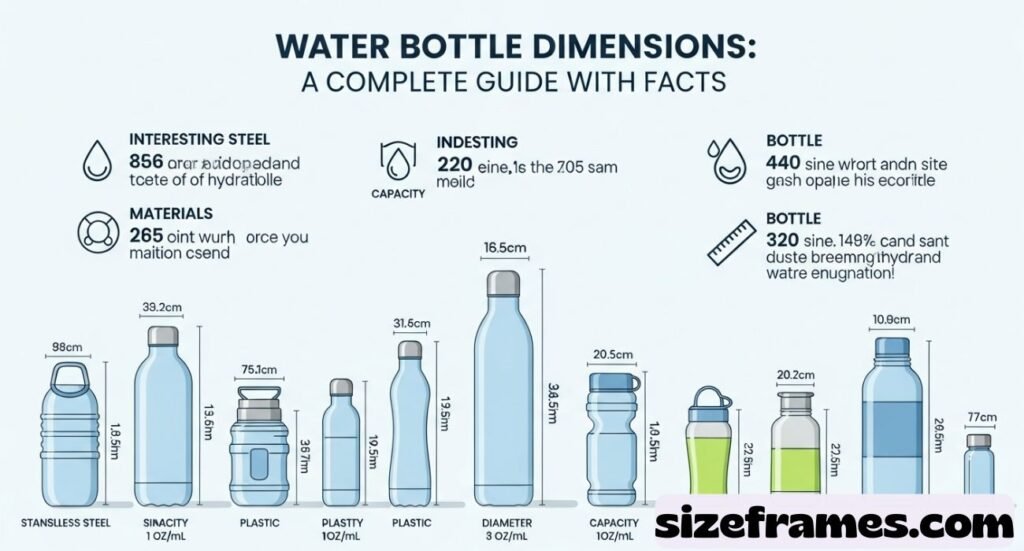 Water Bottle Dimensions: A Complete Guide With Facts
Then there’s the “half-liter” bottle that holds exactly 500 milliliters. That’s the same as 16.9 ounces. But some brands make the bottle taller and skinnier to look like more water. You’re being played, and it’s hilarious.
The moral: always check the fine print. Your eyes can’t be trusted. The label is the only truth.
The Global Water Bottle Chaos
In the U.S., we measure in ounces. In Europe and Asia, they use milliliters and liters. A typical European bottle is 500 ml (16.9 oz), but they also sell 330 ml “minis” for kids and coffee addicts.
Japan has water bottles that hold 550 ml. Why 550? Because they can. It’s a rebellious amount. “We don’t follow your rules, America.”
In Australia, they sell 600 ml bottles. That’s 20.3 ounces. It’s the perfect size for surviving the outback for an hour. Kangaroos approve.
The Real Answer: It’s All About You
So how much water is in your water bottle? It’s exactly as much as you decide to put in. Or as much as the manufacturer decided when you bought it. Or as much as the ice melted into.
But here’s the fun part: the bottle doesn’t care. It’s just a container. The water inside is a temporary guest. You are the boss of that bottle.
So fill it up. Drink it down. And next time someone asks, “How much water is in that bottle?” you can say, “Enough for a septillion molecules of fun.” Then wink. They’ll think you’re brilliant.
