How To Get Rid Of Calcium In Pool

You know that feeling when you’re prepping for a backyard barbecue, the grill is hot, the burgers are ready, and you look at your pool—and it looks like someone dumped a bucke...

You know that feeling when you’re prepping for a backyard barbecue, the grill is hot, the burgers are ready, and you look at your pool—and it looks like someone dumped a bucket of powdered donuts into it? That’s calcium, my friend. It’s not sugar, and it’s not a snow globe effect you signed up for. It’s that stubborn white crust that clings to your tile like a bad habit, and it can make your water feel rough, cloudy, and plain uninviting.
So, why should you care about kicking calcium out of your pool? Because nobody wants to swim in a milkshake. High calcium doesn’t just look ugly—it can scratch your liner, clog your filter, and turn your relaxing oasis into a science experiment. Think of it like that chalky residue on your coffee mug after you forget to rinse it for a week. Except your coffee mug doesn’t cost thousands of dollars to fix.
The “Uh-Oh” Moment: How Calcium Sneaks In
Calcium usually enters your pool through your tap water or those fancy calcium-hypochlorite shock treatments. It’s like when you accidentally pour too much salt into a soup—there’s no taking it back once it’s in there. The culprit is hard water, same stuff that leaves white spots on your shower glass and makes your soap sud up like a cartoon bubble bath.
Must Read
Let me tell you a little story. Last summer, my neighbor Bob filled his pool with well water because he was in a hurry. Two weeks later, his pool looked like a swimming hole in a limestone quarry. He spent a whole Saturday scrubbing the walls with a brush and cussing at his hose. Don’t be Bob. Check your water hardness first.
Your Calcium-Fighting Toolkit (No PhD Required)
Getting rid of calcium isn’t rocket science, but it does take a little elbow grease and a pinch of patience. First up: test strips. You can grab them at any pool store or online. If your calcium hardness reads above 400 parts per million (ppm), it’s time to act. That’s your pool’s version of a “check engine” light.
Next, you’ve got a few options. You can drain and refill part of your pool, which is like giving it a fresh start—just like when you dump out a cloudy fish tank. But be careful: never drain more than a third at a time, or your pool liner might pop out like a deflated balloon. I learned that the hard way during a heatwave.
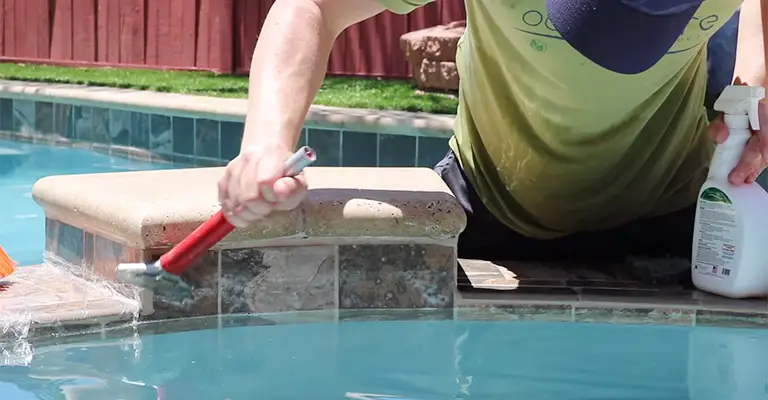 A Guide to Cleaning Pool Steps Underwater
Another trick is adding a chelating agent or a sequestrant. Those are just fancy words for a liquid that wraps up calcium particles so they can’t form that dusty crust. Think of it like a bouncer at a club who keeps the rowdy calcium molecules from dancing on your pool walls. They’re available at any pool supply shop and usually cost less than a pizza dinner.
Scrubbing and Brushing: The “Old Faithful” Method
Sometimes, you just need to put in the work. A stiff nylon brush and a splash of pool-safe tile cleaner can do wonders on that white line around the water level. It’s like scrubbing a bathtub ring after a muddy kids’ bath—annoying but satisfying when you see the sparkle return. Wear old sneakers, put on some tunes, and make it a 20-minute party.
For stubborn scale, try a pumice stone. Yes, the same kind you use on rough feet. Gently rub it on the calcium deposits while the stone is wet—it’s like an exfoliating scrub for your tile. Just don’t press too hard, or you’ll scratch the surface. Your pool tile doesn’t need a microdermabrasion, okay?
When Chemistry Gets Fun: Lowering pH Like a Pro
Here’s a little secret: calcium loves high pH. If your pool water’s pH is above 7.8, you’re basically rolling out a red carpet for those chalky crystals. Lower the pH to around 7.2 to 7.4 using muriatic acid or a dry acid product. Do it slowly, like you’re cooling down a hot cup of tea. Test the water after a few hours, and repeat if needed. Wear gloves and goggles—this isn’t a DIY face mask situation.
 YOU CAN Remove calcium from pool tiles...10 min - YouTube
If your calcium problem is extreme—like you can write your name in the scale—consider using a flocculant. It clumps the calcium together into big, heavy flakes that sink to the bottom. Then you vacuum them out like picking up pebbles from your driveway. It’s weirdly satisfying, like watching a lava lamp settle.
Prevention: The “Don’t Let It Happen Again” Plan
Once you’ve kicked calcium out, keep it out by using a scale inhibitor regularly. They’re cheap and easy to pour in after each fill or heavy rain. Also, install a water softener for your fill hose if your tap water is extra hard. It’s like putting a filter on your kitchen faucet—only for your swimming pool.
Lastly, keep your water balanced. Test pH, alkalinity, and calcium hardness every week. I know, it sounds like a chore, but it takes two minutes and saves you from a weekend of scrubbing. Think of it as flossing for your pool—annoying but way better than a cavity.
So next time you see that white stuff creeping around your skimmer, don’t panic. Grab a test strip, a brush, and maybe a cold drink. Your pool will thank you, your swimsuit will thank you, and your backyard BBQ guests will think you’re a wizard. And honestly? That’s the best kind of pool owner to be.
