How Does A Well Work For A House

Ever wonder what happens when you turn on your kitchen faucet and water comes gushing out, seemingly by magic? If your house runs on a private well, the magic is actually a cl...

Ever wonder what happens when you turn on your kitchen faucet and water comes gushing out, seemingly by magic? If your house runs on a private well, the magic is actually a clever, centuries-old system working quietly under your feet. Today, we’re pulling back the curtain on that secret underground world, and trust me, it’s way cooler than you think.
First Things First: What is a Well, Really?
A well is basically a giant straw that pokes down into an underground lake called an aquifer. That aquifer is a layer of rock, sand, or gravel that holds water like a giant, sopping-wet sponge. Your well’s job is to suck that water up and deliver it straight to your home, no city pipes required.
Think of it as your own personal underground reservoir—one that nature refills every time it rains. Pretty neat, right?
Must Read
The Star of the Show: The Well Pump
Here’s where things get mechanical. A submersible pump, which looks like a shiny metal torpedo, is lowered deep into the well casing (the pipe that lines the hole). When you turn on a tap, this pump roars to life and pushes water up through a pipe and into a special tank in your basement or crawlspace.
That tank isn’t just storage—it’s a pressure tank. It uses compressed air to keep the water pressurized, so you get a consistent, satisfying shower stream every morning. No waiting, no sputtering—just reliable water on demand.
But Wait, There’s More: The Filtering Magic
You might think well water is just “dirt water,” but your well system has your back. Most wells have a screen at the bottom to keep out sand and gravel. Then, inside your house, you might have a sediment filter and a water softener to catch minerals and polish the water to crystal clarity.
The result? Water that is often fresher and more mineral-rich than city water. It literally tastes like the earth—in a good way, I promise!
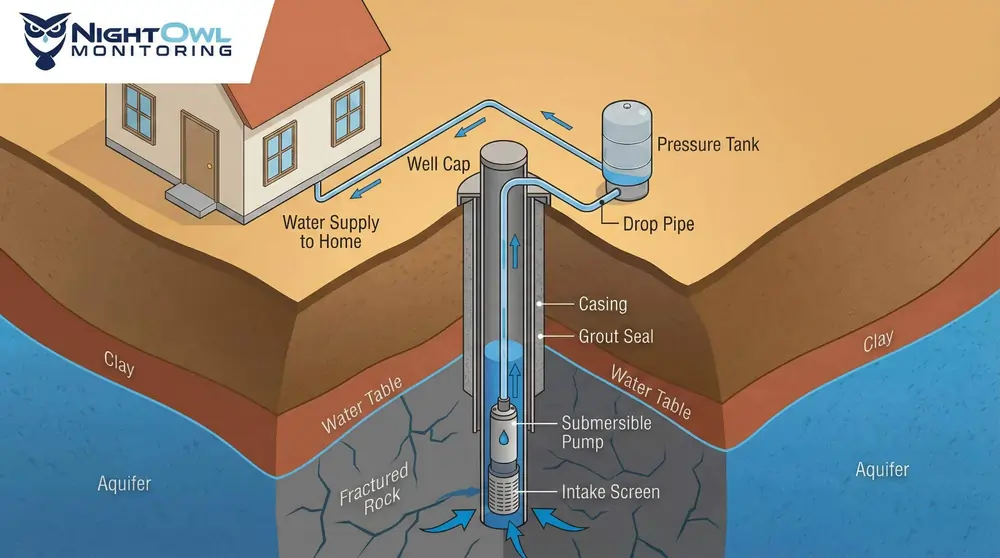 How Does a Water Well Work | Residential Well System Explained
Why Your Well is a Low-Key Superhero
Living on a well means you are totally independent from the municipal water grid. No surprise water bills, no city-wide shutoffs, and no worries if the town’s main pipe bursts. You are your own water utility CEO, and that feels surprisingly empowering.
Plus, you get to become a water wizard for your friends. They’ll ask, “Wait, you get water from where?” and you get to explain the whole underground pipeline. It’s a party trick that never gets old.
The Fun Part: A Little Bit of Homework
Now, don’t let this scare you, but wells do need a tiny bit of love. You should test your water once a year for bacteria and minerals. You also need to check the pressure tank’s air bladder occasionally (think of it as giving your system a belly pat).
But here’s the good news: with just a little care, a modern well system can run problem-free for 20 to 30 years. That’s a long, happy relationship with your personal underground water source.
 Parts Of A Water Well Pump - Infoupdate.org
The Coolest Part You Didn’t Expect
Did you know your well is basically a giant, natural battery for your property? Because the water is stored deep underground at a nearly constant temperature (around 50-60°F year-round), a well can be the heart of a geothermal heating and cooling system. It uses that steady ground temperature to heat your home in winter and cool it in summer, slashing your energy bills.
You can literally pull warmth from the earth and use it to keep your feet toasty. How’s that for a fun fact at dinner parties?
An Uplifting Note for the Curious Mind
Understanding how a well works is like discovering a secret layer of your home’s personality. It’s a reminder that even the most ordinary things—like a glass of water—are powered by ingenuity, nature, and a touch of mechanical charm.
So next time you fill up a glass from your tap, take a second to appreciate the pump humming below, the aquifer deep in the earth, and the invisible team of simple physics making it all happen. You have a little miracle in your backyard. And now that you know how it works, you’re one step closer to becoming the most fascinating person at your own kitchen table. Dive deeper—there’s always more water to discover!
