How To Shut Off Water Softener

So, picture this: last Saturday, I’m in the middle of a full-blown kitchen remodel. I’m feeling like a DIY god—tile is almost perfect, new faucet waiting in its box. Then, my...

So, picture this: last Saturday, I’m in the middle of a full-blown kitchen remodel. I’m feeling like a DIY god—tile is almost perfect, new faucet waiting in its box. Then, my wife calls from the laundry room: “Uh, the water softener is beeping like a dying robot, and there’s a puddle forming.” Classic.
That’s when I realized I had absolutely no clue how to shut the thing off. Not my finest moment. So I fumbled, swore a little, and eventually figured it out—through trial, error, and a panicked YouTube search at 11:00 PM. Now, I’m here to save you that same headache.
Why You’d Even Want to Shut It Off
First, let’s be real: your water softener isn’t a drama queen. It usually chugs along without complaint. But there are valid reasons to give it a timeout.
Must Read
Maybe you’re repairing a leak (like my hero moment). Or you’re moving the unit to a new spot. Or hey, maybe you’re going on vacation and don’t want it regenerating saltwater for an empty house.
Side note: Don’t shut it off just because you think it’s “wasting electricity.” That’s like unplugging your fridge to save a buck—your pipes will throw a fit with hard water scale. Trust me, I tried that once. Regret.
Step 1: Locate the Bypass Valve (Your New Best Friend)
Every water softener has a bypass valve. It’s usually a set of red and blue levers or knobs at the back of the unit. Think of it as a secret escape route for your water—like a VIP lane that skips the salt tank.
Look for a small metal or plastic block with two or three handles. If you see one handle pointing down and another pointing left, you’re probably in business. If you see a single knob, just smile and nod—you’ll still figure it out.
Pro tip: Snap a photo of it now, before anything goes wrong. Future you will thank you when you’re elbow-deep in soapy panic.
Step 2: The “Push-to-Turn” Dance
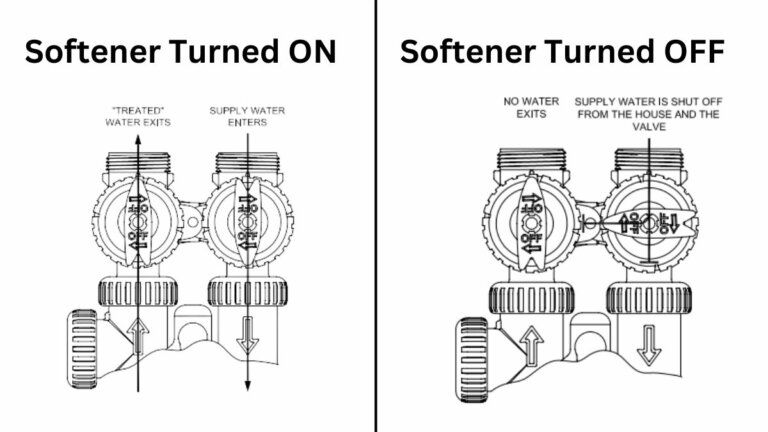
Okay, so you’ve found the valve. Now, most modern softeners have a push-to-turn mechanism. You literally push the knob inward, then twist it 90 degrees. It’s like opening a stubborn jar of pickles—but with less brine.
 How To Turn Off Water Softener? (& When) - Aqua Professor
If you have two levers, here’s the magic: turn both of them so they’re perpendicular to the pipes. That means the water flow is blocked. If they’re parallel, you’re still letting water pass through. Confusing? Yeah, but once you see it, it clicks.
Irony alert: I once spent five minutes pushing a valve that pulls to close. Read the little symbols on the valve body. If it shows a line with a cross, that’s “closed.” If it shows an arrow, you’re in “open” mode. Don’t be me.
Step 3: Kill the Power (If You’re Paranoid Like Me)
There’s a power cord plugged into a standard outlet near the softener. For total shutdown, unplug that sucker. It’s optional, though. The water flow stops at the bypass valve, so the electronics are just sleeping.
But here’s the thing: if you’re going to be gone for weeks, or you’re draining the system for winter, unplugging prevents the control board from waking up and trying to regenerate. That’s just wasted salt and water.
Heads up: Some softeners have a “regeneration cycle” that must complete before you cut power. If you yank the cord mid-cycle, you might break its brain. So wait until the display shows “Idle” or “No Flow.” Patience, grasshopper.
Step 4: Double-Check for Drips (And Dignity)
After you’ve shut the valve and unplugged, run a faucet (like the kitchen sink) on cold water. If the water runs clear and tastes like normal water, you’re golden. If it’s still salty or feels slippery, you forgot something.
 Learn How To Turn Off Your Water Softener The Right Way
No judgment—I’ve done it. Last month, I turned the wrong valve and my “puddle” turned into a “lake.” Just stick your ear to the pipes and listen. A hissing sound means water is still moving. Silly? Yes. Effective? Also yes.
Final irony: Once you’ve shut it off, you’ll probably notice how hard your water actually is. Soap won’t lather, dishes spot, and your hair feels like straw. That’s the real test: if you hate the result, you’ve done it right.
How to Turn It Back On (The Happy Ending)
When you’re ready to restore order, reverse the steps. Turn the bypass valve parallel to the pipes. Plug the power back in. Then, press the “Regen” button manually to flush the system.
Let it go through a full cycle (about two hours). After that, you’ll get that soft, boujee-feeling water back. Your soap will be bubbly, your skin grateful, and your coffee maker will stop screaming at you.
One last thing: If you ever see a red light or hear a persistent beep after you turn it back on, don’t panic. It’s just your softener saying “I missed you.” Press the reset button. Or pour it a glass of salt. I’m kidding. Mostly.
So there you go—no more panicked YouTube sessions at midnight. You’re now officially smarter than me on that fateful Saturday. Go shut that water off with confidence. And maybe keep a mop nearby, just in case.
