How Does The Ro Membrane Work

Ever wonder how your tap water goes from meh to pristine? You might have heard about Reverse Osmosis, or RO, but the science behind it sounds intimidating. Let’s break it down...
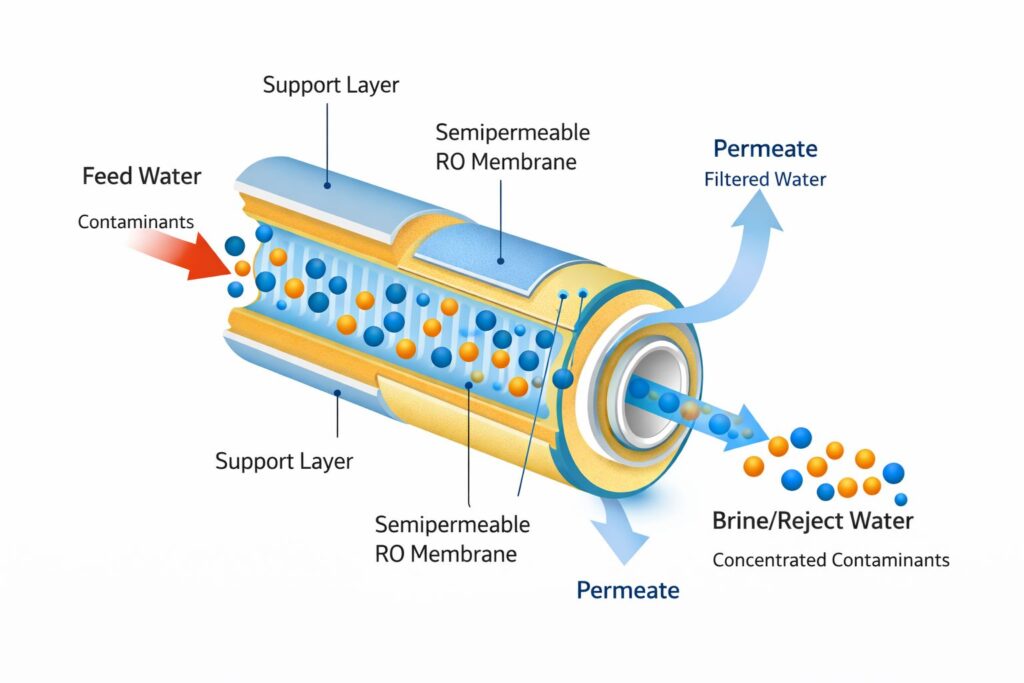
Ever wonder how your tap water goes from meh to pristine? You might have heard about Reverse Osmosis, or RO, but the science behind it sounds intimidating. Let’s break it down in the simplest way possible—imagine we’re just chatting over a glass of that clean water.
What’s the Big Idea?
At its core, an RO membrane is like a super picky bouncer at a club. It lets the cool, tiny water molecules through, but it blocks the riff-raff—things like minerals, chemicals, and bacteria.
Think of your tap water as a crowded party with lots of unwanted guests. The RO membrane is the velvet rope that says, “Sorry, only H₂O gets in tonight.”
Must Read
The Secret Sauce: Pressure
Reverse Osmosis gets its name because it’s basically osmosis in reverse. In nature, water naturally flows from a clean area to a dirty one to balance things out (that’s osmosis). But RO says, “Nope, we’re doing it backwards.”
By applying pressure—usually from your home’s water supply or a small pump—we force water through the membrane from the dirty side to the clean side. It’s like pushing a sieve full of mud until only clear water drips out.
Why is that cool? Because it means we’re not using chemicals or heat—just pure physics and a little elbow grease from your water pressure.
How Tiny Are the Holes?
Here’s where it gets mind-blowing: the pores in an RO membrane are about 0.0001 microns wide. That’s one-millionth of a millimeter. To put it in perspective, a human hair is about 70 microns wide—so these holes are 700,000 times smaller than a hair.
Silly comparison time: if a grain of salt were the size of a basketball, the membrane’s pore would be the size of a pinprick on that basketball. That’s how precise this filter is.
 Ro Membrane Filtration Process Is An Example Of at Emerita Yamamoto blog
What Actually Gets Blocked?
Pretty much everything you don’t want in your glass. The RO membrane stops dissolved salts, heavy metals like lead and arsenic, and even microscopic viruses and bacteria.
Think of it as a net that catches the stuff you can’t see with your naked eye. It’s the reason why RO water is often used in hospitals and labs—they trust it to be pure.
But here’s the fun twist: it’s so good at its job that it also blocks healthy minerals like calcium and magnesium. That’s why some RO systems add a remineralization step afterward—so you don’t end up with water that’s “too clean” and flat-tasting.
The Two-Lane Highway Analogy
Imagine a highway with a toll booth that only lets sedans (water molecules) through. Big trucks (contaminants) are forced to take a detour. But here’s the catch: the highway has to flush those trucks away every so often, or they’ll clog the booth.
That’s why RO systems have a drain line. About 75% of the water that enters your system never makes it to your glass—it’s used to wash away the trapped gunk. Yes, it’s a bit wasteful, but newer membranes are getting way more efficient.
Why It Feels Like Magic
Honestly, the simplicity of it is what gets me. No boiling, no chemicals, no fancy electricity. You just let water pressure do the heavy lifting while a plastic sheet—yes, the membrane is basically a rolled-up plastic film—does the work.
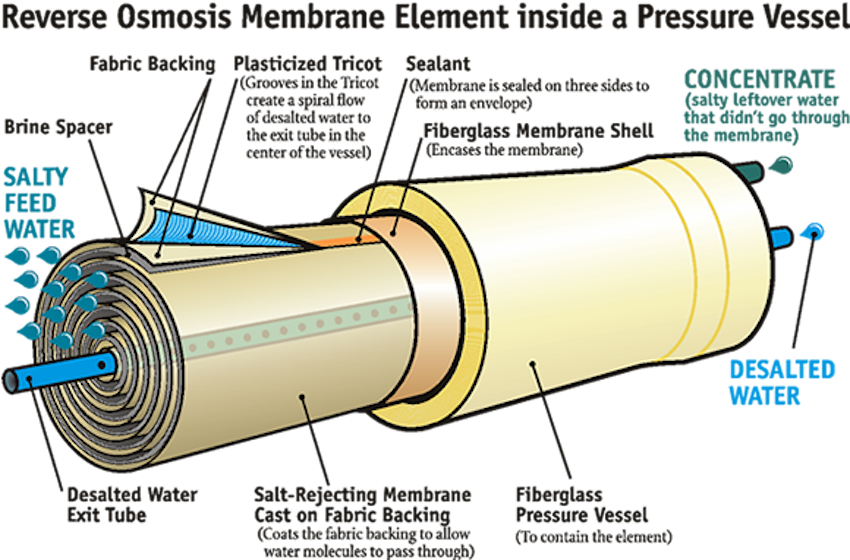 Reverse Osmosis - Aquaphor
It’s the same technology used to desalinate ocean water on ships and in arid countries. That means the filter in your kitchen sink is a miniature version of what makes drinking water possible for entire cities.
Feeling curious about what’s actually in your tap water? You can test it at home—but chances are, an RO system will catch the stuff that even your nose can’t smell.
Does Your Water Really Need It?
Well, that depends on where you live. If your tap water tastes fine and you’re not worried about lead, you might not need an RO system. But if you’ve got hard water (white scale on your kettle) or a weird chlorine aftertaste, RO can be a game-changer.
Think of it like a security blanket for your hydration. You don’t always need it, but it’s nice to know that every sip is free from surprises.
Wrap It Up
So next time you pour a glass of RO water, take a moment to appreciate the tiny plastic membrane that worked its magic. It’s like having a miniature water treatment plant under your sink—pressure-powered, shockingly precise, and just a little bit wasteful but totally worth it.
Curious if you should get one? Try a water filter pitcher first, then see if you’re ready to go full RO. Either way, your taste buds will thank you.
