How To Turn Main Water Off

Picture this: It’s a lazy Saturday morning. You’re half-asleep, shuffling to the kitchen for coffee, when you hear it—a sinister hissing sound from the bathroom. You open the...
Picture this: It’s a lazy Saturday morning. You’re half-asleep, shuffling to the kitchen for coffee, when you hear it—a sinister hissing sound from the bathroom. You open the door, and whoosh—a geyser of cold water is shooting straight from the pipe under the sink, drenching your towels and slowly flooding the hallway tiles. Your brain screams, “Do something!” but your hands just flap uselessly. Been there? (I’m not proud of how long I stood there in a puddle, arguing with a wrench.)
That nightmare scenario has a simple escape hatch: knowing exactly how to turn the main water off. It’s one of those boring adult skills nobody teaches you, but when a pipe bursts or a toilet overflows mid-sneeze, it’s the difference between a “whoops” and a “we need a new floor.” Trust me, your future dry socks will thank you.
First, Find the Beast
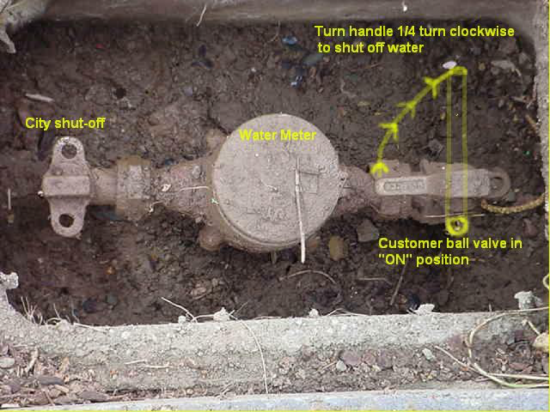
Your main water shut-off valve is usually not in a logical place. Think like a plumber with a grudge: it’s often in a basement, crawlspace, or that creepy utility closet where you store old paint cans. Look for a pipe coming through the wall or floor, and follow it until you spot a wheel-like handle (a gate valve) or a straight lever (a ball valve).
Must Read
If you live in a warm climate, check outside near the street—there’s often a metal cover in the ground with a valve inside. In apartments, check your water heater closet or utility room. Pro tip: If you’re renting, find this before the landlord’s “I’ll fix it Monday” speech becomes a reality. (And if you can’t find it after ten minutes, call a neighbor who looks like they own a tool belt—they probably know.)
Gate Valves vs. Ball Valves: A Tale of Two Wrenches
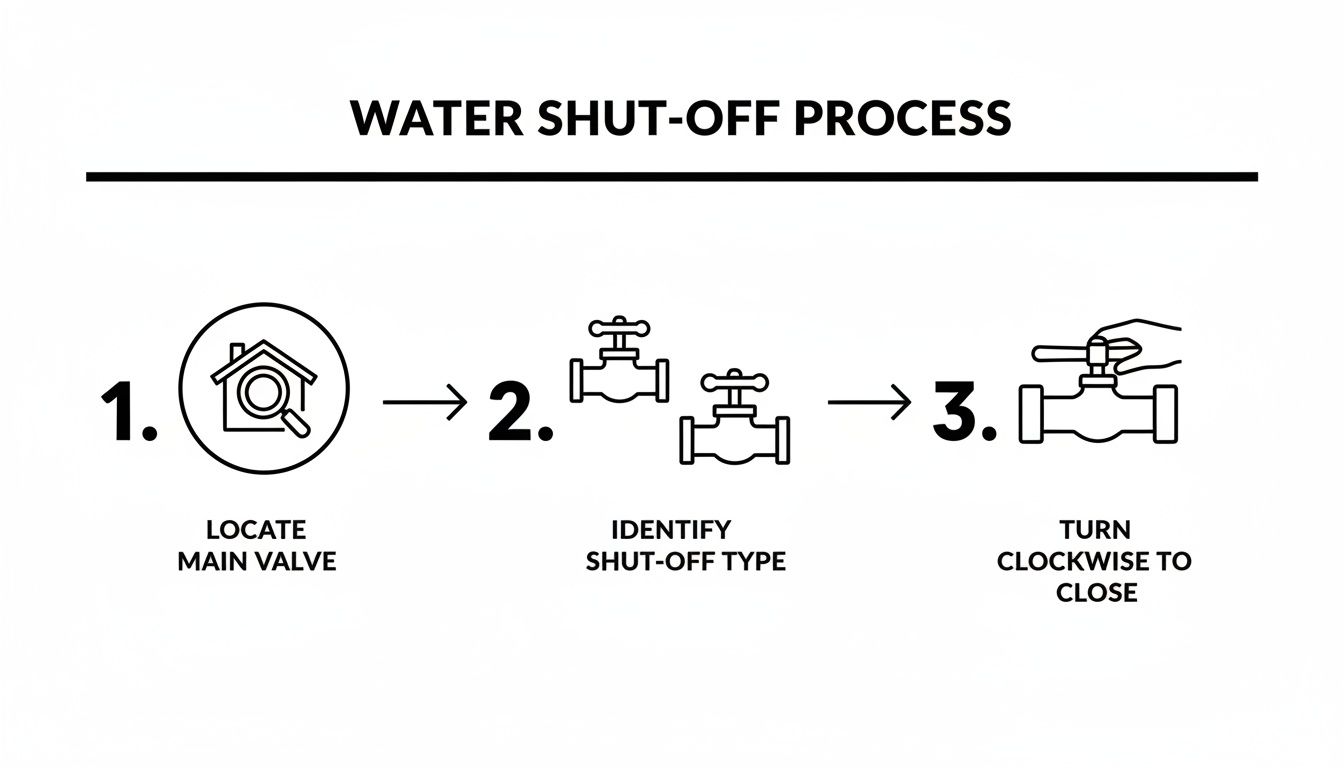
You’ll encounter two types. The gate valve has a round wheel you turn clockwise to shut. It’s old-school and finicky—sometimes it sticks or doesn’t close all the way. Turn it slowly until you feel resistance, then a little more, but don’t Hulk-smash it or you’ll break the stem (ask me how I know).
The ball valve is your modern hero—just a lever that you pivot 90 degrees. When the lever is parallel to the pipe, water flows. When it’s perpendicular (crosswise), it’s off. No guessing, no cranking. If you see one, give it a silent high-five. Warning: old ball valves can get stiff, so use a gentle but firm grip—no sudden jerks that yank the whole pipe loose.
The Actual Turn-Off Ritual (No Drama)
Here’s the step-by-step that won’t make you cry. First, locate your valve and clear any clutter around it—you don’t want to trip over a shoe while water creeps toward your electronics. Then, take a deep breath. You’re in control.
 Step-by-Step Guide to Safely Turning Off the Main Water Supply to Your
For a gate valve: grip the wheel firmly and turn it clockwise (righty-tighty) until it stops. Don’t force it past the stop—you’ll strip it. For a ball valve: just push or pull the lever to the perpendicular position. That’s it. You’ll hear a gurgle, then silence. Like a magic spell for plumbers.
Now, the Irony Check
Once you’ve turned it off, test it. Run a faucet anywhere in the house—if only a trickle comes out, you did it. If water still flows, your valve might be old and leaky (common) or you might have turned the wrong thing. Yes, I once turned off the gas line instead of water. My pilot light was very confused. Don’t panic—just double-check the valve handle and try again.
If the valve won’t budge at all (rusted, seized, or it fought back), call a pro immediately. Do not grab a hammer and “persuade” it. That’s how you turn a $150 repair into a $3,000 basement swimming pool. And yes, that’s a direct quote from my friend Larry, the “accidental backyard pond” guy.
Why You Should Practice (Yes, Right Now)
I know, I know—you’re busy. But do a dry run while everything’s fine. Go find that valve, touch it, maybe even turn it a quarter turn (then back) to check it moves. Doing this in peace is 100% easier than doing it while ankle-deep in water. If you have a spouse or roommate, show them too—because you might be at the grocery store while they’re screaming at a spray hose.
 How Do I Turn Off the Mains Water Supply to My House? | Tutorial | DIY
Label it, too. Grab a Sharpie and write “MAIN WATER” right on the wall or pipe. Future you, panicking with a wet phone, will send you a mental bouquet of gratitude.
The Aftermath: Turning It Back On
When the crisis is over, don’t just blast the valve open. Turn it back on slowly—a quarter turn at a time—to let air and pressure equalize. If you crank it wide open instantly, you can hammer the pipes and cause a leak somewhere else (yes, that’s a thing). Listen for rattling or banging—if you hear it, slow down even more.
And one more ironic thing: after you fix the immediate leak, call a plumber anyway. That burst pipe is often a symptom of bigger issues, like high water pressure or old galvanized pipes. Don’t be a hero. Your weekend is for relaxing, not for becoming a self-taught pipe welder because you watched one YouTube video.
So there you go. Next time you hear a hiss, a drip, or a full-on water explosion, you’ll be the calm one in the room—the one walking purposefully toward the valve while everyone else splashes around. You’ve got this. And if you don’t, well, at least you know where to start. Now go find that valve—it’s waiting for you, probably behind a stack of old board games. (No, I won’t apologize for the games. They deserve better storage.)
