Why Is Pure Water Neutral

Let's be real for a second. You’ve probably heard the phrase “pure water is neutral” a million times. But have you ever stopped to ask why? It sounds so simple, right? Like, “...
Let's be real for a second. You’ve probably heard the phrase “pure water is neutral” a million times. But have you ever stopped to ask why? It sounds so simple, right? Like, “of course it is, because… it just is.”
Well, grab your mug. Let’s spill some tea (or water) on this. It’s way more interesting than your high school chemistry teacher made it sound.
The pH Party Scale
First, a quick refresher. pH is basically a party scale from 0 to 14. Acids (like lemon juice) are the shy, low-number guests. Bases (like bleach) are the loud, high-number party animals.
Must Read
And right in the middle? That’s neutral—a pH of 7. It’s the sweet spot. It’s the “I’m fine with everything” zone.
Pure water lives at this exact perfect 7. But how did it get that parking spot? Let’s dive into the microscopic chaos.
The Secret Life of Water Molecules
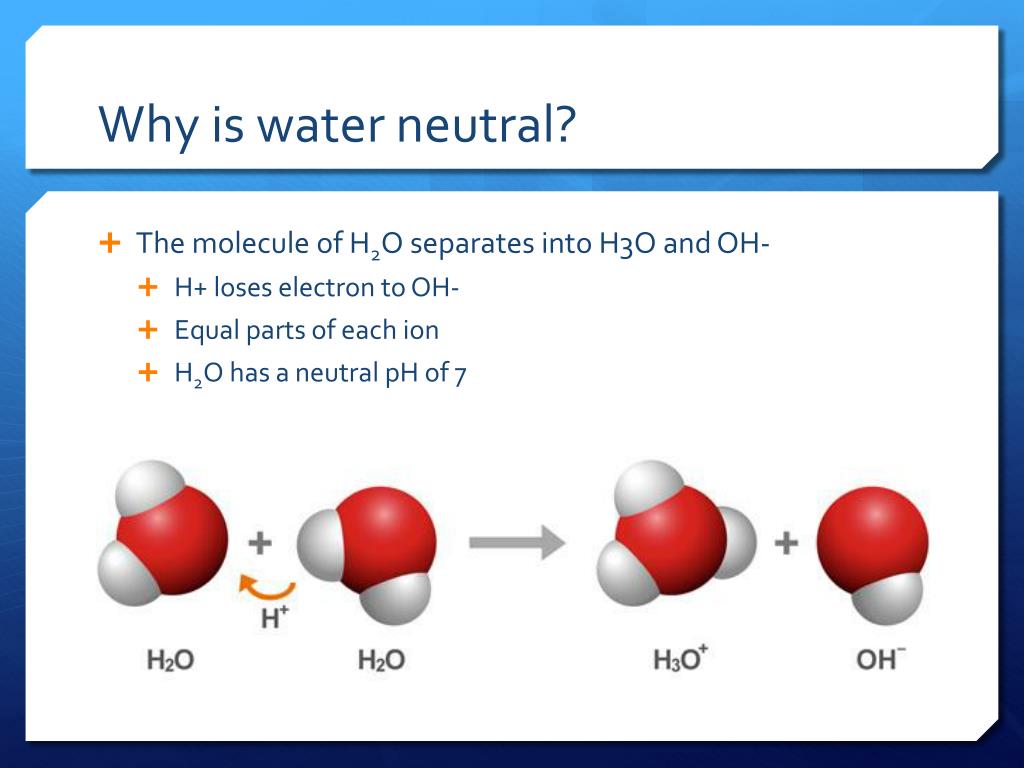
Okay, picture a water molecule. It’s one oxygen atom with two hydrogen atoms clinging to it like shy toddlers. Cute, right? But here’s the kicker: water molecules are constantly playing tag.
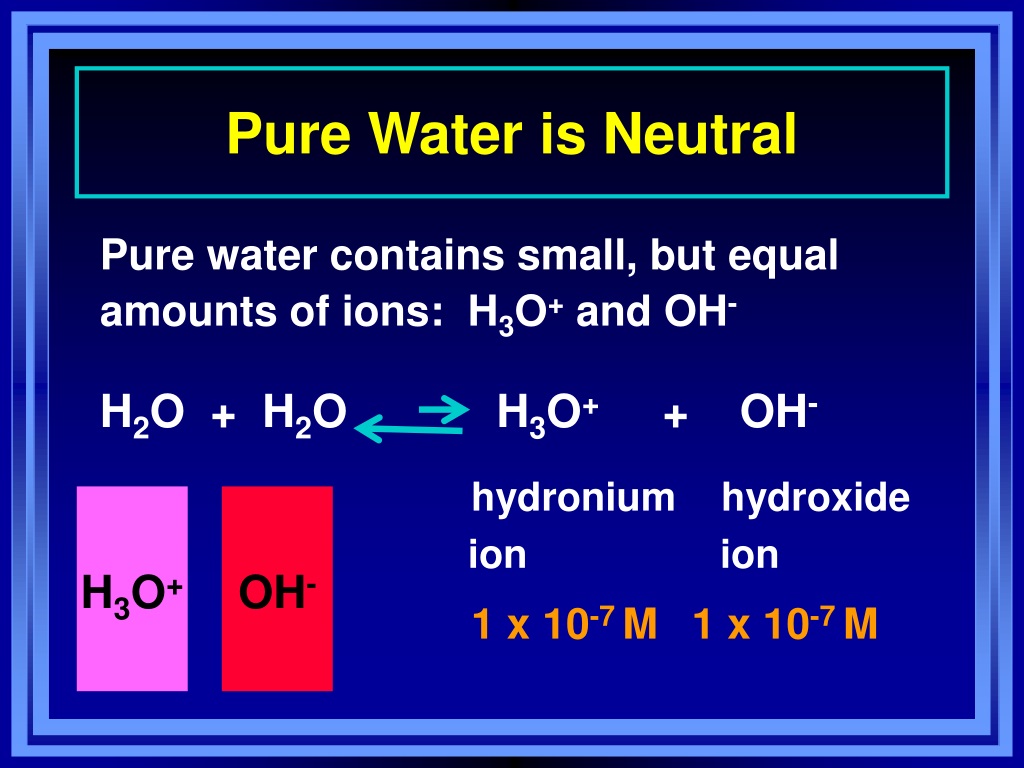
They bump into each other. And sometimes, one molecule steals a hydrogen nucleus (a proton) from its neighbor. This is called autoionization. And yes, it happens all the time.
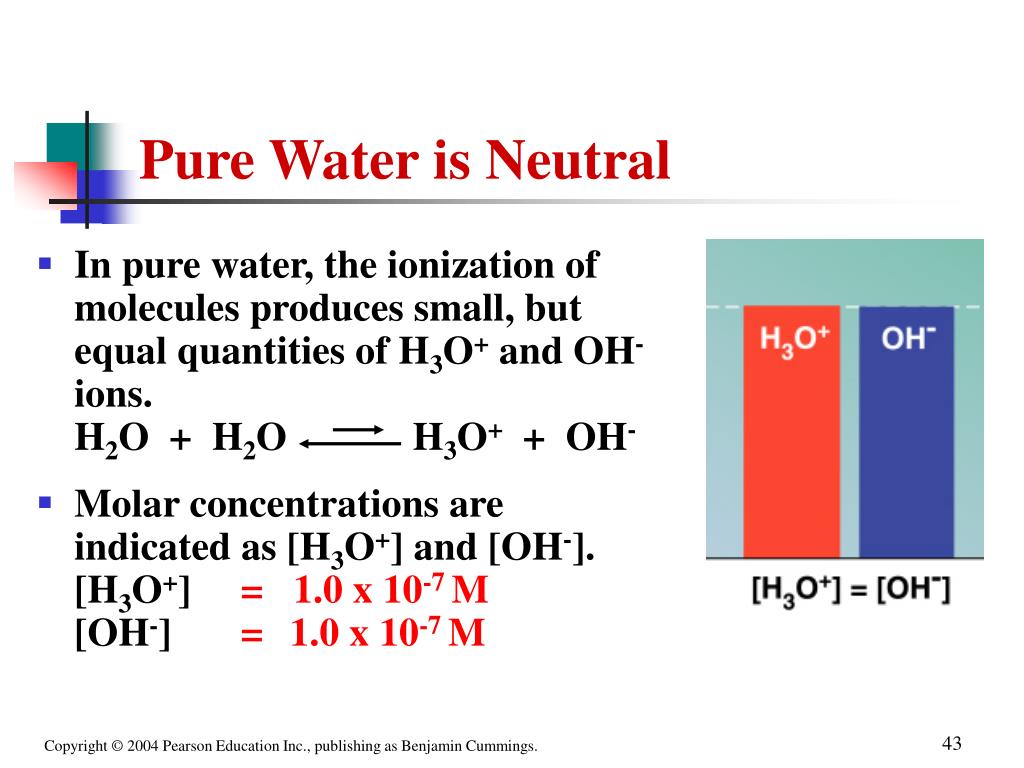
When that theft happens, you get two new characters: a hydronium ion (H₃O⁺) and a hydroxide ion (OH⁻). One is acidic. One is basic. They’re like tiny feuding siblings.
The Perfect, Boring Balance
Here’s the magic part. In pure water (no lemon juice, no soap, no weird stuff), these two ions are born in exactly equal numbers. For every one H₃O⁺ that shows up, one OH⁻ shows up too.
It’s a perfect tie. Like a sports game where both teams score zero goals. It’s neutral because the acidic and basic forces cancel each other out completely. No bullies allowed.
 PPT - Chapter 10 Acids and Bases PowerPoint Presentation, free download
Why do they form in equal numbers? Because water is fair like that. The reaction rates for splitting and recombining are perfectly symmetrical. Nature loves a good balance sheet.
But Wait—Why Isn’t Tap Water Neutral?
Ah, you’re sharp. You’ve noticed your tap water might taste different. Maybe it’s a bit “hard” or “soft.” That’s because tap water is not pure. It’s a noisy cocktail of minerals, chlorine, and random stuff from pipes.
Those extra ingredients mess with the balance. Dissolved carbon dioxide from the air makes water slightly acidic. Minerals like calcium make it slightly basic. Pure water? That’s just H₂O and nothing else.
So your tap water is like a party with too many guests. Pure water is that quiet, empty room where everything stays calm. Boring? Maybe. But perfectly neutral.
The “Clever” Chemistry Trick
Here’s the part that sounds like a joke: pure water is neutral because it plays both sides. It acts as an acid and as a base at the same time. It’s the ultimate centrist in chemistry.
When a strong acid shows up, water grabs its proton and says, “I’ll take that, thank you.” When a strong base shows up, water donates a proton and says, “Here, you need this more than me.”
It’s a diplomat. It keeps the pH steady because it’s equally good at being both a bully and a victim. No wonder it’s the most common liquid on Earth.
 PPT - The Nature of Matter PowerPoint Presentation, free download - ID
So, Is Pure Water Really Neutral?
Technically, yes. But here’s the curveball: purity is a spectrum, not a switch. Perfectly pure water is basically impossible to make in a lab. It’s a theoretical unicorn.
As soon as you pour it into a glass, it starts absorbing CO₂ from the air. That makes it slightly acidic—around pH 5.5. So your “pure” water? It’s already cheating.
But in a vacuum (literally, in space or a sealed quartz container), pure water sits at exactly pH 7. And it’s the reference point for all pH measurements. Without that neutral anchor, we’d have no idea what “acidic” even means.
Why Should You Even Care?
Honestly? It’s just cool to know. Next time you drink a glass of water, you can say to yourself, “I’m drinking a liquid that’s a perfect, peaceful, microscopic civil war.”
It’s also why your body works. Your blood is tightly regulated to stay near pH 7.4. If it swings too far, you’re in trouble. Pure water’s neutrality is the standard your cells strive for.
So the next time someone calls water “boring,” remind them: it’s the master of balance. It’s the Switzerland of molecules. It’s the lukewarm coffee of chemistry. And that’s pretty remarkable.
Now go drink some (slightly acidic) tap water. You’ll never look at a glass the same way again.
