Why Is Well Water Brown

Okay, let’s talk about the elephant in the room. Or, more accurately, the brown water in your glass. You turn on the tap, expecting a crystal-clear drink, and out comes someth...
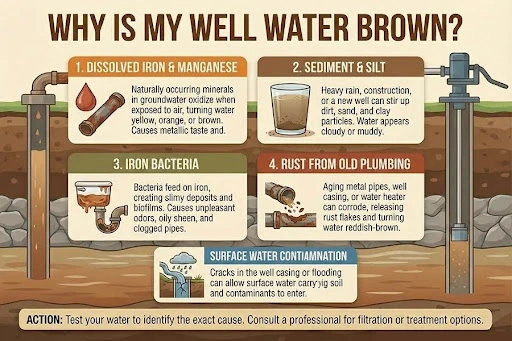
Okay, let’s talk about the elephant in the room. Or, more accurately, the brown water in your glass. You turn on the tap, expecting a crystal-clear drink, and out comes something that looks like weak iced tea.
Your first thought? Yikes. Is it mud? Is it rust? Did a family of beavers build a dam in your pipes? I’ve been there, and I promise it’s usually not as scary as it looks.
So, why is well water brown? Grab your mug (maybe a ceramic one, not a clear glass today), and let’s spill the tea. Literally.
Must Read
The Usual Suspect: Iron
Your well water isn’t trying to become a new soda flavor. Most of the time, that brownish tint is iron. It’s the most common culprit.
Think of it like this: the earth is basically one giant iron skillet. As rainwater filters through rocks and soil, it picks up iron particles. Once that iron-rich water hits oxygen, it oxidizes. Yes, your water is rusting.
This is totally normal for a well. It doesn’t mean your water is dangerous—it just means your house is a science experiment. Fun, right?
But Wait, There Are Layers
Iron comes in a few sneaky forms. There’s ferric iron, which is already oxidized. This is the rusty, red-brown stuff that settles at the bottom of a glass.
Then there’s ferrous iron. This one is a magician. It’s invisible in the water, but the minute it hits air, it turns brown. So you fill a glass, it looks clear, and then—poof—it’s a mud puddle.
And don’t forget iron bacteria. These little critters live off the iron in your water. They create a reddish-brown slime that can clog your pipes and stain your laundry. Gross, but harmless to you.
The Other Guys: Manganese and Tannins
Iron isn’t the only show in town. Sometimes the color comes from manganese. It makes water look more blackish-brown or even purple-ish. Fancy, huh?
Then there are tannins. These come from decaying plant matter—leaves, roots, you name it. If your well is shallow or near a swampy area, you might get water that looks like weak coffee. It smells earthy, not rotten.
 Brown Well Water: Causes, Treatment & Prevention Tips
Think of tannins as the compost tea of the groundwater world. It’s natural, but it can taste weird. Not ideal for your morning brew.
When Should You Actually Panic?
Here’s the good news: most brown water isn’t a health hazard. It’s an aesthetic problem. It stains your sinks, ruins a white shirt, and makes you feel like you’re camping indoors.
But what if the water suddenly turns brown after a storm? That could be surface water seeping into your well. That’s a different story—a yucky one with bacteria risk.
Also, if the water smells like rotten eggs (sulfur) or has a greasy film, you’ve got issues. Call a pro. Don’t just shrug and pour a glass.
Fixing the Brown (Yes, You Can)
Don’t worry, you aren’t doomed to drink Mountain Dew all year. There are fixes. Water softeners can handle some iron, but they’re not always the hero.
For heavy iron, you need a specialized iron filter. These use air or chemicals to oxidize the iron before it hits your faucet. They’re like tiny superheroes for your pipes.
For tannins? A carbon filter or an anion exchange system can work wonders. And for bacteria? You might need chlorination or a UV light system. It sounds extreme, but it’s standard stuff.
The DIY Urge (Resist It)
I feel you. You want to throw some bleach down the well and call it a day. Don’t. Shocking a well is a thing, but you can mess it up royally.
 Why Is My Well Water Brown? Your Ultimate Filtration Guide
Bleach can corrode your pump. It can also kill all the good bacteria in your septic system. Then you’ll have two problems instead of one.
Test your water first. Get a lab test. Know your enemy. Is it iron? Manganese? Tannins? Bacteria? Once you know, you win.
But What About the Smell?
Brown water doesn’t always stink. But iron-heavy water can smell metallic. Tannins smell like a wet forest floor. And sulfur smells like… well, you know.
If your water smells like a dumpster on a hot day, that’s a red flag. Could be sewage or a dead animal near your well. That’s not casual coffee talk anymore—that’s an emergency.
Most of the time, though, it’s just iron and a little bit of earthiness. Liveable, if you’re brave. But not ideal.
The Bottom Line
Brown well water is like a quirky neighbor. Annoying, but usually not dangerous. You just need to understand it.
So, test, filter, and don’t panic. Your water is probably just a little rusty. No big deal. Just don’t serve it to a guest in a clear glass—unless you want them to think you’re serving iced tea.
Or, you know, own the look. Call it “artisanal well brew.” I won’t tell the difference.
