Setting Water Hardness On Water Softener

So, you’ve got a water softener. Congratulations! You’ve joined the elite club of people who no longer have to scrub bathtub rings that look like geological strata. But now yo...
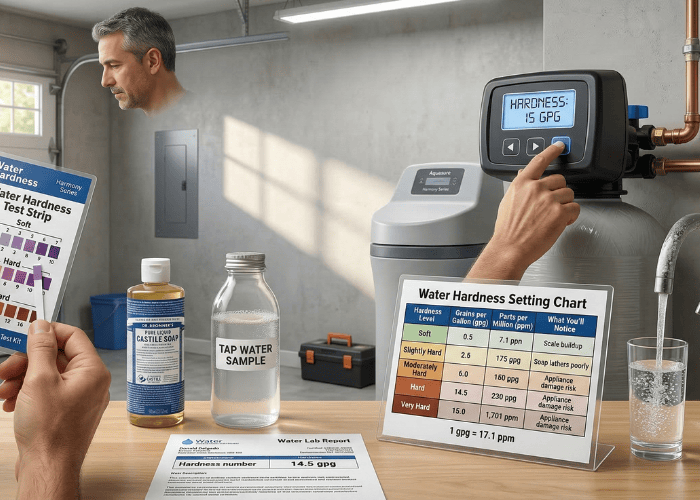
So, you’ve got a water softener. Congratulations! You’ve joined the elite club of people who no longer have to scrub bathtub rings that look like geological strata. But now you’re staring at that dial that says “Hardness Setting” and wondering if you need a PhD in hydrology to wash your socks. Relax. I’m here to turn this into something fun—like a very nerdy game show.
First, let’s get one thing straight: your water hardness is not a personality test. It’s not “are you more of a 12-grain or a 30-grain soul?” It’s a number. A number that tells you how much calcium and magnesium are partying in your water. The higher the number, the more your pipes look like a hardened artery after a lifetime of cheese fries.
To set the dial, you need to know your water’s grains per gallon (GPG). This is where you play detective. Call your local water company, or—if you’re feeling really old-school—buy a test strip. Dip it in a glass of tap water, and wait. It’s like a pregnancy test, but instead of a baby, you’re discovering mineral buildup.
Must Read
The Sweet Spot
Here’s the tricky part: you don’t set the dial to your exact GPG. You’re not baking a cake where precision is life-or-death. Instead, think of the water softener as a bouncer at a club. It lets some minerals in, but kicks out the riffraff. You want a setting just above your water’s hardness—usually add 2 to 4 grains per gallon as a safety buffer.
Why the buffer? Because water softeners are like that friend who shows up late to a party: they sometimes miss a little. Adding a few extra grains ensures the softened water stays soft, even when the neighbor runs their washing machine during your shower. Nobody wants mid-lather tragedy.
Surprising fact: If you set the dial too high, you’ll waste salt and water like a billionaire trying to wash off their yacht money. Too low? Your water will stay “hard as a fire hydrant,” and you’ll be back to scrubbing soap scum that looks like alien crust.
What If You Don't Know Your Water's Hardness?
Don’t panic. You can estimate it. If your city’s water is “well water,” assume it’s between 10 and 20 GPG. That’s like the hardness of a leather boot. If it’s municipal water from a river, it’s often 1 to 5 GPG—soft enough to baby your coffee maker. When in doubt, set the dial to 12 GPG. That’s the “Goldilocks zone” for most of North America. Your water will thank you, probably with a soothing gurgle.
But wait—there’s more. Iron in your water is a secret boss in this video game. If you have even 1 part per million (PPM) of iron, it adds 3 to 5 GPG of "fake" hardness. Why? Because iron is a jerk that sticks to resin like glitter at a craft fair. So if your water leaves orange stains on the toilet, add 4 GPG to your setting. Your porcelain will weep with joy.
 Water Softener Hardness Chart at Arnold Peete blog
The “I Messed Up” Test
You’ve set the dial. Now, wait 24 hours. Then run the kitchen faucet. Catch some water in a clear glass. Look for bubbles. Softened water should feel slippery (like you dipped your hands in liquid silk) and produce big, fluffy bubbles with soap. If it still feels like you’re washing with vinegar, turn the dial up by 2 GPG. If it leaves a sticky residue, turn it down.
Joke break: What’s the difference between a water softener and a therapist? The softener tells you to “add more salt,” and then actually fixes the problem.
Another surprising fact: some modern softeners have automatic hardness sensors. That’s right—your water softener is smarter than your toaster, and possibly your uncle who still uses a flip phone. But even those can be tricked by sudden changes (like a city flushing fire hydrants). So you still need to check the dial every few months.
The Final Nerd Win
Setting water hardness is not rocket science—it’s chemistry with a sense of humor. Once you’ve dialed in the right number, your water will be so soft you can wash a wool sweater in the same load as a cat. Okay, don’t do that. But you’ll have spotless dishes, hair that doesn’t feel like straw, and a shower head that won’t clench up like a fist.
So go on. Turn that dial with confidence. And if you still mess up? Just add more salt and pretend you meant to do it. That’s the water-softener equivalent of a mic drop.
P.S. – If you have “liquid” water softener, ignore everything I said. You just pour it in and pray. That’s a whole different kind of rodeo.
