How Often Should You Test Your Well Water

Okay, friend, let’s talk about something nobody brings up at brunch: your well water. You know, that magical liquid that comes straight from the earth into your sink. It’s not...

Okay, friend, let’s talk about something nobody brings up at brunch: your well water. You know, that magical liquid that comes straight from the earth into your sink. It’s not like city water, where some government lab tests it while you sleep. You’re the boss now. So, how often should you actually test the stuff?
The short, slightly boring answer is at least once a year. Yes, every single year, like clockwork. Think of it as a birthday for your water—a little check-in to see if it’s behaving.
But wait, there’s more! I’m not just going to drop a number and walk away. Life happens, and your well water doesn’t care about your busy schedule.
Must Read
Why so serious? (Or, what could go wrong?)
Look, I get it. You’re thinking, “My water tastes fine! No weird colors, no funny smells.” That’s what everyone says right before they find out their water is hosting a bacteria rave.
The stuff you can’t see—bacteria, nitrates, arsenic—is the sneaky villain. It won’t send you a postcard. It won’t make your water glow green. It just quietly hangs out, doing bad things to your gut or your pipes.
So once a year for the basics. Total coliform bacteria and nitrates. That’s the minimum. No excuses.
But what about the other stuff?
Great question! You get bonus points for asking. Once a year is for the health stuff. But you should also do a bigger test every three to five years. This is the “we’re getting serious” test.
This fancy test hunts for metals like lead, copper, and iron. It looks for pesticides, volatile organic compounds (VOCs), and pH levels. Think of it as a full-body scan for your well.
Why bother? Because your water might be slowly dissolving your pipes. Or your garden fertilizer is creeping into your aquifer. Gross, right?
The “emergency” testing list (save this!)
Sometimes, you don’t wait for the calendar. You test immediately if something feels... off. Trust your gut—and your nose.
Test right away if the water suddenly tastes like a penny, dirt, or bleach. Test if it gets cloudy, or if your kids get a weird stomach bug that won’t quit.
Also test after any flood, earthquake, or massive storm. Basically, if Mother Nature sneezes, you should check your glass. You don’t want to drink mud runoff, do you?
Oh, and if you recently fixed your well pump or replaced any pipes? Test again. Always. Even if you’re 100% sure you didn’t drop a wrench in there.
What about seasonal stuff?
Here’s a pro-tip from someone who learned the hard way: Spring is the best time to test. Why? Because all that snow and rain is melting and washing everything nasty into the ground.
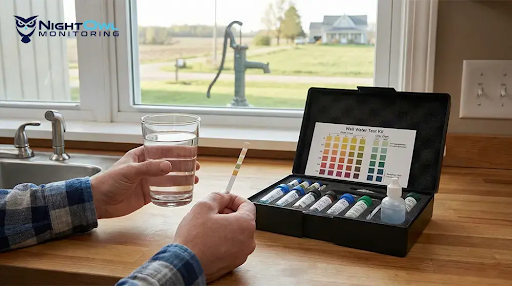 How to Test Well Water: Complete Home Testing Guide
Your well is most vulnerable after a wet spring or a heavy thaw. If your water is going to get contaminated, this is when it happens. So circle April or May on your calendar. That’s testing season, baby.
Conversely, if you live in a dry area, test after the first big rain after a drought. That first flush can stir up all sorts of horrible hitchhikers.
“But my neighbor never tests, and he’s fine!”
Oh, the classic neighbor argument. Let me stop you right there. Your neighbor might be immortal. Or maybe his well is 300 feet deep in solid rock, while yours is 40 feet deep in sandy soil.
Every well is a little snowflake. Your neighbor’s water has zero to do with yours. Don’t let Frank from down the road dictate your health choices. Frank also eats expired yogurt and thinks it’s “fine.”
Plus, are you really going to bet your family’s kidneys on Frank’s opinion? I didn’t think so.
Okay, how do I actually do this?
It’s not hard, I promise. You don’t need a hazmat suit. Most local health departments or county extension offices sell test kits for cheap. Like, $20 to $50 cheap.
They’ll give you a sterile bottle and tell you to fill it from the kitchen tap. No special ritual required. Just don’t touch the inside of the bottle cap. That’s where the magic lives… and also where your fingerprints can ruin everything.
Mail it in, wait a week or two, and they’ll email you a report. Easy peasy.
The real truth (don’t skip this)
Here’s the thing I want you to remember: Your water is a living system. It changes. what was safe last summer might be a bacterial swimming pool this winter.
Testing isn’t a punishment. It’s a power move. It’s you looking your well in the eye and saying, “I’m watching you, buddy.”
So, yearly for the basic check. Every 3-5 years for the fancy version. And anytime your gut says, “Hmm, that’s a little weird.” You can do this. You’re a well owner now. Own it.
Now go drink some water—after you order that test kit, of course. Cheers!
