How Much Water Does A Average Person Drink A Day

Let’s be real: you’ve probably heard the “eight glasses a day” rule so often it feels like a wellness commandment, handed down from a very hydrated deity. But is that number a...
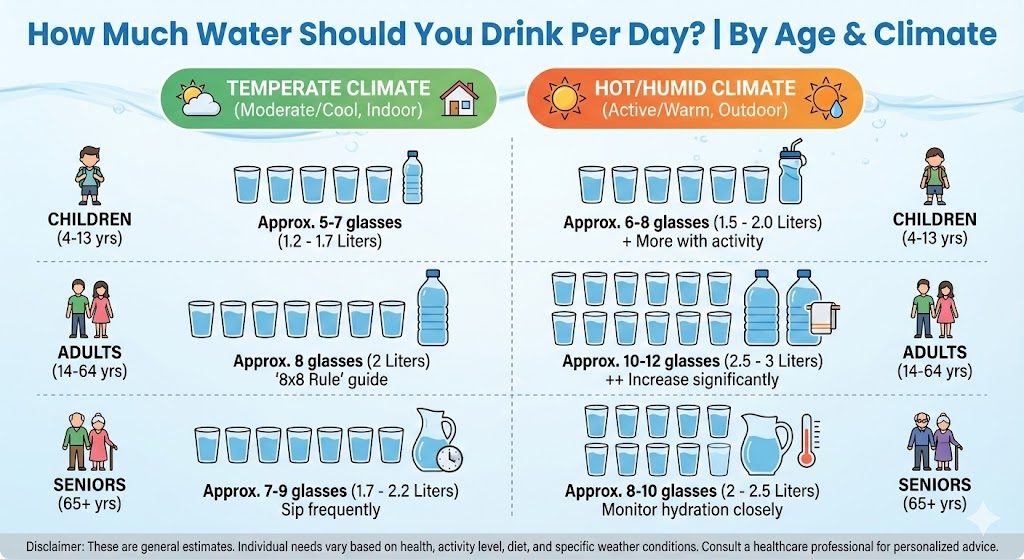
Let’s be real: you’ve probably heard the “eight glasses a day” rule so often it feels like a wellness commandment, handed down from a very hydrated deity. But is that number actually correct? And more importantly, do you really need to be that person who lugs a gallon jug everywhere like a security blanket?
The short answer is: no, the one-size-fits-all rule is a myth. Your personal water intake is as unique as your coffee order, influenced by your body, your activity, and even the weather. What we’re really talking about is finding your own sweet spot between parched and sloshed.
The Real Number (Spoiler: It’s Flexible)
The U.S. National Academies of Sciences, Engineering, and Medicine actually does have a recommendation. For the average woman, it’s about 2.7 liters (91 ounces) of total water per day. For men, that number climbs to 3.7 liters (125 ounces).
Must Read
But here’s the kicker: that’s total water, not just what you drink from a glass. About 20% of your daily intake comes from food—think juicy fruits, soups, and even that iceberg lettuce on your sandwich. So, the “drink” part is roughly 9 cups for women and 13 for men.
Think of it less like a strict math test and more like a loose recipe. Your body is a smart machine; it’s constantly adjusting based on your inputs.
When You’re a Thirsty Machine
Did you crush a hot yoga class? You’re going to need more. Are you eating a whole watermelon for a snack? Excellent—you’re already halfway there. The biggest variable is sweat. If you’re active or live in a dry climate, your baseline needs a bump.
Also, listen to your urine. Sounds gross, but it’s the ultimate cheat code for hydration. Pale, straw-colored? You’re golden. Dark as iced tea? Time to chug. Clear as tap water? You might be overdoing it.
Here’s a fun fact: your body is about 60% water. That’s roughly the same water composition as a banana. You are, essentially, a walking, talking piece of produce.
Cultural Quirks and the History of H2O
In Japan, it’s common to drink a glass of water first thing in the morning, a practice called “water therapy.” In Italy, you rarely see people walking around with a reusable bottle—they just grab a small, cheap plastic one from a café. It’s a different vibe.
 Chart Shows How Much Water People Need To Drink According To Weight
The whole “8x8” rule (eight 8-ounce glasses) actually dates back to a 1945 recommendation from the Food and Nutrition Board. It wasn’t even a hard rule; it just got simplified into common wisdom. Marketing from bottled water companies later cemented it in our brains.
So, when your friend swears by their 64-ounce jug, remember: they’re following a myth that became a movement. And that’s perfectly fine, as long as it works for them.
Practical Tips for the Busy (and Forgetful)
You don’t need a water-tracking app that nags you. Simple tricks work better. Start your day by leaving a glass of water on your nightstand—drink it before you even check your phone.
Use the “one glass per coffee” rule. For every cup of your favorite roasted bean, follow it with a glass of water. It’s a gentle balance that also helps with the jitters.
If plain water bores you, get fancy. Infuse it with cucumber, mint, or a squeeze of lemon. The goal isn’t to punish yourself; it’s to make hydration a little pleasure, not a chore.
And here’s a pro tip from marathon runners: eat your water. Snack on cucumbers (96% water), celery, or berries. You’ll get fluids plus fiber and vitamins. It’s efficiency in a bite.
 Hydration 101: How Much Water Should You Drink Each Day?
When Too Much is a Thing
Yes, you can over-hydrate. It’s called hyponatremia, and it happens when you drink so much water that your blood sodium levels become dangerously low. It’s rare, but it’s real, particularly for endurance athletes.
Don’t chug a gallon in an hour. Sip steadily throughout the day. Your kidneys can only process about 0.8 to 1.0 liters per hour. Anything beyond that just becomes expensive urine.
Also, thirst is a late signal. By the time you feel parched, you’re already slightly dehydrated. The trick is to stay ahead of it, not play catch-up.
A Quick, No-Pressure Final Check
Forget the number. Focus on feeling. If your mouth is dry, your energy is low, or your skin feels tight, drink up. If you’re fine, don’t stress about meeting a random quota.
The best water routine is one that fits your life, not one that adds more noise. You’re not running a hydration marathon; you’re just trying to move through your day without a headache.
So, fill your glass, take a sip, and trust your body to tell you the rest. It’s been doing it since you were mostly water, anyway.
