How To Test Pfas In Water

So, you’ve heard about PFAS—those “forever chemicals” lurking in your tap water like uninvited party guests who refuse to leave. Maybe you’re worried your morning coffee is se...
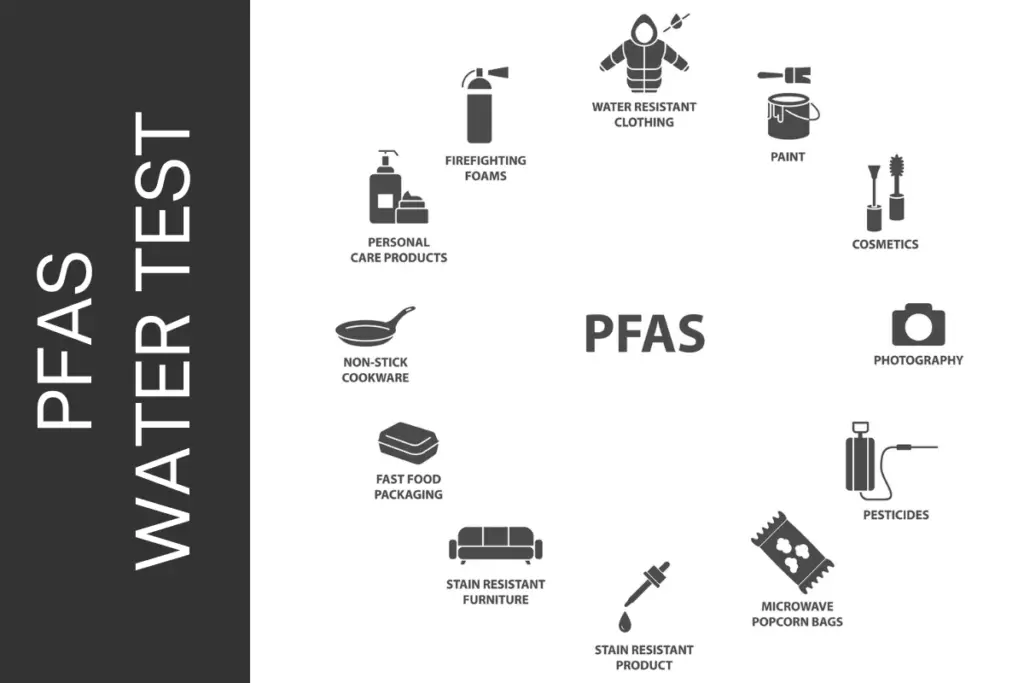
So, you’ve heard about PFAS—those “forever chemicals” lurking in your tap water like uninvited party guests who refuse to leave. Maybe you’re worried your morning coffee is secretly a chemistry experiment gone wrong. Well, grab a glass of tap water (at your own risk) and let’s figure out how to test for this stuff without needing a PhD in toxicology.
The “Forever Chemical” in Your Glass
First, a quick reality check: PFAS are more than 4,700 different compounds used to make things non-stick, waterproof, and stain-resistant. They’re in your raincoat, your pizza box, and probably your bloodstream right now. Studies show over 45% of U.S. tap water contains at least one PFAS—so you’re not paranoid, you’re just informed.
Testing for PFAS isn’t like checking if milk is sour (just sniff it). No, this is the high-stakes world of parts-per-trillion—that’s one drop in 20 Olympic-size swimming pools. But don’t panic: I’m here to guide you through three ridiculous-but-real methods.
Must Read
Method 1: The “Call a Pro” (Aka, the Wallet Drainer)
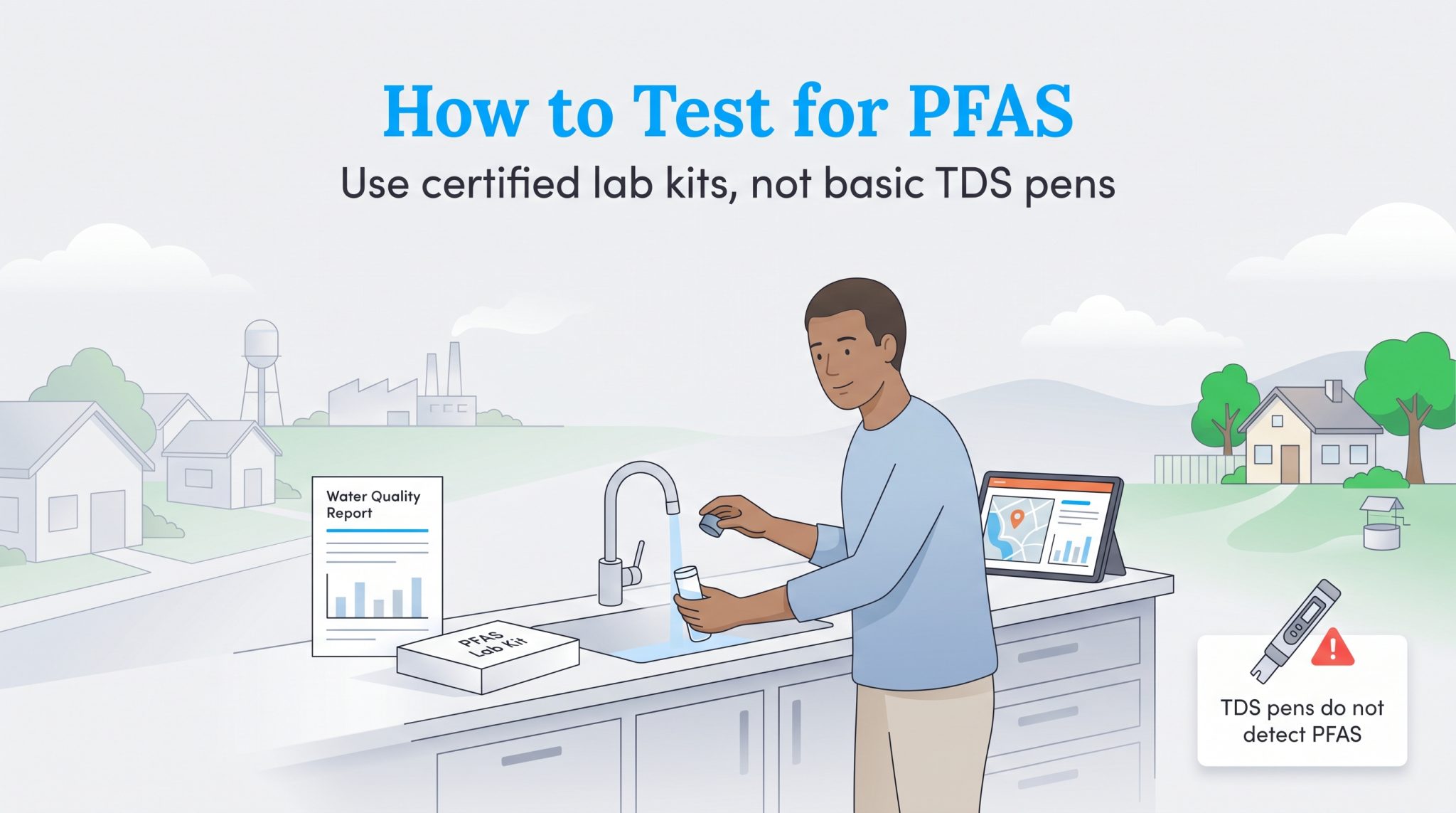
Do not try to test PFAS with a home aquarium kit—I know it’s tempting, but you’ll just get sad numbers about fish poop. Instead, hire a certified lab that uses EPA Method 537.1 or 533. They’ll send you a sterile kit, you fill a bottle like you’re bottling Tetris, and FedEx it overnight. Cost? Between $200 and $500—roughly the price of a very fancy dinner for two, except the only leftover is anxiety.
You’ll wait two to four weeks for results, which is perfect time to practice your “I have no idea what this means” face. The report will show levels for specific PFAS like PFOA and PFOS, measured in nanograms per liter (a.k.a. parts per trillion). Fun fact: if you have one part per trillion of PFAS, you’re still mostly water—just, you know, expensive water.
Method 2: The “DIY Mail-In Hack” (For the Brave and Budget-Conscious)
If you’re too cheap for lab prices but still want answers, grab a Tap Score or SimpleLab kit. These cost around $100 to $200 and are like an above-ground pool filter versus a full Olympic spa. You’ll still mail your water sample, but the friendly nerds behind the scenes will email you a report with cartoons (okay, no cartoons, but they should).
One hidden gem: some university labs offer discounted testing for residents near suspected contamination zones—think “student researcher with a pipette and too much caffeine.” Check your local school’s environmental science department. Warning: they might ask you to fill out a survey about your childhood pet—this is normal.
 PFAS in Water: What ‘Forever Chemicals’ Are and How to Filter Them
If you’re really desperate, there’s a $35 public lab in California (the Purser Laboratory) that tests PFAS for pennies, but you’ll have to drop the sample in person. Yes, a road trip for water testing—just remember to bring snacks.
Method 3: The “Snake Oil” (Do Not Try This at Home)
You might find a “PFAS test pen” on Amazon that claims to detect chemicals by dipping it in water. Do not buy this. It’s a scam, and the pen’s only superpower is making you feel dumb. Likewise, those in-home TDS (total dissolved solids) meters? Useless—they measure everything except the stuff you care about. It’s like checking your car’s tire pressure by sniffing the exhaust.
Another dead end: boiling your water. PFAS laugh at boiling—they’re forever chemicals, not sensible ones. Even the most aggressive pitcher filters (like activated carbon) only catch some PFAS, and only if you change the filter every Tuesday. Reality check: reverse osmosis systems work, but they cost a kidney and waste three gallons for every one you drink.
What to Do With Your Results
Let’s say your report comes back. If PFAS levels are below 4 parts per trillion for PFOA (the EPA’s new health advisory), you’re fine—pop the champagne (from a glass bottle, not a non-stick pan). Above that? You need action. Call your water utility—they’re legally required to tell you if PFAS is in your supply, but they might mumble something about “improving treatment.”
 Epa Approved Pfas Testing Methods at Simona Brown blog
If you’re on a private well, send your data to local health officials and prepare to invest in a granulated activated carbon filter or anion exchange system—think $1,000 to $5,000 for a real solution. For the budget crowd: buy bottled water from a source known to be PFAS-free (hint: it’s not the brand with the mountain logo—test that, too).
And here’s a wild twist: PFAS testing is only as good as the lab’s detection limit. Some tests stop at 2 parts per trillion, while newer ones go down to 0.1. That’s like measuring your waistline with a telescope—you miss the details. Always ask for the “minimum reporting level.”
The Bottom Line (With a Side of Panic)
Testing your water for PFAS is a mix of adventure, expense, and existential dread. But knowledge is power—or at least, it’s the power to buy a good filter. Start with a mail-in kit, avoid the $10 Amazon pen of lies, and if you see results over 10 parts per trillion, seriously consider moving to Canada (where PFAS is also a problem, but at least the maple syrup is clean).
In the end, you’ll emerge smarter, poorer, and probably more hydrated. And really, isn’t that the ultimate goal? Drink up—but maybe test first.
