Difference Between Water Softener And Water Filtration System

Last Tuesday, I poured myself a glass of water from my friend’s tap, took a sip, and nearly spit it out. It tasted like a miner’s sock soaked in bleach. “Relax,” she said, “it...

Last Tuesday, I poured myself a glass of water from my friend’s tap, took a sip, and nearly spit it out. It tasted like a miner’s sock soaked in bleach. “Relax,” she said, “it’s just the water softener doing its thing.” I blinked. I thought she had a water filtration system. Spoiler alert: she didn’t. And that’s when I realized most of us—myself included—have no clue what’s actually happening inside those shiny cylinders under the sink.
The Plot Thickens: Hard Water vs. Dirty Water
Here’s the thing: your water can be hard and still be clean. Or it can be soft and loaded with chemicals that taste like a swimming pool. A water softener is a specialist—it’s obsessed with one thing: removing calcium and magnesium. You know, the minerals that leave white crust on your faucets and make your soap refuse to lather.
A water filtration system, on the other hand, is the generalist. It targets chlorine, sediment, lead, bacteria, pesticides—basically anything that makes you go “blech.” Think of it as the bouncer at a club, kicking out the riffraff. The softener is more like a stylist, just fixing your hair’s texture. (Fancy, right?)
Must Read
Softener: The Mineral Swap Meet
If you peek inside a water softener (don’t, it’s messy), you’ll find resin beads covered in sodium or potassium ions. Hard water flows in, the beads grab the calcium and magnesium, and trade them for a bit of salt. Poof—soft water. But here’s the ironic part: that soft water can still carry chlorine, dirt, and microscopic critters you really don’t want in your morning coffee.
So, yes, your skin will feel silky after a shower. Your dishes will spot less. But if you drink that water straight? It might still taste like a municipal swimming pool. Don’t say I didn’t warn you.
Filter: The Deep-Clean Crew
Filters come in all shapes—activated carbon, reverse osmosis, UV light, even fancy ceramic blocks. Each one grabs different villains. Carbon filters? They’re great at removing chlorine and bad tastes. Reverse osmosis? That’s the nuclear option, stripping away almost everything—including beneficial minerals. Which is kind of a bummer, honestly.
Some people install a filtration system and think they’re done. Then they wonder why their shower head is still clogged with white gunk. Huge clue: filtration doesn’t remove hardness. You’ll still get scale buildup on your kettle. Your hair will still feel like straw if you live in a hard-water area.
The Great Combo: When They Play Nice Together
Here’s the secret handshake: you can use both. In fact, many homes go softener first, filter second. Why? Because soft water flows through a filter better—less mineral buildup means the filter lasts longer. And the filter catches all the nasty stuff the softener ignores. It’s like having a bouncer and a stylist working the same party.
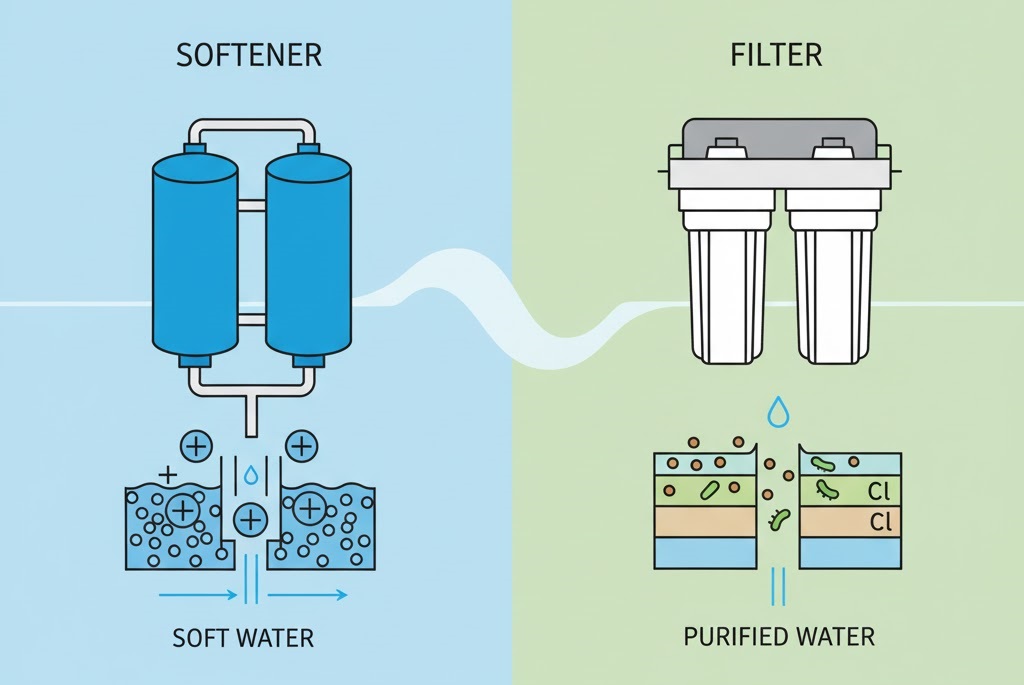 The Difference Between a Water Softener and a Water Filter | Knoxvile TN
But don’t assume you need both. If you’re on city water, check your local report. Low hardness but high chlorine? Just get a filter. Scalding hard water but safe from contaminants? A softener might be enough. I’m still bitter about that time I bought a softener without reading the specs—my water tasted like a salt lick for a month.
A Quick Reality Check (aka, What I Wish Someone Told Me)
Softeners use salt, which means you’ll add sodium to your diet. If you’re watching your blood pressure, look for potassium-based softeners or consider a salt-free conditioner. (Yes, those exist—they don’t remove minerals, they just crystallize them so they won’t stick.) Also, filters need regular filter changes. I know, shocking. My last one turned into a science experiment after six months. Don’t be that person.
And here’s a plot twist: some “whole house” filters claim to soften water too. Spoiler: they mostly don’t. They’re usually just big carbon blocks that catch sediment. If you want silky hair and spotless glasses, you still need a dedicated softener. Or you can just move to a city with naturally soft water. (I’ll wait while you look up real estate prices.)
The Final Pour
So, next time your friend brags about their “water system,” ask them: Is it a softener or a filter? If they stare blankly, send them this article. Your water’s job is to keep you hydrated and happy—not to taste like a chemistry lab or leave your skin feeling like sandpaper. Choose your weapon wisely. And if all else fails, just buy a Brita pitcher and call it a day. No shame.
Now, if you’ll excuse me, I’m going to test my own tap water. Always trust, but verify—especially when it’s coming out of your faucet.
